By Francis Ajuonuma
With less than a year left in the second term of Governor Babajide Sanwo-Olu, the Lagos State Government is stepping up efforts to complete several strategic housing projects as it races to fulfil its promise to deliver more than 2,000 housing units before the end of the administration in 2027.
The push has placed renewed attention on ongoing developments at the Egan-Igando Mixed Housing Scheme, the Joint Venture Housing Scheme in Ipaja, and the Lagos State Workers’ Village along Command Road, Ipaja, where state officials are grappling with delays, rising construction costs, and mounting public expectations.
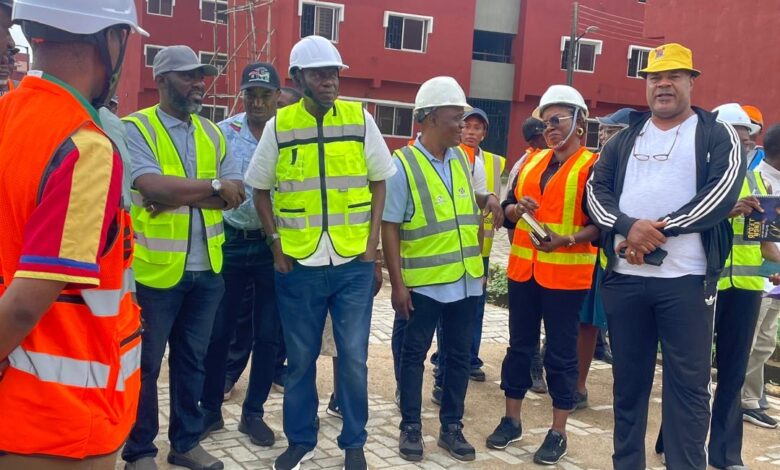
Leading an inspection of the projects, Commissioner for Housing, Moruf Akinderu-Fatai, delivered a clear message to contractors lagging behind schedule: speed up delivery or risk undermining one of the government’s flagship social interventions.
“We are here to assess the progress of work and identify areas requiring urgent attention. We have a contractor who is far behind schedule, and that is one of the major challenges we are addressing. However, that will not stop us from moving ahead with our plans to complete these projects,” he said.
The warning underscores the pressure on the administration to translate years of policy pronouncements and construction activity into completed homes for residents in a state facing one of Africa’s largest housing deficits.
Estimates place Lagos’ housing shortfall at more than three million units, a deficit fuelled by rapid urbanisation, population growth and soaring property prices that have pushed home ownership beyond the reach of many middle- and low-income earners.
Against this backdrop, the Sanwo-Olu administration has repeatedly promised to ramp up housing delivery through a combination of direct government intervention and public-private partnerships.
Only recently, state officials reaffirmed plans to complete and deliver more than 2,000 housing units before the current administration’s term ends, a target expected to be one of the enduring legacies of the government’s housing programme.
At the Egan-Igando Mixed Housing Scheme, officials reported significant progress, with critical infrastructure already in place.
“We are happy that we have been able to resolve the electricity issues. Electricity is a major component of the scheme. The water treatment plant is ready, the sewer system is also ready, and most of the housing units are substantially completed,” Akinderu-Fatai stated.
The project is expected to be among the first beneficiaries of the government’s accelerated completion drive.
Attention is also focused on the Joint Venture Housing Scheme in Ipaja, comprising 128 housing units, including 80 two-bedroom and 48 three-bedroom apartments.
Nearby, the Lagos State Workers’ Village at Command Road is gradually taking shape with 176 housing units spread across 11 blocks, each containing 16 two-bedroom apartments.
Both developments form part of the state’s strategy to increase housing stock while expanding access to affordable accommodation for workers and middle-income residents.
However, affordability remains the elephant in the room.
The surge in inflation, exchange rate volatility, and the rising cost of cement, steel and finishing materials have dramatically increased construction costs, forcing many developers to review prices upward.
Lagos says it is attempting to cushion the impact by redesigning certain finishing components without compromising structural quality.
“We have reviewed certain finishing elements to make the houses more affordable. Residents can move into the homes immediately and make additional improvements at their convenience. The objective is to ensure that the houses remain within the reach of ordinary Lagosians,” the commissioner explained.
The government insists that its housing schemes are deliberately priced below prevailing market rates, a move aimed at promoting home ownership among civil servants and other low- and middle-income earners.
The latest inspections at Egan-Igando and Ipaja came barely two weeks after the Lagos State Government undertook a similar review of major housing projects in the Abraham Adesanya Extension and Sangotedo axis of Ibeju-Lekki, where officials reiterated plans to deliver more than 2,000 housing units before the end of Governor Sanwo-Olu’s administration.
The projects, being developed through Public-Private Partnership arrangements, include the 526-unit Sangotedo Housing Scheme Phase II and other large-scale developments targeted at middle- and low-income residents.
During that inspection, Housing Commissioner Akinderu-Fatai issued perhaps his strongest warning yet to defaulting contractors, declaring that the government would not hesitate to remove firms that were unable to meet delivery timelines despite receiving adequate funding.
“If the government has given them enough money to finish up these projects and they are slow, we will quickly take them off the site,” the commissioner warned.
He acknowledged that inflation and the sharp rise in the cost of building materials had stalled some projects and forced contract reviews, but insisted that the administration had moved beyond excuses and was now focused solely on delivery.
“We have gone past that; the level we are at now is delivery,” Akinderu-Fatai said.
Over the past seven years, Lagos has delivered thousands of housing units across locations such as Sangotedo, Badagry, Epe and Igando, but demand continues to outstrip supply in Nigeria’s commercial capital.
For many prospective homeowners, therefore, the real measure of success will not be the number of estates announced or inspected, but the number of keys eventually handed over before the curtains fall on the current administration.
As 2027 draws nearer, the race to deliver affordable homes may well become one of the defining tests of the Sanwo-Olu government’s legacy in Lagos.