By Emma Obe, Kassim Omomia, Mudiaga Affe, Cajetan Mmuta, Olusegun Olanrewaju and David Lawani
Nigerians marked the 28th anniversary of the epochal June 12, 1993 Presidential election on Saturday with lamentations that democracy has yet to free the country from many unresolved political and economic issues.
They identified ethnicity, insecurity, insurrection, religious divide, corruption, abuse of powers, unemployment among the numerous challenges bogging the Nigerian nationhood.
If these issues remained unresolved, they claimed, then the sacrifices made by Nigerians for democracy which culminated in the popular June 12 presidential election and the return to full democracy in 1999 would not have made much meaning.
Though turnouts at rallies held across the country on Saturday to mark the Democracy Day was poor, many Nigerians who X-rayed the event, regretted that the nation has yet to catch up with the symbolism of the day.
President Muhammadu Buhari, in his broadcast to the nation, admitted as much, lamenting that democratic hurdles had not allowed him to tackle some of those issues, especially the ones bearing on insecurity and insurrection, squarely.
Buhari promised to end insecurity, saying his administration was not only going to deal with criminal elements but would also address issues of poverty and youth unemployment.
“When you elected me as your President in 2015, you did so knowing that I will put an end to the growing insecurity, especially the insurgency in the North East, but the unintended consequences of our scattering them in the North East pushed them further in-country which is what we are now facing and dealing with. We will, by the Grace of God put an end to these challenges too,” he said..
Regretting that some criminals were profiting from the loopholes in the polity, the president said his administration was already addressing these obstacles in order to bring the culprits to justice.
Eminent persons who spoke on the commemoration of the day include former Vice President Atiku Abubakar; National Leader of the All Progressives Congress (APC), Senator Bola Tinubu; Governor Inuwa Yahaya of Gombe State; Senator Dino Melaye; President, Women Arise and Centre for Change, Dr. Joe Odumakin.
June 12: the unending journey
Others are The Senate Minority leader, Enyinnaya Abaribe; a former Secretary, National Democratic Coalition, Chief Ayo Opadokun and the President Arewa Youth Forum, Ibrahim Gujungu.
Atiku, in his Democracy Day message, called on Nigerians to unite for democracy.
He said, “But we shouldn’t lose the lessons as we build our democracy to greater heights. I’m proud to join Nigerians in the celebration of this important day in our recent political history not only because I was part of those challenging moments, but also because of my unshaken belief in democracy.”
Recalling events leading to the election, the former Vice-President said, “Abiola, whom I stepped down for in the 1993 primary of the Social Democratic Party (SDP) in Jos, was a good man, and his only primary reason for joining the race was to offer selfless service to the ordinary Nigerians.”
Click to add photos
He, therefore, admonished Nigerians to take June 12 as a lesson to further unite the country in the defence of democracy.
Tinubu, urged Nigerians to fight against anything that was hindering democracy in the country.
In his message, Tinubu urged Nigerians to stand for democracy despite the challenges they were going through.
He also urged Nigerians to stand against those engaging in insurrection and violence as well as those trading in bigotry and hatred.
“We celebrate Democracy Day not only because we have come far but to help give us the social fuel and encouragement to continue onward because we have farther to go and even greater things to achieve as one nation and one people,” Tinubu said.
The APC leader urged Nigerians to remember MKO Abiola whose political victory was ‘stolen’ as well as Nigerians who sacrificed so much to bring democracy to the country.
He added, “We best honour these people not by reciting their names but by injecting the spirit and hope of democracy into our words and deeds.”
Opadokun, in his contribution, noted that nothing spectacular has been achieved so far.
He said, “We have unfortunately not fared well. It is a great pity because most of us who laid down our lives, who lost our sweats and blood and got battered in the process, thought that after we had succeeded in getting the military to return to the barracks, those who emerged in government will ensure quantitative, qualitative improvement in the living condition of our people.
“There had been so much unbelievable level of poverty and misery among our people, so, we thought that those who emerged as political operators will turn things around in all ways. Unfortunately, that is not what we got since then.
“What is on ground is different from the Abiola’s vision. Abiola had seen poverty at the worst level before he became wealthy, so, he knew where the shoe was pinching Nigerians”.
Abaribe also believes that not much has been achieved all these years.
The Senate minority leader said, “ I subscribe to the fact that Nigeria is a flawed nation. And to get it right is to restructure the country in such a way that merely occupying an office won’t give you anything.
The senator, who said that the country could be renegotiated, added that there was the need for a conversation to determine how the commonwealth would be shared equitably.
He asked, “Can we renegotiate the contraption called Nigeria? Can we have a conversation among ourselves to know actually who is a citizen of Nigeria and determine for ourselves how our commonwealth will not be shared in this lopsided manner? Can we determine how some people will not be seen as second-hand citizens, which is most important because you are looking for a president, you should be able to give it to the most competent person because that is what will help all of us. We need a president that can pull us out of this despondency that is in the land today. We need a president who can bring us out of the economic doldrums, a president that would look me in the face as a Yoruba man, Hausa man or a Benin man and see me as a Nigerian not as a Christian or as a Muslim.”
On ethnic tension, the Arewa Youth Forum, Ibrahim Gujungu, said that the rising tension across the country, has led to the loss of lives and properties.
The AYF helmsman said, “As it stands, owning to the actions of non state actors and the inaction of state actors mainly the federal government and the governors of the respective states, the country is fast drifting and action must be taken immediately to stem this drift.”
Senator Melaye in his message, lamented that Nigerians were still “on a learning curve” 28 years after June 12.
“Our nation unfortunately is permeated with inequalities at all levels, with injustices slithering through it and bleeding a slow yet turbulent death,” he said.
“I could list the inequalities and injustices ranging from skewed appointments, lack of security, teeming unemployment, economic regression, outdated education, unfair justice system, inadequate healthcare, all these problems are underpinned with a lack of vision or strategy to mitigate and impending implosion.
“Democracy provides Nigerians an opportunity to build not to destroy; to reorient and aspire; to give our guts for the glory. Nigeria is our nation, and in the absence of leadership we all have to become builders”, he added.
Odumakin urged Nigerians to always commit the ideals of the day to memory.
“We again salute the martyrs, heroes and heroines of that moment: Chief MKO Abiola, Alhaja Kudirat Abiola, and many more who paid with their lives. Those who stayed to fight, those who ran to fight another day: We salute you all”, she noted.
But appraising the current situation, she explained that the nation was father away from enjoying democracy dividends.
She said the 1993 annulment could still be seen in a situation where “candidates who ended up at the number four position now becoming number one. A nation cannot be failing consistently and still be hoping to prosper.”
Calling for the restructuring, she said “The current federating units must be quickly empowered to secure their states.”
However, Governor Inuwa Yahaya of Gombe State, said that uninterrupted democratic rule in the country has proven naysayers wrong.
He said Nigeria’s “democratic maturity has shattered the myths about African democracy being under the grip of one single leader or political party.”
Yahaya paid tribute to all Nigerians, “who have made (and continue to make) enormous sacrifices for the country’s unity and democracy over the past decades.”
Lawmaker representing Esan North East/ Esan South East in the House of Representatives, Sergius Ogun, urged Nigerians not to lose faith in democracy.
Noting that the nation has been overwhelmed by insecurity, inflation, infrastructural rot and failing economy, he stated that the PDP would alter the situation when it returns to power in 2023.
The Head of Programmes of the Centre for Democracy and Development,Mr. Timipriye Allison, tasked the citizens to continue to imbibe the tenets of democracy.
“The socialization process of instilling democratic attitude has not been there. We should establish micro systems in our schools where students can elect their own leaders; people should grow into the culture of participation, democracy and tolerance, not only at elections. Society should have a way of punishing those who fail and default,” Allison said.
The Country Reps, Policy House International and Chairman of the Association of Nigerian Authors, Abuja chapter, Mr. Taiwo Akerele, urged Nigerians to have a rethink about the country.
In a statement to commemorate the day, Akerele said the June 12 1993 election was truncated because of overzealous political actors.
He said, “As a 17 years old boy back then in Igarra, Edo state, we saw hundreds of adults peacefully queuing up in an organized manner under a very convivial atmosphere to cast their votes. That election was annulled after few days when a winner had clearly emerged.
“Do we now have a better issues based campaign culture? Are our elected officials accountable to the people? Is democracy working to grow the economy and improve the quality of lives of the citizens? Are the political parties with agenda that can be measured in terms of output and outcome?
“Twenty eight years after June 12, how is the national budget working for the people, especially in research and development, innovation, science and technology? What percentage of our national budget do we dedicate to basic education as against global recommendation?
“For me these are issues that should dominate our reflections as we celebrate the June 12 anniversary in our dear country Nigeria.”
Constitutional lawyer and former National Secretary, Labour Party, Dr Kayode Ajulo, asked the President to redouble his effort in electricity and security as well as in providing jobs for youths.
Also, the President, Faculty of Peace Organisation, Kelly Omokaro, said Nigerians enjoyed freedom of expression under military rule better than under democracy.
Similarly, President of One Love Foundation, Patrick Eholor, said the government must push for state police to ensure the safety of lives and property of the citizens of the state.
From Anambra State, an Onitsha-based lawyer, Mr. Jideofor Chinwuba, said protesting against this present federal government was a waste.
“The only thing any dissatisfied person in this country should do now is to get his or her voters card ready. Whatever it is we want as a group or people under this present government will not be granted, whether by peaceful approach or violence,” he said.
Apparently referring to those who intend to use protests to cause change, Chinwuba said, “The government by its body language is not amenable to peaceful resolutions, demonstrations, protests or even dialogue. I wonder what any reasonable civilian with no trained army intends to do about it if not to waste lives. Forget it, foreign nations will only talk and advise, and what is happening will continue to happen.
“The war mongers should sheathe their swords and ready it to protect their votes during the next presidential election. Any person talking about no elections in any part of the country is deceiving you and wants you to perpetually remain with the type of government we have now.”
In Awka, there were no signs of any celebration or protest as social and economic activities went on normally.
Politicians also carried on with campaigns in preparation forthcoming governorship election later in the state.
Meanwhile, many state governments did not mark the day. Rivers State Governor, Chief Nyesom Wike, rather spent the day inaugurating the Ogbakiri internal road project in Emohua Local Government Area, while his counterpart in Bayelsa State, Senator Douye Diri, used the day to host a media chat during which he answered questions about developments in the state.
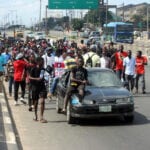
In several places like Lagos, Abuja, Benin and Port Harcourt, civil society organisations held demonstrations to call attention to the state of insecurity, abuse of human rights by government agencies and the need for restructuring.
In Abuja, security agents dispersed groups that gathered at Gudu to hold rallies and protests with tear-gas, even as two journalists were among persons arrested on the occasion.
However, the situation was calmed when a former Defence Minister, Theophilus Danjuma, and former Vice-President, Atiku Abubakar arrived the venue.
Also in Abuja, a fight had ensued among members of the #IStandWithBuhari, a counter-protest group at the Unity Fountain, Abuja over the sharing of their stipends.
In Lagos, after early protesters that converged on Gani Fawehinmi Park in Ojota were dispersed by the police, there was a regrouping in front of a nearby motor park where they listened to speakers including comedian, Debo Adebayo, alias Mr. Macaroni, who said it was regrettable that it was President Buhari who had contested four times before becoming president that was causing the people pains.
Protesters chanted solidarity songs and carried placards with inscriptions such as ‘Freedom of Speech’, ‘Buhari Must Go,’ ‘#EndbadGovernment,’ ‘Protest is a Fundamental Right’, ‘Revert Oil Prices Now.’
But by noon, the protest had fizzled out.
In Port Harcourt, a scanty group of protesters gathered at the Port Harcourt Pleasure Park, where they were addressed by the Chairman of the Rivers State Civil Society, Mr. George Enefaa, and other leaders of the Take It Back organization.
In Benin, Edo State, the spate of insecurity and the rising cost of living topped demands of the protesting groups. The protesters called on the federal government to provide good governance and security.
According to them, the failure of the government has brought Nigeria to its knees.
The protesters who were outnumbered by security personnel moved from Ring Road and Government House where they were received by the state Deputy Governor, Philip Shaibu.
They carried placards with inscriptions such as “Respect human rights”, “the economy is in a shambles,” “22 years after, we are back on the streets fighting for democracy,” “#Insecurity, #Statepolicing, stop capitalism,” among others. The protest march caused traffic along major streets.
Kola Edokpayi, of the Talakawa Assembly, who spoke for the groups, lamented the insecurity in the land.
Edokpayi said, “The ineptitude of President Buhari has brought us to this sorry state. His nonchalant attitude has caused a lot of security problems. It has been difficult to combat Boko Haram, bandits, and kidnappers. Nigerians now live in fear and nobody knows what will happen next.”