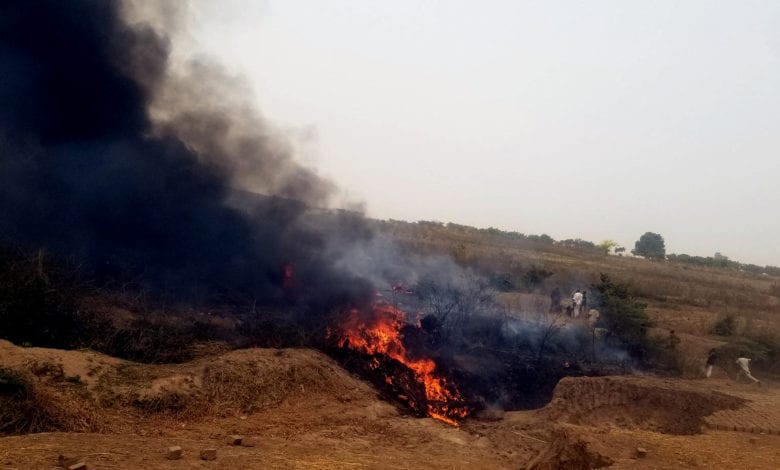
The tragic news of the air crash in the afternoon of Sunday, 21st February 2021, involving the Nigerian Air Force (NAF) Beechcraft King Air B350i, which killed all seven personnel onboard did not only come to the Nigerian military and indeed citizens of goodwill as a rude shock, but also threw the entire world into mourning.
Painfully, the unfortunate incident has also hampered, in no small measure, the coordinated efforts of the military, the Federal and Niger State governments, towards securing the quick release of the students and staff abducted from Government Science College, Kagara, Niger State, by mindless armed bandits.
Director, Public Relations and Information, NAF, Air Vice Marshal Ibikunle Daramola, in a statement, disclosed that the Beechcraft King Air B350i (NAF 201) crashed while returning to the Nnamdi Azikiwe International Airport, Abuja, after reporting engine failure enroute Minna, where it was scheduled to conduct surveillance missions over Niger State and its environs.
This, no doubt, was an eloquent demonstration of commitment on the part of authorities to secure the release of the students and staff abducted from the Government Science College in Kagara, Niger State, even as we express serious concern on the aspect of the “engine failure” which eventually was the cause of the monumental loss both in human lives and air assets of NAF.
Against the backdrop of the troubling report of “engine failure” by the NAF authorities, ThisNigeria is of the view that those who certified the ill-fated military aircraft air-worthy on that fateful day should be called to question by relevant military and aviation authorities.
Cutting short the lives of young, promising military officers, in addition to the depletion of military platforms in a war time, should neither be taken lightly, nor swept under the carpet, under any guise whatsoever.
ThisNigeria commiserates with the Armed Force of Nigeria (AFN), the Nigerian Air Force (NAF) family, the families of the fallen heroes, and indeed the entire nation, and applaud the steps so far taken by the Chief of the Air Staff, Air Vice Marshal Oladayo Amao, in setting up an investigative panel to unravel the immediate and remote causes of the tragic incident.
As these lasts, we further demand that, unlike others, the report of this tragic incident must be made public, and appropriate sanctions meted out where culpability is established, to serve as deterrence.
Although there have been series of air crashes in the country, aside the recent one, which is the second worst in recent history, the crash of the Nigerian Air Force C-130 on 26 of September 1992, which claimed the lives of over 150 persons onboard, as well as the accident of Nigerian Air Force Dornier D O 228 -212 en route Kaduna-Abuja in August 29, 2015, which killed all the seven persons on board, all make the lists of air mishaps in the country.
However, this is not the first time the Beechcraft King Air will be involved in a mishap in the Nigerian airspace. We recall that on May 24, 2011, the Beechcraft King Air C-90 operated by Shawa Engineering crashed, killing two persons on board. Describing circumstances that led to the May 2011 crash, the Bureau of Aircraft Accident, said, among others, that the “Crew was performing a test flight following ground maintenance. After take-off, while climbing, the twin-engine aircraft went out of control and crashed the Aircraft which had just been sold to Shawa Engineering, a Nigerian Oil Company” was destroyed by post- impact fire, killing all crew members in a field near the Old Kaduna Airport.
It was one crash too many. Also, an Aeritalia G.222 also crashed in Port Harcourt. The aircraft was damaged beyond repair, with ten occupants seriously injured.
In addition, the air mishap involving NAF aircraft in 2019, during the preparation for October 1 Independence Day Anniversary, which killed personnel and injured another, can also not be forgotten in a hurry.
While we commend the renewed effort of the leadership of the NAF in reactivating serviceable platforms in the country, as part of measures geared towards local capacity building, as well as save foreign exchange associated with overseas maintenance, it is our conviction that air safety standards must not be compromised at any point.
Nonetheless, we call on the National Assembly and the Ministry of Finance to place the NAF budget on a first line charge, to avoid inaccessibility, delay and other bottlenecks associated with releases, to enable the ‘Service’ to engage in the routine in-country activation of serviceable platform in NAF inventory.
Yet, in as much as there are no intent to pre-empt the outcome of the investigative panel and its recommendations, ThisNigeria believes that one of the major take-away from this ugly development is the fact that there is an urgent need for regular maintenance of platforms in NAF’s inventory. There is also the need to strengthen all the channels that certify military aircraft airworthy, preparatory to their surveillance and other operations. Those in this category -both military and the civil aviation authorities – should be made to pay dearly whenever the fault is traceable to them.
It is our view, therefore, that this business-as-usual and Nigerian-factor phenomenon, should not be allowed to creep into the aviation sector, considering its delicate and somewhat complicated nature, as evidenced in the level of casualties, whenever a crash occurs.