It is commonplace to say that in the last period of 55 years when the military banished the practice of true federalism in Nigeria, our understanding of the barrenness of our forced union has been profoundly modified. Our speculations now extend to embrace the infinite; and, whether we are aware of it or not, our daily life has taken its tone and color from this tremendous realization in our outlook. We have only to open our eyes to the reality on the ground to echo in our hearts and awaken a similar sensation of anguish, from which the humblest intelligence amongst us is not immune.
But the truth is that Nigeria’s federal arrangement is blatant fraud, abinitio. Nobody is saying that it is absolutely bad to copy any political model from elsewhere. The only problem is that due to greed and our inherent intolerance, we lack the political will and courage to practice what we copy from other climes. The American federal system which we claim to have copied is in truth a partnership in which the doctrine of dual federalism, held generally for upward of a century and still widely embraced, and has, in fact, given way before the practice of cooperative federalism. The last and least thing that could be said of America’s federal system is that it is fixed, formal, and certain in its distribution of powers and in the relations between the partners.
On the contrary, it remains to this day an experimental system, one which probes constantly for pragmatic accommodation where legal principle fails. It is, above all, a practical system. At this critical stage of our national life when there is palpable tension in the land due to the ravaging effect of the prolonged attempt by some to lord it over others and the dissatisfaction on the part of those at the receiving end of injustice and marginalization, a central question for those engaged in constitution writing or amendment must be how to distribute powers territorially.
If truly our political managers want this country to remain as a single entity and in peace they should contend with these pertinent questions. How can national and state powers be delineated with clarity and precision sufficient enough to minimize uncertainty and conflicts? What will be the basis of representation for the nation and also for the component parts? How can national supremacy be assured? What provision should be made for intergovernmental relations? What will be the relationship between national, state, and local governments? What percentage of tax should the component units pay to the central government for the control of mineral and natural resources? When you ponder on these questions you realize that those against the restructuring of Nigeria are truly those who want the country to break up.
Our “leaders” must also be reminded of the fact that in making territorial arrangements for government, two methods are commonly used: unitary and federal. The former concentrates authority and power in a single central government having legal omnipotence overall territory to which it holds the title. In practice, central (unitary) governments have no states but establish local units to serve as their agents. Examples of unitary states include France, Great Britain, and most of the other smaller nations. On the other hand, under the federal form of government, authority and power are divided between the central government and self-governing parts, with each operating in a sphere defined by the fundamental law of the land called the Constitution.
The self-governing parts, which may be referred to as “Provinces”, “States,” “Regions,” or something else, usually organize internally along unitary lines and establish local governments to serve as their agents. Besides the United States, Switzerland, Mexico, and Canada are examples of federal states. Under the federal arrangement, matters of primary importance to the country as a whole are assigned to the federal government. Usually, these include foreign relations, defense, regulation of foreign and large-scale commerce, and the monetary system. Taxes such as Value Added or First Taxes are controlled by the component units or centripetal forces. All over the world, the Federal or Central government does not control VAT.
Functions of more localized interests such as public education, protection of lives and property, construction and maintenance of roads, and highways and regulation of small-scale businesses, are given to the federating units. Unfortunately, in Nigeria, a unitary constitution is imposed on a federal arrangement by the military because it suits a section of the country. What makes it even more unfortunate is that rather than proceed to some penitence, those who have held this country hostage for too long, those who are openly associated with this orchestrated process of domination, are still making provocative statements and actions that portray other nationalities as second class citizens even when they are the lifeblood of the nation. The humiliation of the former Chief Justice of Nigeria, Hon. Justice Walter Samuel Nkanu Onnoghen from office by President Muhammadu Buhari is a case in point. The spiteful removal of Onnoghen did not follow any due process.
Since Hon. Justice Ayo Irikefe vacated the office of the Chief Justice of Nigeria in 1985 during the military administration of former President General Ibrahim Babangida, no Southerner had occupied that position until Onnoghen was confirmed by the Senate in March 2017. We all know how hesitant President Buhari was in sending Onnoghen’s name to the Senate for screening and confirmation following the retirement of the immediate past CJN Hon. Justice Mahmud Mohammed on November 10, 2016, was much against the seniority tradition of the Supreme Court and the nation’s adjudicatory system. It was the Acting President Prof. Yemi Osinbajo who did the needful when President Buhari was on medical vacation in London. More than two years after his removal, the Judiciary as an arm of Government has been pocketed by the Executive arm of Government. If Governor Nyesom Wike of Rivers State and Governor Babajide Sanwo-Olu of Lagos State go to the Supreme Court, we all know how the case would end.
The refusal of the Buhari administration to include the southeast geopolitical region in the nation’s security architecture and the deliberate flooding of the leadership of the country’s security forces with Fulani Muslims of Northern extraction to the exclusion of others since Buhari came to power in May 2015, is another case in point. Even up until now, President Buhari has not deemed it fit to appoint an Igbo as head of any of the security forces in a country as diverse as ours. Despite the braggadocio and flaunting of tribal and religious bigotry, the North brings nothing to the table.
Aside from proceeds from the ports and the Value Added Tax (VAT), largely generated from Lagos, the nation lacks creative ideas and competitive ability to generate revenue from the bounteous natural resources the country is blessed with. For instance, the country has been overtly focused on oil with impunity and vehemence without caring a hoot about what becomes of the oil-producing areas when the oil wells eventually dry up. These self-seeking rulers do not bother about the fact that widespread gas flaring and oil spillage have inflicted incalculable havoc on the human, plant, and animal life in the oil-producing region. Not as if they use the oil money to provide infrastructure for Nigerians, they rather steal the huge revenue from oil leaving the country to rot. How do we rationalize the fact that after states from the far North destroy millions of beer bottles as a result of Sharia, they still share from monies generated by states in the South from VAT?
Given the pains and traumas of our past and present experiences, the very basis of our existence as a united entity needs fundamental restructuring. Nigeria has been taken to the cleaners by the military in cahoots with an irresponsible and opportunistic political class. It is lamentable that the country’s national socio-political and economic score sheet indubitably reveals that the giddy hopes of many have been overtaken by the inordinate ambition of a few. But those who think that things will remain like this forever are making a terrible mistake. Nigeria is too large and diverse to be tossed like dice by just a section of the country.
What is required is the unity of other sections to call the bluff of the arrogant interloper. For too long, an all-powerful central government has been sweeping away the rights of individuals and minorities. If Nigeria is a federation, the National Assembly must give the people of this country a federal constitution and not the unitary constitution foisted on us by the military. We must go back to the tenets of the 1963 Republican Constitution in which one was made to eat what one killed and paid tax to the Central Government. Federalism all over the world is a compromise between the centrifugal and the centripetal forces. There is no alternative to a restructured Nigeria. Our politicians know the implications of making a peaceful change impossible.
Last week, we commenced this vexed issue wherein we defined who Prisoners of war are? And what does International Humanitarian Law and Armed Conflicts law say about the rehabilitation of surrendered parties? Today, we shall continue and conclude our above discourse. Please, read on.Prosecution of surrendered terrorists
As enshrined in Sections 5, 6, and 7 of the Geneva Convention, 2004, a protected prisoner of war and a protected internee can be prosecuted. This is in consonance with Article 3 of the Geneva Convention on the treatment of Prisoners of War, 1949, which provides that:“… in the case of armed conflict not of an international character occurring in the territory of one of the High Contracting Parties, each Party to the conflict shall not subject persons that are not taking part in the hostilities, including members of armed forces who have laid down their arms and those placed hors de combat by sickness, wounds, detention, or any other cause, to… the passing of sentences and the carrying out of executions without previous judgment pronounced by a regularly constituted court affording all the judicial guarantees which are recognized as indispensable by civilized people.
Thus, under International law, subjecting these prisoners of war to trial in a court properly constituted is the right course to take.
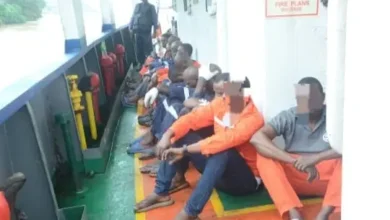
At this stage, it is pertinent to state that pursuant to the Geneva Conventions on the treatment of Prisoners of War and Hague Regulations cited above, those members of the dreaded Boko Haram sect who have suspiciously laid down their arms by “surrendering” to the Federal Government of Nigeria, may perhaps be classified as prisoners of war. Their weird ideology and atrocious acts against constituted authorities and the unconscionable crimes they committed or abetted in Nigeria, will however serve as strong evidence against their not being genuine prisoners of war in the true context of the Geneva Convention. But, however, having “surrendered” to the Federal government of Nigeria’s apparent “firepower” automatically makes them prisoners of war. They must therefore be tried for all the crimes and atrocities they have committed against the Nigerian people. The rationale for this is that all Nigerians are subject to the laws of the land and no one, however highly placed or violent, is above the laws of the land.
Merely surrendering to the Federal Government of Nigeria should not be erroneously construed as evidence of repentance on the part of the Boko Haram movement. Nor does it signify the unwillingness of the deeded sect (one of the four most dreaded and violent sects in the world) to further the course of their murderous engagements and pastimes.
It is common knowledge that these vampires insurgents are said to be surrendering because their acclaimed leader has been killed. Nigerian actors in government are not good students of history. If they are, they would have known that when Mohammed Yusuf (the founder of Boko Haram) was killed, his followers dispersed only to regroup and come back stronger. Abubakar Shekau (Yusuf’s successor), who was never apprehended and tried, was to later put Nigeria in a worse position than Yusuf ever did. There is therefore a very strong probability that if these surrendered terrorists are rehabilitated in the funny way the Federal Government of Nigeria has been going about it, they would come out worse than Shekau if they are not properly tried under appropriate laws of the land.
Is rehabilitation the right way to go?
Were we not suffering from collective amnesia, we should have scrutinized the antecedents of members of this deadly sect whose goals are to kill, maim, destroy established institutions and set up the Islamic Republic. They made it clear in their very name, “Boko haram” (education is a taboo). In pursuit of this ignoble venture, members of Boko Haram in Nigeria have adopted the cruelest war tactics of attacking noncombatants, civilians, soft civilian spots and nonviolent cantonments, and whole villages. They abduct women and children at will and subject them to all manners of grievous ill-treatment, forced labor, rape, torture, abuse, dehumanization, forced marriage, child marriage, and all sorts of unimaginable crimes against humanity. Unlike the then Niger Delta militants who were rehabilitated by then President Umaru Yar Adua (God bless his soul), these bandits are not fighting for any perceived imbalance in the society. They are not fighting for a better society or restoration of any denied rights or privileges. Their war is fundamentally against western civilization/education, the very bedrock of the Nigerian society, and all known tenets of democracy.
The insurgents are merely surrendering because they do not have any nucleus leader to galvanize them at the moment. The moment a new leader emerges and is announced, they would definitely rejoin their colleagues in the forests and resume their destruction of civilization and all institutions in Nigeria.
Conclusion
Rehabilitation is certainly not the right course to pursue. It is surely counter-productive. As provided in the Geneva Convention Act, the right way to go is to subject these surrendered terrorists to a fair trial in properly constituted courts of law and get their just deserts.
Did President Buhari reshuffle his cabinet?
I simply guffawed when someone first drew my attention to President Buhari’s alleged much-expected cabinet reshuffle. I told him to hold his peace because it was impossible for Buhari to reshuffle his cabinet, as he was quite happy, comfortable with, and fixated with the unbalanced lop-sidedness of his cabinets in the well over 6 years of his rudderless and lack-luster administration.
Was it that President Buhari wanted power for the sake of it? Just to match Olusegun Obasanjo as having been both military and civilian President? Just to enjoy the unending pecks of office, fly presidential jets, and get sent forth and heralded by kakaaki- blowing trumpeters and a horde of fawning obsequious and fawning aids? I cannot understand. Or, can you understand?
I was proved right after all, upon reading the text of the alleged reshuffle. Buhari did not carry out any cabinet re-shuffle meant. All he did was merely toss out two unwanted Northern Ministers and immediately, but expectedly, replace them with two wanted Northern serving Ministers whom he disingenuously drew from existing ministries. Thus, the Minister of Agriculture, Alhaji Mohammed Sabo Nanono, was replaced by the Minister of Environment, Alhaji Mohammed Mahmoud Abubakar, whom he poached from the Environment Ministry. Similarly, Buhari replaced Alhaji Mamman Saleh of the Ministry of Power with Alhaji Abubakar Aliyu, the erstwhile Minister of State, Works, and Housing.
As expected, I saw only Alhajis on the chessboard of his four players. I searched in vain but did not see or hear of a Revd Tunji, Evangelist Okechukwu, Chief Ejiro, Dr. Oshozokha, Elder Tyehimba, Mosignor Effiong, Mrs. Toritsefe, Miss Ibiere, or Mr. Anoko, I didn’t see any. Or, did you?
So, what has changed, nearly two and half years down the road after Buhari cobbled together one of the most impotent, uninspiring, and incompetent cabinets ever assembled in the history of Nigerian governance? Nothing; absolutely nothing at all! At best, Buhari merely put new recycled wine into old tired skins.
Mind you, fellow compatriots, if the two sacked Ministers were of Southern extraction, Buhari would have promptly, with immediate alacrity, replaced them with Ministers from his Northern geopolitical enclave. Such nepotistic, prebendalistic, cronystic, and sectionalism mindset is what has done, perhaps the greatest damage to his colorless leadership.
My humble suggestion to Buhari, as a full-blooded Nigerian patriot (not imported marauding AK-47- wielding foreigners killing and seizing indigenes lands and ancestral homes), is that he should immediately dismantle the entire cabinet, rejig and reinvigorate it with some flesh blood that can lift from the sorry State of nadir, his already failed government. He can of course retain some of the very few performing ones if he so desires. They are quite a few and in-between. You can simply count them on your right-hand fingertips.
President Buhari has told Nigerians that he will, in due course, replace the dismissed Ministers with substantive ones. Mr. President sir, I hereby humbly challenge you to prove me wrong for once, only just for once, by appointing Southerners in place of your sacked Northern clique. Prove me wrong sir, and I will applaud you from my little inconsequential corner.
And this crack your ribs
There are two sides to every coin. Life itself contains not only the good but also the bad and the ugly. Let us now explore these.
“When I was young, I was told that if I laugh at people’s condition I will be like them. But, I have been laughing at DANGOTE and nothing has changed. Or is it that I am not laughing enough?” – Anonymous.
“A man checked into a hotel. There was a computer in his room, so he decided to send a mail to his wife. However, he accidentally typed the wrong email address, and without realizing he sent the mail to a widow who just returned from her husband’s funeral. The widow decided to check her mail, expecting condolence messages from relatives and friends. After reading the first message she fainted. The son rushed into the room, found his mother on the floor and saw the computer screen which read: “ to my loving wife, I know you are surprised to hear from me, they have computers here and we are allowed to send mails to loved ones. I have just been checked in. How are you and the kids? The place is really nice but is lonely here. I have made the necessary arrangements for your arrival tomorrow. Expecting you darling. I can’t wait to see you……” – Anonymous.
Thought for the week
“The rehabilitation of order as a universal principle, however, suggested at the same time that orderliness by itself is not sufficient to account for the nature of organized systems in general or for those created by man in particular.” (Rudolf Arnheim).
Last line
God bless my numerous global readers for always keeping fate with the Sunday Sermon on the Mount of the Nigerian Project, by humble me, Chief Mike Ozekhome, SAN, OFR, FCIArb., LL.M, Ph.D., LL.D. kindly, come with me to next week’s exciting dissertation.
When the glory of the “God” of good leadership departs, the people perish. Chris Kwaja PhD
So it’s now Value Added Tax VAT, everyone is an expert on taxation, the tempo has again increased on the need to restructure, we again are back to the fact we cannot continue like this, that all is not well, and that good governance is far from us. All the agitations is a mirror of the fact that citizenry looks up to no one, to others, it is Mazi Nnamdi Kalu, for others Sunday Igboho, there’s a cacophony of voices, on Monday it’s Miyetti Allah, Tuesday, Ortom, Wednesday, MURIC, Thursday CAN takes over. Wike is trending, there’s currently a tour ongoing in the UK with political gladiators visiting the personae.
For six years, we have moved from grazing to RUGA, to Ranching, now its farm estates, we have dissipated energy discussing cows that we now act like one. With anti-grazing and grazing routes we are still a business running on a deficit, no political will, no sense of leadership at getting anything done.
So, before the advent of this democracy many of us insisted that there was a need for a Sovereign National Conference SNC, we faulted the structure, we saw the wind that today holds no good for us all, there was the school of thought that with years of military rule, all our ills would be cured with the coming of democracy. Alas, with our kind of democratic practice “the breeze has only exposed the buttocks of the fowl”. Yet of truth between the Obasanjo and Goodluck era we did a caricature that is best captured in the manner below—
The National Conference by the Goodluck Jonathan administration had 94 delegates more than the number nominated into the defunct National Political Reform Conference, NPRC, convoked by former President Olusegun Obasanjo administration in 2005, it cost the Nigerian taxpayers an extra N6 billion.
While 492 delegates were nominated to the National Conference, about 398 delegates attended Obasanjo’s NPRC.
About N7 billion was allocated to the Goodluck conference, the amount is about N6 billion more than the about N1 billion believed to have been spent on organizing and maintaining delegates to the defunct conference.
Two conferences, countless wasteful legislative houses from national to the state level, a gathering of ex-this and ex-that. We still have not gotten it right, the god of good leadership simply has turned his back on us.
We do the same things repetitively and crave a difference. Nigerians do well everywhere but home, we debate over what term is best—bandits, terrorists, unknown gunmen, or gunmen unknown.
Jobless young population litter everywhere, the few jobs available are in the market sold by our senators, ministers, high ranking political and civil service officeholders to the highest bidders, not minding that they are not qualified, leaving us to dry in the sun. Everywhere fire is on the mountain, the systems reek of incompetence, public offices are glitched on the premise of ethnicity and faith, nepotism is at an all-time high for the benefit of the elite. Even the young ones with entrepreneurial spirit are frustrated with a system that stamps their ideas dead on arrival.
The Nigerian character has become passive, and I will explain our so-called federalism in this manner.
A few days ago, a mutual friend of ours spoke to a senior official at the World Health Organisation (WHO). He asked her if she knew how many people lived their lives on our planet without shoes. The reason he asked her this question is because he was wondering about Tungiasis, an ailment caused by the infection that results from the entry of a female sand flea (Tunga penetrans) into the skin.
This problem has a variety of names in many different languages – from jigger or chigoe to niguá (Spanish) or Bicho do pé (Portuguese) to funza (Kiswahili) or tukutuku (Zande). It is a terrible problem that disfigures the feet and makes mobility difficult. Shoes prevent these fleas from burrowing into the skin. She was not sure about the number but presumed that at least a billion people must live without shoes. Tungiasis is only one malady amongst many caused by a lack of access to shoes, with others such as Podoconiosis afflicting people who walk on red volcanic clay soil that inflames their feet in Central America, the African highlands, and India.
A billion people without shoes in the 21st century. Hundreds of millions of them are children, many unable to get to school for lack of shoes. Yet the global footwear industry produces 24.3 billion pairs of shoes a year, namely three pairs of shoes for every person on the planet. There is big money involved in the footwear industry: despite the COVID-19 crisis, the global market for shoes was estimated at $384.2 billion (2020), which is expected to grow to $440 billion (2026).
The major consumers of shoes live in the United States, Japan, Germany, the United Kingdom, France, and Italy; the major producers of shoes live in China, India, Brazil, Italy, Vietnam, Indonesia, Mexico, Thailand, Turkey, and Spain. Many of those who produce shoes in a country like India can neither afford to buy the shoes that they produce nor even the cheapest flip-flops available in the market. There are more than enough shoes in the market, but there is not enough money in the hands of hundreds of millions of people to buy these shoes. They work and produce, but they cannot afford to consume enough for a decent life.
IPOB explains why another sit-at-home order was declared for Tuesday
Read the above again and you will understand why Nigeria cannot work, those that are responsible for the taxes, monies that fund the lifestyle of the elite, and opulent politicians cannot enjoy good governance, the god of governance is not anywhere around. Our politicians promise footwear, but take away our legs, they promise hospitals, but cannot deliver on a local chemist, they promise roads, and transportation, but we get roads that are death traps, with boreholes on them, we build trains with locomotive engines when the world in Dubai is inducing rain, and Facebook and Rayban glasses have moved to the next phase while we discuss cow routes.
It is rocket science to boost the health care sector. To evolve a corrupt-free social protection programme to low-income households in the form of cash transfers, electricity subsidies, and food aid, as well as expanding unemployment benefits to workers in the informal sector, and implementing tax deductions. Government and governance apologists keep pointing to boreholes in 2021, and motorcycles bought for security outfits, when will the god