By Igho Akeregha, Olusegun Olanrewaju, Cross Udo, Ben Adoga, and Paul Onwude
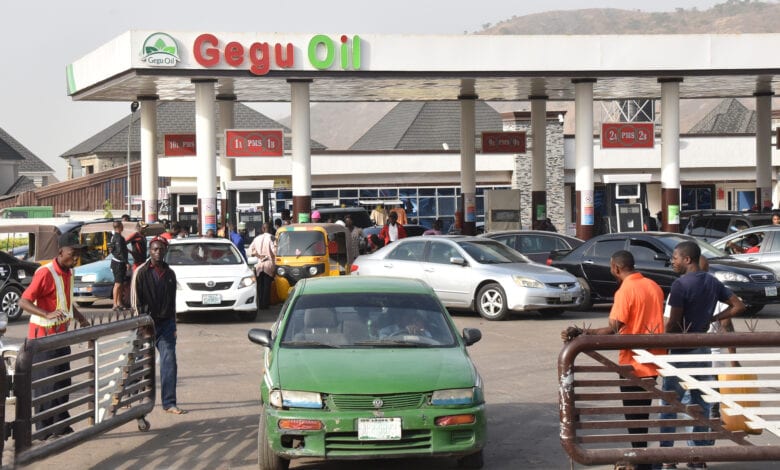
Black marketers yesterday took advantage of the lingering scarcity of Premium Motor Spirit (PMS) to make a brisk business from residents and motorists in Lagos State.
Investigations at different locations nationwide show that fuel stations are still besieged by motorists and consumers who have little or no products to buy.
In Abuja, a civil society activist, Comrade Martins, who operates with Christian Aid International, Nigeria, described the hoarding and scarcity development as unfortunate, shameful, and extremely embarrassing.
He said Nigerians are living through one of the darkest periods in our nation’s history. “How did a major oil-producing country like Nigeria end up in such a precarious position?” he asks, adding that the evolution has had a wide-ranging impact on him.
Martins laments, “I used to pay N800 to and from the office every day, but now I spend between N1,400 and N2,000 every day. That’s after spending nearly two hours looking for a vehicle. So, to avoid being late for work, I’ve been leaving at 4:30am for the past two weeks, because getting to town from my area causes a lot of traffic jams, and the current fuel scarcity has exacerbated the situation.”
Similarly, a broadcast journalist, Emeka Amakoh, observed that coping with the fuel crisis in Abuja since it first struck has been one experience that is better imagined than expressed.
“For some of us, driving to and from office now constitute a luxury as petrol is difficult to get now. “Most gas stations are conspicuously under lock and key, while those ready to do business have a massive queue of consumers to contend with. To this end, I often elect to park my car at home since I can’t hustle for the product as it were, and can’t convince my boss in the office that I stayed away from work, just to queue up for endless hours to source for fuel.
“Over and above all, the situation is biting so hard, but if the assurances from the NNPC is anything to go by concerning the availability of about one billion litres of petrol, it goes without saying that the end to the ongoing misery is within a touching distance.
In Lagos, a News Agency of Nigeria (NAN) correspondent, who monitored the situation at Oshodi, Ojota, Ikeja, Mushin, Surulere, Iyana-Ipaja, Abule Egba, and Lekki areas, observed that many filling stations were still not selling petrol.
Long queues were seen at the few stations selling, with private and commercial motorists, as well residents, besieging them as early as 5am.
Vehicular queues led to traffic gridlock on some major roads across the state, especially on the Lekki-Epe axis.
•Black market booms
Black marketers with various sizes of kegs were seen hawking petrol within a few meters of the filling stations.
Their operations were also noticeable in areas such as Ikorodu Road, Mushin, Mobolaji Bank Anthony Way, and Surulere.
Some marketers were selling a litre of fuel for prices between N180 to N250 per litre, depending on the location, demand, and negotiating skills of the buyer.
A commercial bus driver, Mr Wasiu Oyeleke, said he bought 10 litres of PMS (petrol) for N2,000.
“Yesterday,” he said, “I could not get fuel after I closed for the day, and none of the stations in my area is selling. I managed to buy from these boys (black marketers) in Mushin, which I am using now.”
Another commercial bus driver, Mr Emma Udoh, said he was offered 20 litres of fuel for N3,600 by one of the black marketers, which he refused.
He said: “I remember my last experience in their hands when I bought fuel from them and nearly destroyed my car. I have been here for almost three hours and will wait until I can get fuel, but it is very frustrating for all of us.
A tailor, Mr Anu Ayorinde, said operators of small businesses were also suffering from petrol scarcity due to epileptic power supply by the electricity distribution companies.
Ayorinde said they had to get fuel from the black market for their generators, rather than wait in the queue for hours to be unable to deliver jobs on time for their customers.
•Kaduna residents are groaning, as motorists have deserted the highways
Light traffic flow now characterises most highways in the Kaduna metropolis, as residents lament the hardship caused by fuel scarcity in major towns of the state.
Long vehicle queues adorn petrol filling stations, with some car owners spending nights on fuel queues.
Residents urged the government to intervene in the matter and ensure the availability of fuel.
One of them, Mr Dogara Samaila, said he had to pay N600 per litre of petrol in the black market as he could not withstand the long queues in the few fuel stations selling petrol.
“As you can see, few vehicles are plying the road due to fuel scarcity; the government should ameliorate the suffering of Nigerians.
“Nigeria, as a member of the Organisation of Petroleum Exporting Countries (OPEC), is not supposed to be experiencing this hardship; we are beyond that,’’ he said.
A civil servant, Malam Adamu Muhammad, said he had to spend the night at a fuel station before he could get fuel for his car, urging the government to look into the matter and proffer solutions.
Meanwhile, some commuters have lamented the dearth of commercial vehicles on the highways because of the scarcity, saying movement in the metropolis has become stressful.
A market woman, Ruth John, said her transport fares have doubled, adding that she has to hustle to board commercial vehicles.
2023: APC will takeover Delta, Omo-Agege says
On her part, Miss Salma Ibrahim said she had to trek a distance from her house before she could get a taxi to get to her location, praying to God to make things easy for Nigerians.
•NLC blames hoarders
The NLC has accused oil major marketers of being responsible for the fuel scarcity causing untold hardship among Nigerians.
Its president, Ayuba Wabba, in a statement in Abuja yesterday, said marketers were causing scarcity by hoarding products to make a profit.
In the statement entitled, “The Position of Nigerian Workers on Festering Issues of National importance”, the NLC stated: “We understand that the current situation is as a result of petroleum products hoarding.
“We call on all petrol marketers to show sensitivity to the difficulties faced by the generality of Nigerians and ensure prompt discharge of petrol to consumers. We also call on relevant regulatory agencies of government to rein in the activities of unscrupulous petroleum products marketers who go devilish miles to make dishonest gains.”
•Scarcity has worsened Nigeria’s woes –CAN
Christian Association of Nigeria (CAN), Kaduna Chapter, said the sufferings of Nigerians have been made worst by the current fuel scarcity.
In a press statement, CAN chairman, Kaduna State, Rev. Joseph John Hayab, who also doubles as Vice Chairman of CAN, Northern States, said “Continual scarcity of fuel in Nigeria and the pains of having adulterated fuel in circulation have further increased the hardship Nigerians are going through for about a month now.”
Hayab said “CAN is worried and wondering who is responsible for this bad product and scarcity. We are compelled to ask who is our Minister of Petroleum? What has he and the ministry done to avert and remedy this situation?
“Do the pains we are facing not enough for the minister to make a public apology, or honorably resign for not delivering the service Nigerians are yearning to get? Nigerians should not continue to suffer due to the negligence and incompetence of people holding public offices. Why should our leaders abuse the patience of our citizens?
“Our citizens are considered to be the most patient people on earth because we have been enduring bad governance, poor service delivery, which has led to deaths that could have been avoided by many family members, friends, and associates.
“How can we be a major oil producer, but have failed to fix our refineries and find lasting solutions to the challenge of oil subsidy? Our leaders should show pity on hardworking Nigerians who are spending hours and nights at fuel stations. Commuters who are paying high transport fares and waiting for a long time to get to work and back home after work due to lack of fuel to buy.”
•Kyari, NNPC GMD, begs Nigerians, says the issue will soon be resolved
Meanwhile, the Chairman, House of Representatives Committee on Petroleum (Downstream), Abdullahi Mahmud Gaya, has assured Nigerians that his committee will ‘handle’ companies who imported methanol-blended PMS into the country. The chairman was responding to a question from one of the committee members in that regard.
Gaya spoke during an engagement with the management of the NNPC organised by the committee on the current fuel situation in the country.
While briefing the committee, the CEO/GMD, Mele Kyari, explained that the situation came about as a result of the discovery of methanol in the PMS cargoes shipped to Nigeria under the subsisting commercial contract operated by NNPC and its partners.
According to the CEO, the reason why tests did not reveal methanol presence was because Nigeria’s specifications do not include methanol.
“We are a law-abiding company. There is no way we could have known about the methanol presence. The only way we could have known about it is if our suppliers, in good faith, disclosed it to us.
“In this particular instance, the discovery was made by our inspection agents who noticed the emulsification at the filling stations and brought it to our attention. Subsequent investigation revealed that the four cargoes which are all from the same source also contained methanol-blended PMS,” the CEO added.
He said NNPC then moved swiftly to trace all the affected products and quarantine the same.
While assuring the committee and Nigerians that measures had been put in place to accelerate fuel supply and distribution in the country, the NNPC CEO said the company had placed significant orders of over 2.1 billion litres of methanol-free PMS to ensure the queues vanish in a few days.
Kyari pledged that NNPC would co-operate with the committee and the Nigerian Midstream and Downstream Petroleum Regulatory Authority (NMDPRA) to get to the root of the matter.
The NNPC CEO also expressed deep empathy with Nigerians on the current situation and assured that adequate measures had been put in place to maintain supply sufficiency and prevent future occurrence.