By Mudiaga Affe, Emma Obe and Jude Idu
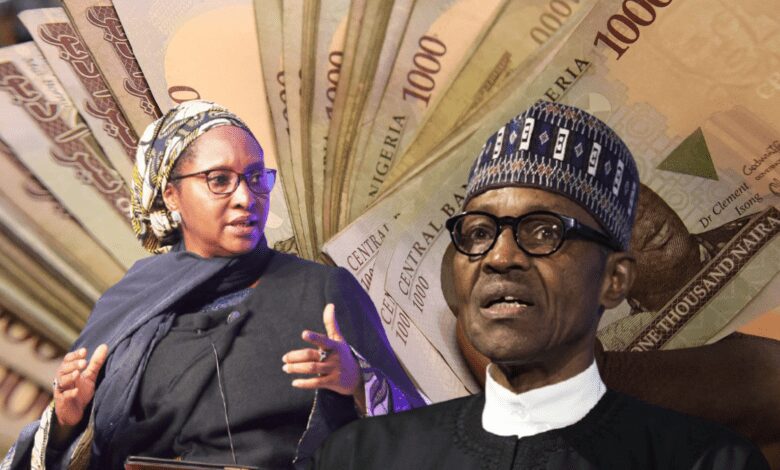
With a $33.348bn external debt and debt stock of N32.915trn, the economic policies of the President Muhammadu Buhari-led administration has come under serious scrutiny with many experts declaring that Nigeria is heading for economic doom.
Their worries stemmed from the President’s recent letter to the National Assembly seeking its approval to borrow a N2.3trn ($6.18bn) external loan to finance part of the 2021 budget deficit of N5.6trn.
Federal lawmakers have already granted the president’s plea even as the Debt Management Office (DMO), said the request was already captured in the 2021 budget.
However, Nigerians have lambasted the Buhari-led administration for what they referred to as plunging the nation into economic woes that may take several years to redeem.
Several economic and finance experts, including the renowned professor of Economics at the Olabisi Onabanjo University, Ago-Iwoye, Ogun State, Sherrifdeen Tella; a developmental economist, Prof Odilim Nwagbara; Chairman, Manufacturers Association of Nigeria (MAN), Rivers/Bayelsa chapter, Senator Adawari Pepple; and a Port Harcourt-based finance consultant, Churemi Ekaa, said external borrowing have a far-reaching negative impact on the economy and foreign exchange.
According to Nwagbara, it appears the present administration does not know what the endless borrowings meant for the future of the country.
“I know that most of the loans he (Buhari) took have double interest rates, which makes it precarious for the country at any point Nigeria services the loan. Buhari’s own is out of the ordinary and maybe there is another reason why he does what he does. Any sane President should not go it this way,” he said.
The economist said with over N33trn loans under this administration and still counting, the nation’s foreign debt profile might hit N100trn before 2023..
“It means that in the next 30 years, Nigeria’s capital income, should not be used for developing the country more especially that part of the country that has been short-changed. I don’t want to say that this is premeditated as an unenlightened person would believe, but in times like this, I am forced to think so.
“It also means that the Nigerian currency would continue to trail others with the loan signed in dollars and be serviced and paid in dollars. And during these years, the Nigerian foreign reserves will suffer, education will suffer, hospitals and the entire needed infrastructure will suffer because Nigeria may be involved in no capital projects except payment and servicing of loans,” Nwagbara explained.
He added, “I don’t even know why they keep saying that Nigeria is out of recession, I so much believe that Nigeria will soon go back to recession because no sector of the economy is working.
“It is, however, obvious that some of the financial policies are not followed since the rubber-stamped National Assembly says yes at every request. But one grave question should be, of what purpose does Buhari indulge in borrowing? I believe that there must be some political undertone because this is more than trying to build infrastructure, which we have not seen for some six years now.”
In his views, Pepple said apart from the fact that the process of obtaining previous loans had not been transparent, the loans taken so far have not been applied to the real and manufacturing sectors, which would have stimulated the economy.
He said, “There is nothing wrong with borrowing. What is essential is that the borrowing should be for development, so that the items for which the loans were taken can pay for themselves.
Implement Economic Plan approved by NASS, Lawan tells Executive
“It is important that we should note that the Debt Management Office had come out with staggering amounts that the federal and state governments owe already. And this has not been healthy. The country has borrowed heavily from China recently.
“In what sectors would these monies be applied? And what is the due diligence process? What are the transparency processes that were used in seeking these loans? That has been the major issue.
“In other African countries, you would be surprised that building rail lines of very high lengths are done with $1m, for example, and in Nigeria, it is $20m-plus. What does that tell us? It tells us that there is a problem of corruption and incompetence within the system.
“And if you are borrowing in an incompetent system, it is a total waste. You are only passing your debt burden to generations yet unborn because these debts must be paid at a point in time. This is not the time that you would say that the debt would be forgiven. We have already enjoyed that and it might not work again in our lifetime.
“So, I don’t think it is a proper thing to do. I am not in the National Assembly any more. And I may not if that request was accompanied by specific projects. But so far I have not read in the press or the social media that that the request came with projects to enable the National Assembly to even to analyse and able to come out with the feasibility of borrowing such money.”
Loans injurious to economy
For Tella, the nation’s economic managers are not thinking beyond the loan. He said, “Their thinking is that you must get a loan to move forward and that is not true. They should be thinking of how to create revenue and wealth rather than just going for loans which is part of what is currently killing the economy.
“Before now, when there is a price increase in crude oil which leads to an increase in revenue, you will see the difference and the economy will start picking up gradually. Unfortunately, that is not the case now because we are spending a large amount of money to offset loans that are already due and to service debts. So, getting more loans is very injurious to the economy.”
Tella, who called for cutting down cost of running government, also accused the National Assembly members of approving loans for their pecuniary gains.
“What we should do now is to cut down on the expenses. We would have to re-prioritise the items that we are spending money on. It seems the government is bent on spending what they have budgeted for the year and that is not correct. A budget is just an estimate. I think the National Assembly is supposed to caution the Federal Government.
“Again, the lawmakers believe that approving the loans will enable them to get the money that they have been getting because when you get the loan it gives you a kind of money illusion, and therefore, you will not find a solution to the problems confronting us.
“The two major problems that we have now are the payment and servicing of debts as well as for settling political office-holders. Ghana, for instance, is running a presidential system but are they are not complaining about the cost of running the government because they follow the laws with regard to financial spending. Which law, for instance, allows our legislators to be collecting at least N15m every month? There is none.
“There is a fiscal policy law that stipulates how many civil servants will collect monthly, but the lawmakers have gone ahead to implement policies that will enable them to collect huge monies. So, we are caught in the web of payment for debts and the cost of governance.
“We are already spending 70 per cent of our budget on recurrent and that is why we are having the problems we are faced with now. So, such loans will never be turned down by the National Assembly because they will benefit from the loan” he added.
A Port Harcourt-based Finance Consultant, Ekaa, said instead of going for external borrowing, which might have negative impact on the economy and foreign exchange, the authorities should harness abundant domestic resources and opportunities that are lying fallow.
He said, “We have enough resources in this country for us to harness without having to go for external loans. If an external loan is to be applied to investment projects and we are using it to yield something that would generate employment and would generate employment and improve the living standards of the people, it is a different thing.”
Similarly, a Rivers State-based legal practitioner, Dr. Emmanuel Mgbe, said those in government have not done what they should do to reduce borrowing. According to him, the government should adopt austerity measures in the expenditure of public officers.
“By all statistics, international agencies and economists say Nigeria is over-leveraged with loans. So, adding to it without assured productivity is a No! IMF has talked, World Bank has talked and even government economists have all talked that we are over-leveraged,” he lamented.
Lead Director, Centre for Social Justice (CSJ), Mr. Ezeh Onyekpere, said Buhari had lost economic direction. “It is obvious that the President is bereaved of the economic indices and that is why we keep gambling into contradiction. What is the repayment plan? What is the duration of the loan and at what interest rate is that loan coming into Nigeria? Among all these, I can tell you that there is no clear evidence to show that we are close to getting it right.
“I believe that the next Nigerian President will be frustrated out of office by the countless loans President Buhari has taken from foreign countries and the fact remains that the deeds on the condition of these loans are shrouded in secrecy. Ordinarily, it should be a public document domiciled at the National Assembly or the DMO or possibly make a national publication of the loan negotiation.
“He wants to live a huge debt to the incoming president. Another point is that we are already enslaved to the lenders because the condition for payment must not be so easy for the country to wriggle out of it.
A former Dean of Faculty of Applied Economics, University of Port Harcourt, Prof. Mike Ezugwu, said issues in the country had no technical approach because its leadership was not listening to advice.
He said, “Do you think that borrowing is a bad thing? No, it is not. But the way this administration is going about it, shows our ways of doing things. Every day now, we hear of Mr. President asking for loans and more loans and I keep asking myself, is this how past leaders did it. And the way this National Assembly approves the loan speaks volumes.”