By Seyi Odewale
Yesterday, the federal government predicted heavy rains and floods in 30 states and the Federal Capital Territory (FCT).
The high-flood risk states are: Abia, Adamawa, Akwa Ibom, Anambra, Bauchi, Bayelsa, Benue, Borno, Cross-River, Delta, Ebonyi, Edo, Gombe, Imo, Jigawa, Kebbi, Kogi, Kwara, Lagos, Nasarawa, Niger, Ogun, Ondo, Osun, Oyo, Rivers, Sokoto, Taraba, Yobe, Zamfara and the Federal Capital Territory.
The Minister of Water Resources and Sanitation, Joseph Utsev, said rising sea levels would cause coastal and riverine flooding in some parts of the country’s South-South geo-political zone.
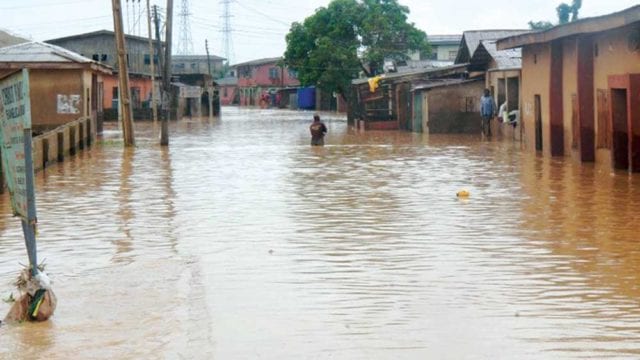
Some Maiduguri communities were flooded following a leak in the Alau Dam in 2024.
Among these states are Bayelsa, Cross River, Delta, and Rivers, while Akwa-Ibom and Edo are considered high-flood-risk states.
Utsev stated this during the public presentation of the 2025 Annual Flood Outlook by the Nigeria Hydrological Services Agency (NIHSA) in Abuja.
The 2025 Annual Flood Outlook (AFO) was segmented into three parts to address the pressing challenges of flood disasters and provide information for mitigation, especially in the most vulnerable communities
The Minister disclosed that flooding remained one of the most devastating natural disasters in Nigeria, and climate change was accelerating its frequency and severity.
He revealed that 1,249 communities in 176 Local Government Areas (LGAs) across 30 states and the FCT fall within high-risk flood zones this year, while 2,187 communities in 293 LGAs face moderate flood risks. Key risk areas include Abia, Benue, Lagos, Bayelsa, Rivers, and Jigawa.
This year’s AFO introduced a community-based flood forecasting approach to improve early warning and response systems. Rather than just general predictions, forecasts are now tailored to specific communities, enhancing actionable communication and preparedness at the grassroots level.
Borno residents displaced by flood in Maiduguri, the state capital, on September 10, 2024
In his remarks, the Permanent Secretary of the Ministry of Water Resources and Sanitation, Richard Pheelangwah, urged stakeholders to prioritise early response. “This outlook isn’t just about numbers; it’s about protecting lives and livelihoods,” he said.
The Director General of NIHSA, Umar Mohammed, noted that this year’s flood forecast goes beyond mapping LGAs and now identifies specific communities at risk.
“Our focus has expanded to assess sectoral impacts on health, education, agriculture, and infrastructure, offering more robust tools to policymakers and disaster risk managers,” he said.