By Chukwudi Obasi
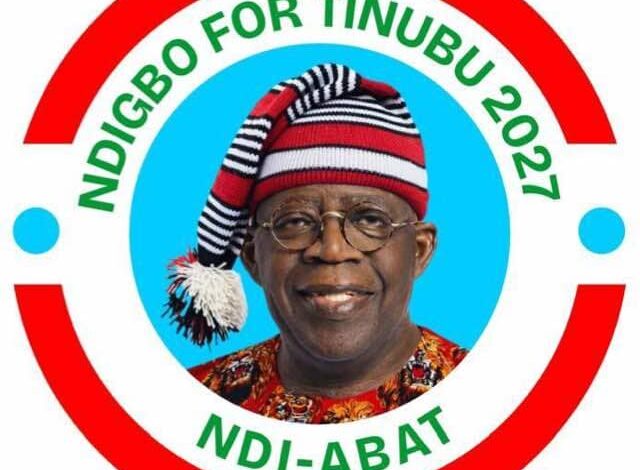
The Ndigbo for Asiwaju Bola Ahmed Tinubu 2027 Forum (NDI-ABAT) has developed a data-driven political strategy aimed at strengthening grassroots engagement and support for President Bola Tinubu in the Southeast ahead of the 2027 presidential election.
The forum said it would formally present its proposed 2027 Southeast Winning Strategy and Political Blueprint to President Tinubu and the Convener of the City Boys Movement, Mr Seyi Tinubu.
In a statement jointly issued on Monday by NDI-ABAT National Coordinator, Mazi Okechukwu Isiguzoro, and Secretary-General, Dr Ugwuoke N. Ugwuoke Jr., the group said the blueprint was developed from grassroots consultations, stakeholder engagements and an analysis of voting patterns in the Southeast.
The forum said its approach would place electoral data, grassroots organisation and measurable political engagement at the centre of efforts to expand support for the APC and President Tinubu across the five Southeast states.
NDI-ABAT said the voting figures from the 2015, 2019 and 2023 presidential elections provided useful benchmarks for understanding the region’s political dynamics.
According to figures cited by the group from Independent National Electoral Commission (INEC) records, APC’s presidential votes in the Southeast rose from 198,248 in 2015 to 403,968 in 2019 before recording 127,605 votes in 2023.
The 2019 figure represented an increase of 205,720 votes, or more than 100 per cent, over the 2015 performance.
NDI-ABAT said the figures demonstrated the potential for significant electoral movement in the region when political engagement and mobilisation were effectively structured.
The group, however, said the 2023 result also showed the need for a more sustained approach to grassroots political organisation ahead of 2027.
“The numbers cannot be ignored,” NDI-ABAT said, stressing that electoral data should guide the political conversation about the Southeast rather than assumptions or unverified assurances.
The forum said the Southeast should also not be treated as a single political bloc, arguing that political strategies must reflect the peculiarities of Abia, Anambra, Ebonyi, Enugu and Imo states.
It proposed a structure focused on individual states, senatorial districts, local government areas and polling units.
NDI-ABAT further said the existence of prominent Southeast politicians in government and federal appointments should be complemented by measurable grassroots engagement.
According to the forum, political influence should ultimately be reflected in sustained voter mobilisation, stakeholder engagement and verifiable electoral results.
“Political promises must ultimately be tested against political structures, and political structures must ultimately be tested against verifiable electoral results,” it said.
The group also identified federal infrastructure development in the Southeast as an important component of the political conversation, particularly projects under the supervision of the Minister of Works, Senator Dave Umahi.
It said visible government projects should be accompanied by effective communication, enabling communities to identify interventions, understand their status and assess their impact.
NDI-ABAT said its proposed blueprint was not intended to replace existing APC structures but to provide an additional framework for examining past performance and developing a more coordinated grassroots strategy.
The forum said presenting the blueprint to President Tinubu and Seyi Tinubu would provide an opportunity for its recommendations and grassroots findings to be considered within the broader political engagement ahead of 2027.
“The South-East political equation must be understood through evidence, organised through the grassroots and measured through verifiable results,” the forum said.