By Cross Udo, Abuja
President Bola Tinubu on Tuesday pledged to forge a resilient economy and an inclusive society, urging federal and state governments to translate National Economic and Development Council (NEC) resolutions into tangible benefits for Nigerians.
Speaking at the close of the two-day NEC conference at the Old Banquet Hall, Abuja, President Tinubu, represented by the President of the Senate, Godswill Akpabio, vowed to press reforms that deliver real results.
“Reform is not an event. It is a process requiring courage, patience, and consistency. Our decisions must spark visible gains—jobs created, businesses backed, roads built, schools bolstered, healthcare enhanced, and opportunities widened.”
Tinubu hailed Vice President Kashim Shettima’s leadership of the NEC and thanked governors, ministers, partners, and private-sector players. He stressed deeper federal-state collaboration and disciplined policy execution to realise the Renewed Hope Agenda.
“This is no slogan—it’s a national pact demanding delivery over dialogue,” he added. “Together, we’ll craft a stronger federation.”
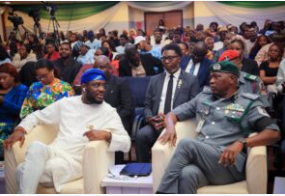
Key resolutions from the conference with the theme: “Delivering Inclusive Growth and Sustainable National Development: The Renewed Hope National Development Plan,” the gathering—convened by Budget and Economic Planning Minister Senator Abubakar Atiku Bagudu—drew over 350 delegates, including governors, ministers, the Inspector-General of Police, lawmakers, and private sector representatives.
Permanent Secretary Dr Deborah Odoh read the communiqué, highlighting these priorities: Anti-oil theft and security: Sustain and expand the NEC committee’s mandate; blend non-kinetic efforts with military ops to target unemployment and poverty; and boost inter-agency ties and state alignment with national security under Renewed Hope.
*Council expands anti-oil theft mandate, urges states on tax, social spending
On taxation, NEC commended 12 states for passing harmonised tax laws; pushed 13 states with pending bills to act fast; and urged 11 others to start enacting to curb multiple taxation alongside new federal reforms.
States should enact the harmonised tax law to address multiple taxation and complement the new tax reform laws,” the communiqué stated.
On human capital development, the conference called for increased investment in education and health, warning that persistent underinvestment in the sectors required urgent correction.
“State governments should increase per capita spending on health, education and youth employment to improve human capital outcomes and expand opportunities for economic participation.
“Nigeria’s persistent underinvestment in the education and health sectors needs to be revisited, particularly when compared with peer countries,” Odoh read.
On security, the conference recommended non-kinetic approaches to complement military operations, stressing that tackling unemployment and poverty would help curb insecurity.
It also called for stronger interagency cooperation and urged state governments to align with the national security framework in line with the Renewed Hope Agenda.
Other resolutions included expanding concessional financing for productive sectors, securing production corridors, strengthening federal-state coordination for domestic production, and ensuring optimal investment in oil and gas while accelerating diversification into non-oil sectors.
The communiqué further recommended expediting constitutional amendments to address inconsistencies in the implementation of fiscal federalism and to enable the effective rollout of the tax regime across all tiers of government.
Speaking to State House Correspondents after the conference, Lagos State Governor Babajide Sanwo-Olu said the outcomes of the retreat must be extended beyond government circles to include the organised private sector and the legislature.
“I’ve picked a whole lot personally. I tend to appreciate the challenges and problems that different parts of the country currently face, but also be able to speak our individual stories and share our individual experiences,” Sanwo-Olu said.
He urged governors to implement the resolutions, noting that Nigerians would only benefit when agreed decisions are fully executed.
Sanwo-Olu said the Tinubu administration had made notable progress in strengthening federal-state collaboration, adding that real development happens at the subnational level.
Ogun State Governor Dapo Abiodun, on his part, described the administration’s macroeconomic reforms as a major confidence booster for investors, citing improved stability in the foreign exchange market.
“There’s stability in the forex market. There’s confidence in holding the naira. Macroeconomic policies are the biggest enabler of investor confidence,” he said.
He also praised Tinubu’s infrastructure drive, particularly the Lagos-Calabar coastal highway and the Sokoto-Badagry road, describing them as far-reaching enablers of economic activity.
Abiodun said governors had “never had it so good” under Tinubu’s leadership, noting that states remained central to policy implementation because they were closest to the grassroots.
The conference, convened by the Minister of Budget and Economic Planning, Senator Abubakar Atiku Bagudu, attracted over 350 delegates, including governors, deputy governors, ministers, the Inspector-General of Police, members of the National Assembly, and representatives of international development partners and private sector organisations.
Odoh said the gathering provided a platform to review key economic issues and align subnational governments with the Tinubu administration’s strategic vision under the Renewed Hope National Development Plan 2026–2030.