By Cross Udo, Abuja
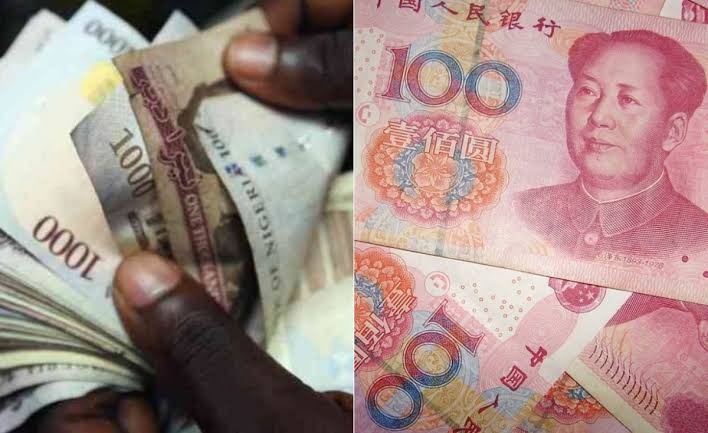
Nigeria and the People’s Republic of China have expressed their commitment to encouraging flexible and diverse regional, monetary, and financial cooperation, such as local currency swaps, to facilitate trade between the two countries and contribute to global economic stability.
This was contained in the joint statement between China and Nigeria on establishing being part of the broad consensus reached by the two sides during President Tinubu’s official visit to China.
The Central Bank of Nigeria (CBN) signed a bilateral currency swap agreement with the People’s Bank of China (PBoC) in 2018, worth about $2.4bn.
However, the implementation could have been more challenging due to trade imbalances between countries.
The two countries also agreed to carry out international cooperation on financial intelligence on anti-monetary laundering/countering the financing of terrorism (AML/CFT) and support Nigeria’s efforts to safeguard the order of its economic and foreign exchange markets and to crack down on financial crimes, including money laundering.
By signing a series of partnership agreements and Memorandum of Understandings (MoUs), the two sides further supported the establishment of more friendly relations between Chinese and Nigerian provinces/states and municipalities to expand and deepen cooperation at the subnational level.
They committed to stepping up the protection of lawful rights and interests of each other’s citizens on their territories and to creating a favourable business environment for each other’s companies.
*Asian giant supports Nigeria’s geographical, development advantage in W’ Africa
As China welcomed Nigeria to expand trade between the two countries, the two sides agreed to make joint efforts to fully support Nigeria’s geographical and development advantage in West Africa to establish Africa’s flagship projects on cross-national and cross-regional cooperation.
Tinubu is in China at President Xi Jinping’s invitation for a State Visit and to attend the Beijing Summit of the Forum on China-Africa Cooperation (FOCAC).
In their discussion, the two presidents agreed that both countries stood at a new historical starting point as significant representatives of major developing countries and emerging economies.
They noted that their strengthened strategic cooperation will propel a new dynamic for China-Africa relations in the new era and lead the Global South to march together.
To consolidate mutual trust, expand cooperation, and strengthen coordination, the two presidents have agreed to upgrade the China-Nigeria relationship to a Comprehensive Strategic Partnership and build a High-level China-Nigeria Community with a shared future.
The statement noted that Nigeria and China have sought strength through unity for win-win cooperation, reaffirming their support for their core interests and major concerns, particularly sovereignty and territorial integrity.
While the Chinese side resolved to support Nigeria’s Renewed Hope Agenda and its efforts to maintain national unity, peace, security, and social stability, promote economic development, and improve people’s welfare, the Nigerian side stated its firm adherence to the one-China principle.
Nigeria acknowledged that there is but one China in the world, the People’s Republic of China is the sole legal government representing China, and Taiwan is an inalienable part of China’s territory.
“Nigeria opposes any form of ‘Taiwan Independence’ or interference in the internal affairs of China and firmly supports all efforts made by the Chinese government to achieve national reunification,” the statement added.
The two sides spoke highly of FOCAC’s leading roles in advancing the quality of cooperation between China and Africa over the past 24 years since its establishment, believing that the successful convening of the Beijing Summit of FOCAC opened a new chapter of unity and cooperation between China and Africa.
Nigeria and China reiterated their firm support for each other in independently seeking a development path that suits their national interests. This will further strengthen exchanges on governance experiences.