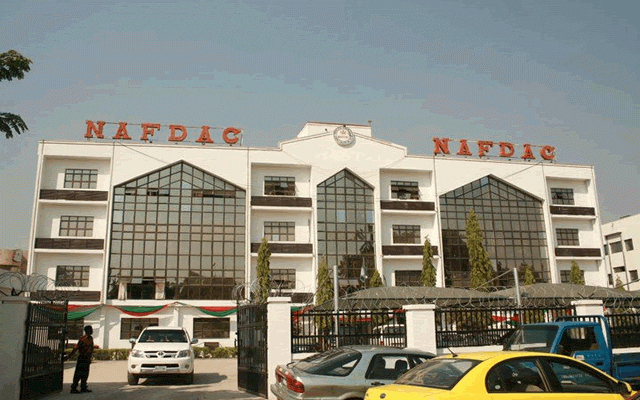
Prof. Moji Adeyeye, the Director-General of the National Agency for Food and Drug Administration and Control (NAFDAC) has said that Nigeria will not be a dumping ground for chemicals banned in other countries.
This is contained in a statement issued by Mr Olusayo Akintola, The resident media consultant of NAFDAC.
Adeyeye also explained that it was not true that 40 per cent of the registered brands of pesticide products in Nigeria were banned or restricted for use by European Union.
“The agency has put in place procedures to enable it take regulatory decisions and determine whether an active ingredient should be banned or restricted.
“NAFDAC is a signatory to the international convention that banned chemicals and pesticides such as the Rotterdam Convention, an international treaty designed to facilitate informed decision-making by countries with regard to trade in hazardous chemicals and pesticides.
“NAFDAC is ISO: 900: 2015 Quality Management System (QMS) and a certified organisation that has put in place procedures that enable the agency take regulatory decisions to determine whether an active ingredient should be banned or restricted.
“Chemicals banned by international convention have been phased out and never entertained for registration or given import permits as raw materials for production as a sovereign state,” she said.
She said NAFDAC has stringent requirement of ensuring that any pesticide to be imported into Nigeria is on the Market in the exporting country, the current Free Sale Certificate is authenticated by the Nigerian Embassy in the exporting country.
The NAFDAC boss also stated that in order to ensure that only active ingredients approved by the agency are allowed into the country, appointed testing agents (CRIA) and laboratories to conduct tests and forward results to the agency before any pesticide is shipped in.
COVID-19: NCDC records 573 new infections, 6 deaths
Adeyeye stated that the World Health Organization (WHO) names four toxicity classes of pesticides:Class I – a: extremely hazardous, Class I – b: highly hazardous, Class II: moderately hazardous, Class III: slightly hazardous, Class U: Unlikely to present acute hazard.
She said these classifications are for guidance purposes to enable users to take necessary precautionary measures and to ensure the safety of food for humans, animals, and the environment.
Adequate quality control tests, she said, are carried out by the agency before granting certifications for all products that are either imported or manufactured within the country.