As Nigeria marks its 65th Independence anniversary today, the mood across the country is less celebratory than reflective.
Anger over hunger, insecurity, poverty, and decades of failed promises by successive governments has overshadowed pride in nationhood.
From Lagos to Kano, voices are rising not just to commemorate independence but to interrogate the nation’s journey and demand a rebirth anchored on justice, equity, and accountability.
For many, President Bola Tinubu’s reform agenda, including the removal of fuel subsidies, a floating naira, and fiscal tightening, has only deepened hardship.
Meanwhile, President Bola Tinubu today reassured Nigerians that the tough economic reforms undertaken by his administration have begun to bear fruit, insisting that “the worst is over” and that a new era of growth and stability is emerging.
In a nationwide broadcast to mark the country’s 65th Independence anniversary, the President said Nigeria had overcome the turbulence of subsidy removal and foreign exchange reforms, which initially triggered hardship, and is now reaping gains in growth, revenue, and stability.
“Yesterday’s pains are giving way to relief. The dawn of a new, prosperous, self-reliant Nigeria is here,” he declared.
Tinubu noted that the economy grew by 4.23% in the second quarter of 2025, marking the fastest pace in four years and surpassing the International Monetary Fund’s projections.
Inflation, he said, had fallen to 20.12% in August, the lowest in three years.
“We chose the path of reform. We chose the path of tomorrow over the comfort of today. Less than three years later, the seeds of those difficult but necessary decisions are bearing fruit,” the President said.
He listed milestones, including record non-oil revenue exceeding ₦20 trillion by August, foreign reserves rising to $42.03 billion—the highest since 2019—and five consecutive quarters of trade surplus.
According to him, non-oil exports now account for 48% of total exports, compared to oil’s 52%, marking real diversification.
“We are now selling more to the world than we are buying,” Tinubu said.
The naira, once battered by volatility, has stabilised, with the gap between official and parallel rates significantly reduced. He also pointed to improvements in debt sustainability, noting that the debt service-to-revenue ratio had dropped from 97% to below 50%.
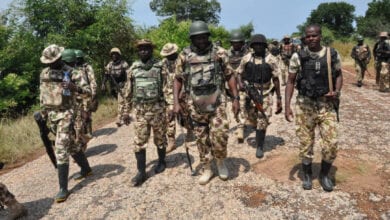
On security, Tinubu praised the gallantry of the armed forces and security agencies, saying they were “winning the war” against terrorism, banditry, and separatist violence.
He cited the return of peace to many liberated communities in the North-East and North-West and ongoing operations that have curbed IPOB/ESN violence in the South-East. “We see their victories in their blood and sweat,” the President said.
Tinubu devoted a section of his address to the youth, describing them as Nigeria’s greatest assets. He highlighted the Nigeria Education Loan Fund (NELFUND), which has disbursed nearly ₦100 billion to over 500,000 students, as well as Credicorp loans worth ₦30 billion for vehicles, energy, and digital devices.
The YouthCred programme, he added, had begun offering consumer credit to corps members, while the iDICE initiative is set to empower entrepreneurs in the digital and creative sectors.
Acknowledging the pains of rising living costs, Tinubu said that economic collapse or bankruptcy was not an option.
He urged Nigerians to embrace productivity, innovation, and “Made-in-Nigeria” goods.
“Let us be a nation of producers, not just consumers. Let us farm our land and build factories to process our produce. I say Nigeria first,” he urged.
The President closed with a message of hope, “With Almighty God on our side, I can assure you that the dawn of a new, prosperous, self-reliant Nigeria is here.”
*Nigerians demand accountable leadership, good governance and welfare of citizens from leadership
The Coordinator of the Recover Nigeria Project, Comrade Osita Obi, painted a grim picture of Nigeria at 65, stressing that while citizens should be thankful for another year of nationhood, the country is in dire straits.
He acknowledged that there had been some progress, “we are alive”, but quickly noted that such progress was overshadowed by systemic failure.
“When I was growing up, we had electricity. Now, we don’t. Poverty is everywhere, insecurity is everywhere, and the middle class has disappeared.”
He lamented the widening gap between politicians and ordinary citizens, accusing leaders of hypocrisy.
“Our leaders tell us to tighten our belts, but they are not tightening theirs. They buy houses and land, living ostentatiously, while the citizens suffer. The worst part is that people today cannot feed; there is extreme hunger.”
For Obi, the collapse of the middle class is symbolic of Nigeria’s regression.
He recalled that during his youth, professionals in the civil service lived comfortably, but today, such stability no longer exists.
The activist called for radical action, warning that mere complaints would not change the situation.
“Something is wrong in the system, and it must be purged for sanity to return. The citizens must rise to demand results. Leadership is bad, yes, but what are the citizens doing? We must interrogate our leaders, ask them to account. I am calling for a revolution. Sowore is not alone now.”
Obi insisted that revolution does not mean violence, but rather the mass mobilisation of citizens to demand accountability.
“If the government wakes up tomorrow and sees over ten thousand citizens on the streets of Awka, Abeokuta, or Kaduna, that is a revolution.
“Enough of this exploitation. Citizens must say no and insist on holding those in power accountable. Electricity must be affordable, food must be produced, and petrol must be within the reach of the people.”
For him, insecurity remains the biggest obstacle to progress. He argued that farmers could no longer go to their farms, while bandits openly displayed weapons with little response from authorities.
“Our people must return to their farms, and the leadership must provide security. If they cannot, they must step down. If they refuse, then Nigerians must be ready for change, real change, not just slogans.”
Human rights advocate and Chairman of Intersociety, Emeka Umeagbalasi, described Nigeria at 65 as a “Golgotha situation,” insisting that leadership had failed to confront the truth.
“Those in charge of Nigeria’s affairs don’t want to fix the country. They are only interested in inflicting more pain, in borrowing endlessly, and in destroying the system further.”
He said it was disheartening that, despite decades of independence, the country was still unable to meet the basic needs of its citizens.
Umeagbalasi argued that Nigeria’s challenges were not unique, but what set the nation apart was its failure to confront them head-on.
“Other countries have asked national questions and convened sovereign conferences to address constitutional, social, economic, and security issues. Here, leaders prefer to paper over the cracks. They talk about the bush rather than fix the foundations.”
He added that what Nigeria needed was sincerity of purpose and leaders who put national interest above personal enrichment.
He was particularly critical of the government’s penchant for borrowing.
“Unfortunately, Tinubu just secured $21bn. By the time that is gone, another paper will be raised for perhaps $30 billion. These loans are given under stringent conditions, and the money is squandered without accountability. Instead of fixing power, health care, or education, they spend recklessly and return for more loans.”
The activist emphasised that governance was about trust and responsibility, qualities he said were lacking in both federal and state leadership.
“From whichever angle you look at it, the country is not working. Leaders at the state and federal levels are not those who want to fix the system; they are only interested in milking it. Citizens must understand this and demand a different kind of leadership.”
In his view, the way forward is for Nigerians to insist on a new national dialogue and to hold leaders accountable for every naira borrowed or spent.
“We need to return to the basics, a system anchored on truth, justice, and people-centred governance. Without that, Nigeria’s 65 years will continue to be wasted decades.”
Additionally, the Deputy President of the Abuja Chamber of Commerce, Prof Adesoji Adesugba, an expert in economic development, highlighted the paradox of Nigeria’s progress: excellent policies on paper, but little to show on the ground.
He said, “Successive governments have crafted some of the most comprehensive development blueprints in Africa, from Vision 20:2020 to the ERGP and now the Renewed Hope Agenda. However, our problem has never been a lack of vision. It has always been execution.”
Adesugba acknowledged some bright spots in Tinubu’s reforms, including tax restructuring and renewed focus on infrastructure.
“The widening of the tax net and improved fiscal transparency are commendable. Commitment to road, rail, and power development is critical for unlocking productivity. Similarly, promoting technology and industrial clusters points towards inclusive growth.”
Yet he warned that such reforms could only succeed if Nigeria built strong institutions and insisted on accountability.
“Policy success depends not merely on ideas but on the quality of execution. We need to strengthen institutions, ensure that competent people occupy the right positions, and remove those who fail to deliver results without political interference.”
For Adesugba, the lesson of Nigeria at 65 is that prosperity is not automatic.
“Unity and prosperity are not outcomes of age or population. They are products of discipline, integrity, and performance-driven governance. Our unfinished journey to nationhood can only reach its destination if leadership at all levels translates sound policies into tangible impact for citizens.”
He concluded by stressing the urgency of citizen engagement.
“Nigerians must hold leaders accountable for results. We cannot continue to celebrate good ideas that ultimately end up as empty rhetoric. At 65, the margin for failure is gone; now is the time to deliver.”
Emeritus Professor of Economics at the University of Uyo, Akwa Ibom State, Akpan Ekpo expressed frustration at Nigeria’s poor economic performance.
He described it as “shameful” that, after 65 years of independence, the country still lacked an uninterrupted power supply, functional healthcare, and quality education.
“Eighty per cent of Nigerians lack basic amenities. After so many decades, progress remains marginal. This is not acceptable.”
He argued that poverty reduction should be the cornerstone of Nigeria’s rebirth.
“If resources are not redirected to benefit at least 85 per cent of the population, we cannot say we are making progress. Wealth must stop circulating among a privileged few while millions remain in destitution.”
Ekpo emphasised the importance of federal restructuring as a pathway to development. “We must return to true federalism. Grant sub-national entities greater autonomy by transferring key responsibilities from the exclusive to the concurrent list. Let states run at their own pace and drive their own development.”
He accused successive administrations, including Tinubu’s, of failing to prioritise people’s welfare.
“Every administration promises better days, but none has delivered. From infrastructure to employment to healthcare, the record is one of underperformance. Citizens are tired of rhetoric.”
Looking ahead, Ekpo called for a radical shift in governance philosophy. “Nigeria’s progress cannot be measured by slogans or borrowed funds but by visible improvements in the lives of ordinary people. If after 65 years we cannot provide light, water, and education, then we have failed the next generation.”
Additionally, lawyer Okefemi Feyitan stated that things are certainly not what is expected of the country at present. He, however, urged Tinubu to fix things right.
He said many years of decay cannot be fixed in two years.
A chieftain of the African Democratic Congress (ADC), Alhaji Shehu Mohammed, told ThisNigeria that Tinubu needs to deepen Nigeria’s democracy.
He said that in a Democracy, the people must be given the right of choice, pointing out that the seemingly journey to a one-party state is not healthy for our democracy.
He said, “Today there is a dictatorship of the political parties. Candidates are imposed on the people without transparent primaries”.
“In some cases, no primaries take place at all. Governors have become appointing authorities for Candidates for elective offices in their states.”
Lawyer Kingsley Okorie minced no words, “Section 14(2) b of the 1999 Constitution provides that the welfare and security of citizens shall be the primary purpose of government. Under Tinubu, poverty and hunger have reached their worst levels. This is not the brand of leadership our independence heroes bequeathed to us.”
For the National Council of Women, the anniversary serves as another poignant reminder of gender exclusion. Its President, Edna Azura, appealed to Tinubu, “Since independence, women have not been carried along as they should. When women are empowered, society benefits. This is the time for the government to address issues affecting women and children.”
Bartholomew Okoudo of the Conference of NGOs (CONGOS) struck a conciliatory tone, urging unity: “Despite security, ethnic, and political challenges, Nigeria remains one entity. We must celebrate what unites us and shun what divides us.”
A Lagos trader, Murtala Audu, said, “Are we celebrating inflation, unemployment, and bad leadership? This year alone, people have cried over food prices, school fees, and joblessness. Independence without good governance is slavery in disguise.”
Even as Nigerians in the diaspora project global excellence in Nollywood, Afrobeats, and fintech, critics warn that talent without governance is wasted.
As Professor Pat Utomi observed, “We can dance to Afrobeats, but we must also fix our roads, schools, and hospitals.”
Similarly, Dr Jude Okoro, of the University of Calabar in Cross River State, said, “Sixty-five years after independence, Nigeria has survived coups, civil war, and dictatorship.
“But survival is no longer enough. The challenge before Tinubu and future leaders is to rebuild trust, reform institutions, and deliver the dividends of democracy.
“Until then, the cry for accountability, equity, and justice will continue to echo louder than the Independence Day fanfare.”
*Don’t lose faith in your country- Senate
Senate President Godswill Akpabio and his deputy, Senator Jibrin Barau, have called on citizens to remain patient and united in the face of current economic challenges, assuring that ongoing reforms under President Bola Ahmed Tinubu’s administration are already yielding positive results.
In a personally signed Independence Day message, Akpabio congratulated Nigerians for their resilience over the past two years, acknowledging the sacrifices brought on by tough reforms, particularly the removal of fuel subsidy, inflation, and currency depreciation.
He said the administration’s policies were designed to reposition the country for long-term growth and stability.
“We are not unaware of the pains occasioned by the reforms, but I want to assure you, very soon, this will be a thing of the past because the benefits of the reforms are beginning to manifest positively,” Akpabio said.
The Senate President urged citizens to shun pessimism, stressing that Nigeria remains on the right path.
Akpabio said, “I must tell you that Nigeria is not finished. Do not buy into the mischievous narrative that Nigeria is irredeemable.
“The Renewed Hope Agenda of President Bola Ahmed Tinubu’s administration is reshaping the country; we are growing and making progress.”
Akpabio further congratulated President Tinubu, members of the National Assembly, the judiciary, and Nigerians at home and abroad, noting that at 65, the country had reached a level of maturity where unity and collective responsibility must take precedence.
In a separate message, Deputy Senate President Jibrin Barau urged Nigerians to remain steadfast and supportive of Tinubu’s administration, saying the founding fathers’ ideals of unity, peace, and justice should continue to guide the nation.
Barau noted that despite present challenges, Nigeria’s future remained bright.
“Yes, at 65, we have some challenges facing us as a country, but we will overcome them. Our country, the Federal Republic of Nigeria, will emerge stronger from its present challenges, by God’s grace,” he said.
He commended the government’s economic and security reforms, saying improvements were already visible, while appealing to Nigerians to support Tinubu in delivering on the Renewed Hope Agenda.
Barau, who also serves as First Deputy Speaker of the ECOWAS Parliament, pledged that the regional body would continue to support Nigeria in advancing good governance and provide the necessary legislative backing to help the executive achieve its development goals.
Both leaders emphasised that with collective patience, unity, and commitment, Nigeria would overcome its challenges and realise its vision of a greater nation.