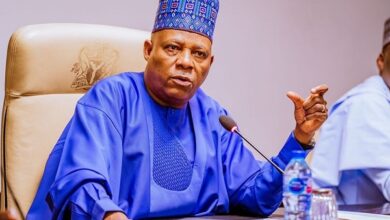
The Federal Government recently, through the Minister of Information and Culture Lai Mohammed literally declared war against individuals and groups behind the spread of hate speeches in the country. Also, Vice President Yemi Osinbajo recently reiterated the Federal Government’s position on the need to curb the menace of hate speeches spreading across the country like a cankerworm. Speaking at the Banquet Hall of the Presidential Villa, Abuja, during a national security retreat for the National Economic Council (NEC) which he presided over as then Acting President, Prof. Yemi Osinbajo, warned that henceforth, peddlers and promoters of hate speeches will be prosecuted under the country’s anti-terrorism laws.
He told his audience made up state governors or their representatives, ministers of justice, finance, interior, national planning, the Central Bank of Nigeria governor, and others, that hate speech was synonymous with terrorism. He warned that henceforth, the Muhammadu Buhari-led federal government would not hesitate to take legal action against any person or group of persons caught making hate speeches.
Prof. Osinbajo explained that “hate speech is a recipe for terrorism,” adding that “terrorism as it is defined popularly, is the unlawful use of violence or intimidation against individuals or groups especially for political ends.” The country’s Terrorism (Prevention) Act 2011 (as amended), defines terrorism as inter alia: an act deliberately done with malice which may seriously harm or damage a country, or seriously intimidate a population. According to Osinbajo, a world renowned professor of law, “the intimidation of a population by words, by speech, is an act of terrorism, and government intends to take this matter very seriously.”
Unarguably, the federal government’s tough stance against peddlers of hate speech came on the heels of the quit notice issued by the Arewa youths to the Igbos resident in the northern part of the country to return to their various towns and villages in the South-East.
Similarly, the quest by the Indigenous People of Biafra (IPOB), led by Mazi Nnamdi Kanu, to secede from the rest of the country; the concomitant dissemination of insidious messages vide Radio Biafra against some individuals and ethnic groups, as well as the nefarious activities of the Niger Delta militants no doubt, compelled the federal government to take a hard stance against merchants of hate speeches. Unfortunately, Nigerians have also fingered officials of the Federal Government as harbingers of hate speeches. It is seen in most of their actions and inactions.
X-raying UNICAL’s first female vice-chancellor after one year
It is gratifying to learn that the federal government has decided to take hard knocks against peddlers of hate speech.
This is a right step in the right direction given the fact that hate speech is detrimental to national unity and harmonious intra-ethnic relationships. The government, by extension, is saying that those hate speeches, if not curbed, could lead to bloody inter-ethnic conflicts, such as the 1994 Rwandan genocide which in a short-space of three months, claimed the lives of 800,000 people, mostly of the Tutsi ethnic minority.
It’s on record that during the three-month period of this senseless massacre of innocent Rwandan children, youths, men and women, local officials and government- sponsored radio stations called on ordinary Rwandan civilians to murder their neighbours. Today – twenty-four -years after the unjustifiable killings in Rwanda- the scars are still noticeable in that East African country.
For a country like Nigeria that survived a 30-month civil war which according to a UN report, claimed about two million lives, mostly children and women, the prospect of another civil war is unacceptable and justifiably terrifying.
The argument from some quarters that the statement credited to Prof. Osinbajo, is tantamount to curtailing the people’s right to freedom of expression as enshrined in the 1999 Constitution of the Federal Republic of Nigeria (as amended), in our view is untenable. This is because no freedom is absolute. Indeed, one’s freedom ends, where that of another person or group of persons starts. The government’s contention in our view is that freedom of expression should, and must be used to edify, rather than destroy the country’s social, political and economic foundations.
Nevertheless, we make bold to say that the actions and inactions of the All Progressives Congress (APC)-led federal government have directly or indirectly encouraged the steady streaming of hate speeches across the land.
For instance, shortly after the APC came to power at the federal level, President Buhari was quoted as saying that his administration would not extend democracy dividends to a section of the country that didn’t vote for him and his party.
This is in addition to denying people from that zone access to plum jobs at the federal level. From the benefit of hindsight, the people from the despised zone, may either withdraw their support for the administration in protest, or make seemingly inflammatory statements against the regime. This is what Nigerians are witnessing since 2015.
Also, the federal legislators have failed to rise up to the challenge of conducting robust debates aimed at resolving those issues that glaringly constitute veritable clog to national unity and development. If members of the National Assembly had promoted the culture of vigorous debates, which is prevalent in every civilized society, they would have seen the pressing need to vote in favour of restructuring the country, as that would have helped calm frayed nerves, and ultimately reduce the spread of hate speeches. The incessant taking of loans by the government since 2015, which are never debated in a democracy, is capable of fueling hate speeches.
However, against the backdrop of its potency to cause disaffection among the Nigerian people, I align myself with the federal government’s resolve to criminalise peddlers of hate speeches. But we nevertheless, appeal to governments at all levels to avoid taking actions capable of giving any person or group of persons, an excuse to resort to making hate speeches. All hands must be on deck to curtail the spread of hate speeches.