By Nathaniel Zaccheaus, Abuja
The Minister of Budget and Economic Planning, Senator Abubakar Atiku Bagudu, has said Nigeria needs a significantly larger national budget to achieve the administration’s ambition of building a $1 trillion economy.
Bagudu said the country could not realistically pursue such an economic target while operating with what he described as one of the smallest national budgets among the world’s most populous countries.
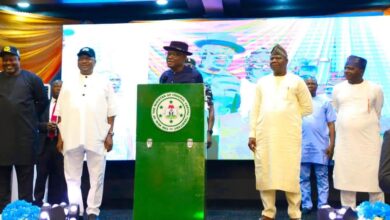
He spoke in Abuja at the 2026 Capacity-Building Workshop of the Senate Press Corps, organised around the theme, “Leveraging Legislative Oversight and Media Collaboration to Safeguard the National Budget from Unlawful Insertions.”
The minister said Nigeria’s budget debate should move beyond distributing available resources to determining the level of resources required to achieve the country’s development objectives.
“Perhaps the starting point for this discussion should be: What should the national budget be? Because without starting from there, maybe we will not reach the right conclusion,” Bagudu said.
He said Nigeria must examine how to build a $1 trillion economy within the next four years while ensuring that the growth is broad-based and inclusive.
“How can we, as a step towards that wider dream, generate a $1 trillion economy in the next four years? And not just a $1 trillion economy, but a $1 trillion economy that includes everyone?” he asked.
Bagudu said Nigeria’s relatively low budget size posed a major challenge to achieving its economic aspirations.
He cited Brazil as an example, saying the South American country’s 2025 budget was at least 25 times larger than Nigeria’s.
“But Brazil’s 2025 budget is at least 25 times the size of Nigeria’s budget. So do I expect to achieve the same outcomes as Brazil?” he asked.
He challenged the media to lead a national conversation on whether Nigeria should continue operating with limited resources or expand its revenue base and mobilise additional funding.
Bagudu also defended the constitutional role of the National Assembly in the budget process, arguing that legislative involvement should not automatically be regarded as inappropriate.
“We chose constitutional democracy, and under constitutional democracy, the National Assembly has a critical role,” he said.
The minister said some constituency projects could appear unnecessary to observers in Abuja but represent genuine priorities for communities.
He cited water projects and other interventions demanded by communities where residents travel long distances to access basic services.
Bagudu also recalled controversy over the provision of freezers in a previous budget, explaining that the equipment was intended for women in fishing communities who lacked facilities to preserve their catch.
On alleged unlawful budget insertions, he called for a distinction between legitimate legislative amendments and genuinely irregular provisions.
He acknowledged that errors could occur in a complex process involving numerous institutions and individuals.
“We are dealing with processes, human beings and human errors. Therefore, vigilance is important. The media and legislative oversight should continue to be vigilant,” he said.
Bagudu urged stakeholders to balance transparency with legitimate national interests, particularly in sensitive areas such as security.
He also challenged the assumption that recurrent expenditure was inherently less important than capital spending, noting that salaries and personnel costs could directly affect the delivery of security and other public services.
He said the budget conversation should focus on outcomes, resources required, resource mobilisation and public confidence.
“The conversation should be about what we are trying to achieve, what resources are required to achieve it, how we mobilise those resources, and how we maintain public confidence while ensuring accountability and transparency,” he said.
Senate President Godswill Akpabio called for closer cooperation among the National Assembly, media and civil society organisations to strengthen scrutiny of the national budget.
Represented by the Chairman of the Senate Committee on Media and Public Affairs, Senator Yemi Adaramodu, Akpabio urged parliamentary journalists to deepen their understanding of legislative procedures and improve the quality of budget reporting.
Adaramodu said the media remained an important accountability mechanism in monitoring public expenditure and urged journalists to investigate spending and expose waste.
The Chairman of the Senate Press Corps, Taiye Odewale, said the controversy surrounding an alleged N1.3 billion provision for a purported Presidential Foreign Intervention Promotion Council underscored the need for stronger mechanisms to identify questionable entries.
He said investigations by the Senate Press Corps indicated that the provision was not among the N9.853 trillion added by the National Assembly to the N58.47 trillion executive proposal that produced the N68.32 trillion 2026 Appropriation Act.
Representing the Civil Society Legislative and Advocacy Centre, Ebu Emmanuel said every budget provision should be justified, costed, measurable and linked to identifiable beneficiaries.
He urged lawmakers to examine project locations, beneficiaries, costs, purposes and expected outcomes before approval.
Other speakers called for closer tracking of budget allocations from appropriation through release, implementation and eventual impact.
Participants also examined the use of artificial intelligence in budget reporting, with experts urging journalists to use the technology to analyse large documents while independently verifying its findings before publication