By Anthony Otaru, Abuja
Nigeria has moved closer to its ambitious crude oil production target of 2 million barrels per day (mbpd), with output climbing to more than 1.8 mbpd as sweeping reforms in the petroleum sector continue to restore investor confidence and attract fresh capital into the industry.
The encouraging outlook emerged on Tuesday at the opening of the 25th Nigerian Oil and Gas (NOG) Energy Week in Abuja, where government officials and industry leaders highlighted significant gains in crude oil production, gas development, upstream investments and regulatory reforms under the President Bola Tinubu administration.
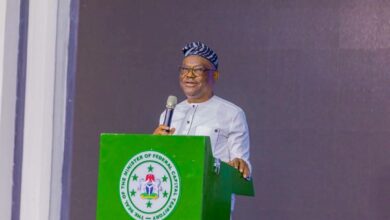
Declaring the conference open, the Minister of State for Petroleum Resources (Oil), Sen. Heineken Lokpobiri, said Nigeria’s production had recovered significantly from the levels recorded when the current administration assumed office in August 2023.
“When we came in, production was hovering around one million barrels per day. Today, the latest report from the Nigerian Upstream Petroleum Regulatory Commission shows we are producing over 1.8 million barrels daily,” Lokpobiri said.
He attributed the recovery to President Tinubu’s directive to eliminate long-standing bottlenecks in the oil industry, improve security around oil assets and create a more attractive environment for investors.
According to the minister, the number of active drilling rigs has increased from about 14 in 2023 to more than 60, reflecting renewed exploration activities and growing confidence in Nigeria’s upstream sector.
Lokpobiri said recent divestments by international oil companies had strengthened indigenous participation rather than weakened the industry.
He noted that companies such as Renaissance, Seplat Energy and Oando have acquired major onshore assets previously held by Shell, ExxonMobil and the Nigerian Agip Oil Company.
At the same time, international operators continue to expand their investments in deep-offshore operations.
“Independent producers now account for over 60 per cent of our daily production. The international oil companies have not exited Nigeria; they have shifted their investments to deep offshore operations,” he said.
To further improve the industry’s competitiveness, the minister disclosed that the Federal Government had engaged PwC to undertake a comprehensive review of more than 270 taxes, levies and regulatory charges imposed across the petroleum value chain.
He said the exercise is aimed at harmonising fiscal charges, reducing the cost of doing business and enhancing Nigeria’s attractiveness as an investment destination.
Lokpobiri also commended Renaissance Africa Energy Holdings and its partners for recording a recent offshore discovery in OML 74, describing it as another indication of renewed investor confidence in Nigeria’s energy sector.
Delivering the keynote address, the Group Chief Executive Officer of the Nigerian National Petroleum Company (NNPC) Limited, Bashir Bayo Ojulari, said the industry was witnessing one of its strongest recoveries in recent years.
He disclosed that NNPC Ltd recorded an average of 98 per cent operational recovery across its five crude oil export terminals between April 2025 and May 2026, compared with an operational low of about 1 per cent at the Bonny Oil Terminal in 2022.
Ojulari also announced that NNPC Exploration and Production Limited (NEPL) had achieved a record production of 365,000 barrels per day, while national crude production had risen to 1.71 million barrels per day, the highest level in five years.
The NNPC boss further revealed that gas production had increased to 7.5 billion standard cubic feet per day, driven by the completion of the River Niger crossing on the Ajaokuta-Kaduna-Kano (AKK) Gas Pipeline and the commissioning of the ANOH Gas Processing Plant.
He added that the company had maintained 100 per cent compliance with Joint Venture cash-call obligations throughout 2025 and up to June 2026, while sustaining efforts to achieve the national target of two million barrels per day.
Ojulari disclosed that NNPC had signed major Gas Sale and Purchase Agreements (GSPAs) covering 1.29 billion standard cubic feet per day for long-term LNG feed gas and 750 million standard cubic feet per day for domestic industrial gas supply to DFL FZE and the Dangote Refinery.
“These agreements represent more than $20 billion in associated investments, with seven additional commercial transactions currently in the pipeline,” he said.
He noted that the company had also resumed full monthly remittances to the Federation Account, reinstated monthly business performance reporting and held its first-ever earnings call, measures aimed at strengthening transparency and investor confidence.
Calling for deeper collaboration across the energy value chain, Ojulari said Africa’s vast hydrocarbon resources would only deliver sustainable economic value through stronger partnerships among governments, investors and industry players.
“The future of African energy will not be determined solely by the resources beneath our soil, but by the quality of the partnerships we forge above it. The opportunity before us is extraordinary, and the time to act is now,” he said.
Also speaking, the Minister of State for Petroleum Resources (Gas), Ekperikpe Ekpo, said Nigeria was steadily transitioning from a gas-producing nation to a gas-powered economy.
He highlighted ongoing strategic projects, including the AKK Pipeline, the OB3 Gas Pipeline and the Nigeria LNG Train 7 expansion, as critical investments expected to deepen domestic gas utilisation, improve energy security and accelerate industrialisation.
“We are moving from a nation that simply produces gas to one that is powered by gas,” Ekpo said.
He added that Nigeria’s admission as the first OPEC member to become an Association Country of the International Energy Agency (IEA) reflects growing global confidence in the country’s energy reforms.
On his part, Chairman of the Independent Petroleum Producers Group (IPPG), Adegbite Falade, said the Tinubu administration had attracted more than $8 billion in upstream Final Investment Decisions since 2023, including the Shell Bonga North and TotalEnergies Ubeta projects.
According to him, Nigeria’s share of Africa’s upstream Final Investment Decisions has risen from four per cent a decade ago to nearly 40 per cent over the past two years.
Falade, however, cautioned that sustaining the gains would require urgent reforms to eliminate multiple taxes and regulatory charges, address workforce shortages and review aspects of the Petroleum Industry Act (PIA) to reflect evolving commercial realities.
“The next geopolitical shock is not a question of if, but when. Nigeria must build sufficient production capacity now to seize future opportunities instead of missing another revenue windfall,” he warned.
The 25th NOG Energy Week brought together policymakers, regulators, investors, and industry leaders from across the globe to discuss strategies to strengthen energy security, drive investment, and position Nigeria as Africa’s leading oil and gas investment destination.