By Vincent Egunyanga, Cajetan Mmuta, Ben Adoga, Nathaniel Zaccheaus, David Lawani, Anthony Otaru, and David Eze
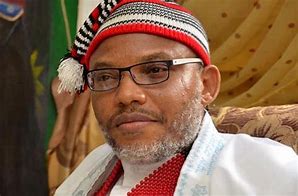
The Federal High Court in Abuja on Thursday sentenced the leader of the proscribed Indigenous People of Biafra (IPOB), Nnamdi Kanu, to life imprisonment, after convicting him on terrorism charges filed by the Federal Government.
The judgment, delivered by Justice James Omotosho, immediately triggered widespread reactions across legal, political and civil society circles, and ignited a wave of anger and sorrow in some parts of the South-East.
Justice Omotosho held that the prosecution had proved its seven-count charge “beyond a reasonable doubt,” imposing life imprisonment on four terrorism counts and additional custodial terms on two others, with the sentences running concurrently.
“I hereby sentence the convict to life imprisonment for Counts One, Four, Five and Six,” the judge said.
“With respect to Count Three, he is hereby sentenced to 20 years’ imprisonment with no option of fine. For Count Seven, he is sentenced to five years’ imprisonment with no option of a fine. The sentences shall run concurrently.”
The judge ordered that Kanu be detained in a highly secured facility suitable for his custody and placed under strict monitoring by the Office of the National Security Adviser.
He also ruled that Kanu be denied access to digital devices and directed that his transmitter equipment be forfeited to the Federal Government.
During the judgment, Justice Omotosho read at length from transcripts of Kanu’s alleged broadcasts, finding that they constituted acts of incitement and direct calls to violence.
“Go to the bush. You need to cut them off from the back, ambush them, take their guns from them and kill them. They are animals and not human beings. They may be wearing uniforms like Police or soldiers, but they are animals. Disarm them and kill them.”
The judge also quoted another passage, “If you allow them to escape, your life is over. I want Lagos Airport to be on fire. Breach the perimeter fence and burn down the Lagos airport. If you have a double-barreled or a pistol, go to the airport and burn it down.
“Set Murtala Muhammed Airport on fire. Set it ablaze right now. You are dealing with animals. Fulani janjaweed; they do not reason.”
Justice Omotosho ruled that the broadcasts constituted terror threats under the Terrorism Prevention Amendment Act 2013, including threats against foreign missions.
“The threats against the British High Commission, the British High Commissioner, and the American Embassy amount to acts of international terrorism,” he said.
There was tension in the courtroom shortly before judgment was delivered. Kanu raised his voice, insisting that the court could not proceed because he had not filed a final written address.
“You don’t know the law!” he shouted at the judge. “Show me where you have the right to waive my right to a final address. Show me what the Constitution says — you cannot show me!”
Justice Omotosho ordered Kanu removed from the courtroom. Judgement proceeded in his absence.
Earlier, prosecution counsel Gboyega Awomolo (SAN) asked the court to impose the death sentence, saying families of slain security operatives deserved justice.
Awomolo told the court, “The families of the 75 officers who were killed will find succour in the verdict. The convict must understand that the law is greater than any individual. He demonstrated no restraint under the ACJA and has shown arrogance rather than penitence.”
*Defence consultant heads to Appeal court, optimistic on reversal
Moments after sentencing, Kanu’s legal consultant, Aloy Ejimakor, rejected the ruling and announced plans to file an appeal immediately.
“We are heading to the Court of Appeal,” Ejimakor told journalists. “The Court of Appeal is the only court in this country that sits as a jury. We will ask the justices to check what happened today.”
Ejimakor added, “By God Almighty, Nnamdi Kanu will not stand convicted. Today is the only day I have seen a man convicted for what he said, not what he did. The sentence is overboard, cruel and unusual. How can you convict a man for broadcasting an unnamed location?”
But a Senior Advocate of Nigeria, Monday Ubani, said Kanu’s choice to rely on a no-case submission was disastrous.
“Kanu’s strategy was a very wrong move that ruined his case,” Ubani said. “A no-case submission cannot stop a trial under the ACJA. He couldn’t defend himself. He has been convicted. We wait for what happens next.”
*Ohanaeze Ndigbo: Judgment reopens old wounds
A former Vice President of Ohanaeze Ndigbo Worldwide, Chief Damian Okeke-Ogene, condemned the ruling, saying it had plunged the region into renewed emotional trauma.
“This is another sad day, another black day for Igbo people; it’s unacceptable,” he said. “It is a rape on democracy, freedom of expression, and, regrettably, the judgment reopened the wounds of the civil war.”
He added, “I wish the Federal Government would react immediately to set him free because I believe the judge acted on a script.”
Chairman of InterSociety, Comrade Emeka Umeagbalasi, said the entire trial was fundamentally flawed.
“It’s a kind of trial mixed up with coercion and state terror,” he said. “The judiciary was compromised and the executive was seen teleguiding the judiciary.”
He insisted the process was invalid, “Any proceeding founded on a faulty process is null and void. Look at the time it took the Federal Government to force a conviction — all the interference, threats, and intimidation. Even if Nnamdi Kanu had assembled 60 witnesses, nothing would have changed.”
Also, the Publisher of Sahara Reporters, Omoyele Sowore, accused the Federal Government of targeting Kanu for political reasons.
“The sentence is a brazen persecution of the IPOB leader,” he said. “Mr President, you are persecuting Kanu while Nigeria drowns in crisis, inflation at 35 per cent, naira free fall, bandits running wild. This isn’t justice; it’s a distraction from your failures.”
Public affairs analyst, Eze Splendour, described the judgment as “driven by anger.”
He said, “To be candid, I saw that judgment delivered by Justice Omotosho as done in anger, not by law. How can a judge sentence someone to life imprisonment just because he is fighting for the freedom of his people, while those killing Nigerians with AK-47 are free?”
He added, “In Nigeria today, the government negotiates with terrorists and bandits while people without guns are sentenced to life imprisonment. This is unfortunate. It is Nnamdi Kanu today — who knows the next victim?”
An Abuja-based lawyer, Uche Nwoko, said the ruling should prompt the government to reevaluate conditions in the South-East.
“The matter should not continue in perpetuity,” he said. “The federal government neglected the East, allowing things to degenerate. It is not enough to find Nnamdi Kanu guilty. Government must deal with the insecurity and economic collapse in the region.”
Another lawyer, Jude Ude, said the conviction will not halt separatist agitations.
“Finding Mazi Nnamdi Kanu guilty will not automatically bring an end to the entire matter,” he said. “It will also not stop the Biafran agitation. I know and hope that his lawyers will go up to the Supreme Court. It has not ended.”
Legal analyst Okon Effiong criticised Kanu’s decision to dismiss his counsel.
“I do not know how Kanu arrived at sacking his lawyers,” he said. “He took a considerable risk that has not helped his case. The court had the responsibility to make determinations based on evidence presented.”
Barrister Eze Onyekpere, Lead Director of CSJ, strongly criticised the sentence.
“How can this be when Nnamdi Kanu was not caught killing anybody,” he asked. “Bandits and Boko Haram are killing and sacking communities, yet they are pardoned and resettled. For me, it is an attack on the Igbos.”
He further said, “Justice Omotosho failed to remember that the IPOB leader was kidnapped from Kenya, which contravenes international law. Yet the Federal Government went ahead to convict him. This is a joke taken too far.”
The National Coordinator of HURIWA, Emmanuel Onwubiko, said the court ignored critical questions.
“The court should have suspended its decision until the Court of Appeal resolved outstanding jurisdictional disputes,” he said. “This judgment is politically motivated to spite some regions.”
Igbo rights activist Ugama Steve said political negotiation would have prevented the current situation.
“As an Igbo man, I think a political solution would have been a win-win situation,” he said. “Releasing him earlier would have calmed nerves. But now we are here.”
He added, “Technically, the judgment is sound, but it will be tested on appeal. The President can still grant him a pardon now that he has been convicted.”
*Abaribe: Life sentence exposes deep-rooted injustice against S’ East
A former Senate Minority Leader, Senator Enyinnaya Abaribe, has described the life sentence handed to the detained leader of the Indigenous People of Biafra (IPOB), Mazi Nnamdi Kanu, as the final confirmation of what he calls a longstanding and well-coordinated plot to marginalise the South-East.
Abaribe, who represents Abia South Senatorial District in the 10th Senate, said in a statement issued in Abuja by his Media Adviser, Uchenna Awom, that the judgment did not come as a shock to “the Igbo nation and other right-thinking Nigerians,” insisting that the entire process had been predetermined from the onset.
The Senator said, “We are not surprised. The life jail handed down to Kanu was a preconceived plot that has only reached its expected end. For many of us, the outcome was foretold.”
He argued that the warning signs were unmistakable, given the Federal Government’s repeated refusal to grant Kanu the same consideration, amnesty, or reconciliation initiatives extended to other armed groups across Nigeria.
“At the time the Federal Government refused to factor in pleadings to extend amnesty to Nnamdi Kanu, as was done for others, we knew that today’s outcome was imminent,” he stated.
Abaribe contrasted the government’s harsh posture toward Kanu with what he described as more conciliatory and indulgent treatment given to insurgents and militants in other regions.
He said, “Is it not an irony that local governments, states and the Federal Government gleefully initiated negotiations and peace deals with rampaging terrorists in the North-East and North-West?
“Just like the amnesty granted to ex-militants in the South-South, many of whom were later rewarded with lucrative oil pipeline contracts. This is to say that justice in Nigeria is not for the South-East.”
He lamented that all appeals, interventions, and advocacy efforts for clemency in the interest of national unity and inclusiveness were ignored, despite the potential for such gestures to promote peace and stability.
According to him, “Our people can only endure and hope for a time when justice in Nigeria would become the sine qua non. We have done our best; we have variously made the case for the authorities to be circumspect and at least accede to pardon for the sake of unity and inclusiveness.”
Abaribe said the latest development places a weighty responsibility on President Bola Ahmed Tinubu, urging him to demonstrate leadership that promotes equity and national cohesion.
“The Igbo nation is now left with no other option than to place her fate squarely on the desk of President Bola Ahmed Tinubu,” he said.
While expressing deep disappointment over the verdict, the Senator urged Nigerians, particularly citizens of the South-East, to refrain from any form of violence or unlawful response.
Abaribe maintained that the struggle for fairness, justice, and equitable treatment of all regions within Nigeria must continue through peaceful and constitutional means.
*Anger, grief, uncertainty in S’ East
Across major cities in the South-East, including Onitsha, Aba, Enugu, Owerri and Abakaliki, tension was palpable, though there were no significant incidents. Community groups, traders, transporters and youth associations expressed shock and deep frustration.
Residents interviewed expressed fear that the judgment might intensify existing insecurity.
A trader in Onitsha, who identified himself as Chukwuma, said, “This judgment has killed the small hope we still had. Government does not understand the implications.”
A teacher in Enugu, Mrs Patricia U, said, “Even if he is guilty, the country is not handling the situation properly. People are emotionally wounded.”