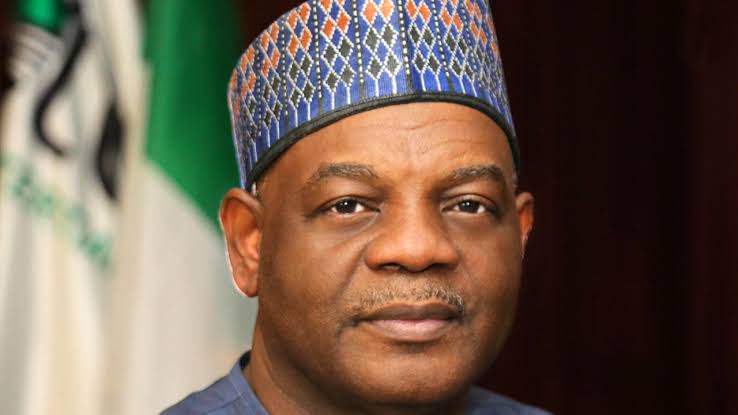
How Yakubu redefined Nigeria’s electoral landscape

By David Lawani
When Professor Mahmoud Yakubu formally handed over to Mrs May Agbamuche-Mbu as acting Chairman of the Independent National Electoral Commission (INEC) on October 8, it marked the end of an era. This decade profoundly reshaped the conduct, credibility, and character of elections in Nigeria.
President Bola Tinubu, who conferred a National Honour of Commander of the Order of the Federal Republic (CFR) on Yakubu the same day, described him as “a steadfast steward of democracy whose innovations have strengthened the foundation of free and fair elections.”
The ceremony, held quietly at the Presidential Villa, was more than a farewell. It was a nod to a man who, for ten transformative years, piloted one of Nigeria’s most complex public institutions through storms and triumphs, scepticism and progress.
Appointed in November 2015 and reappointed in 2020, the first INEC Chairman to serve two consecutive terms, Yakubu’s tenure offered a rare continuity in Nigeria’s democratic evolution.
Under his leadership, INEC conducted two general elections (2019 and 2023), 19 governorship polls, hundreds of bye-elections, and three FCT council polls, the most significant electoral workload in the country’s history.
Observers credit his tenure for giving INEC a measure of institutional stability unseen since the Commission’s establishment in 1998.
He fostered a culture of policy documentation and knowledge preservation, culminating in the creation of Nigeria’s first Election Museum, a repository of materials chronicling the country’s democratic journey.
“Prof Yakubu turned INEC from an election-only agency into a learning institution,” said Dr Amina Zakari, a former National Commissioner. “That’s the real transformation one that will outlive personalities.”
Perhaps Yakubu’s most enduring administrative legacy lies in his restructuring of the Commission’s operational map.
After 25 years of stagnation, INEC expanded polling units from 119,974 to 176,846, decongesting overcrowded centres and improving voter accessibility nationwide.
He also championed the Election Monitoring and Support Centre (EMSC) — a real-time dashboard that tracked over a thousand operational indicators during elections, ensuring logistics efficiency and rapid intervention.
Additionally, he initiated the construction of State Collation Centres across all states and laid the foundation for a new INEC headquarters in Abuja, signifying both physical and institutional renewal.
“These reforms created a predictable, systematic, and data-driven election management process,” said Samson Itodo, Executive Director of Yiaga Africa. “We moved from improvisation to precision.”
If one word defines Yakubu’s era, it is technology. The introduction of the Bimodal Voter Accreditation System (BVAS) and the INEC Result Viewing Portal (IReV) transformed electoral integrity. For the first time, Nigerians could monitor results uploaded directly from polling units, drastically reducing tampering during collation.
Equally transformative was the Automated Biometric Identification System (ABIS), which purged over 2.7 million fraudulent voter registrations, reinforcing the sanctity of the voter register. INEC also digitalised core processes, from candidate nomination to observer accreditation, and even launched an Artificial Intelligence Division, the first of its kind by any electoral body in Africa.
Yakubu once said, “Technology will not solve all our problems, but it will make manipulation more difficult.” Indeed, despite the controversies surrounding the 2023 elections, few dispute that digital tools have made rigging more traceable and accountability more enforceable.
Inclusivity became the heartbeat of Yakubu’s reforms. Through Continuous Voter Registration (CVR) introduced in 2017, Nigerians could register year-round, adding 23 million new voters to the roll between 2019 and 2023.
Online pre-registration portals made voter updates seamless, while detailed demographic data, by gender, age, and occupation, fostered transparency.
He also institutionalised participation for Internally Displaced Persons (IDPs). He established a Department of Gender and Inclusivity, ensuring that women, youth, and persons with disabilities were not just voters but active participants.
INEC’s use of assistive voting devices, from Braille ballots to magnifying lenses, further demonstrated that democracy must be accessible to all.
“Yakubu didn’t just preach inclusion, he implemented it,” said Grace Jerry, Executive Director of the Inclusive Friends Association. “His reforms made democracy visible to people living with disabilities.”
Yakubu’s INEC will also be remembered for its pivotal role in shaping the Electoral Act 2022, a landmark legislation that introduced electronic transmission of results and stricter regulations for political parties.
Working closely with the National Assembly, the Commission drafted detailed operational guidelines and manuals that brought clarity and uniformity to Nigeria’s electoral process.
The deregistration of 74 underperforming political parties was another bold move. By streamlining Nigeria’s political landscape from 92 to 18 parties, Yakubu reinforced quality over quantity and encouraged stronger party institutionalisation.
Recognising that elections are not just technical but also social processes, Yakubu institutionalised quarterly stakeholder engagements with political parties, civil society, security agencies, and the media.
He introduced a Code of Conduct for Security Personnel on Election Duty. He partnered with the National Peace Committee, chaired by former Head of State Abdulsalami Abubakar, to entrench a culture of peace before and after elections.
Regionally, Yakubu restored Nigeria’s leadership through ECONEC (ECOWAS Network of Electoral Commissions), which he chaired. His missions to Ghana, Sierra Leone, Liberia, and The Gambia provided technical support that elevated Nigeria as a hub of electoral diplomacy. The Liberian National Electoral Commission honoured him in 2023 for his contributions to regional democracy — a rare tribute from peer institutions.
Internally, Yakubu redefined staff motivation through merit-based promotions, gender quotas, and welfare reforms. Five INEC legal officers earned the prestigious title of Senior Advocate of Nigeria (SAN) during their tenure, a testament to professional growth within the institution.
He established a Creche at the INEC Headquarters to support nursing mothers, provided hazard allowances, and introduced Long Service Awards and Staff Recognition Nights.
“He humanised the Commission,” recalled Festus Okoye, former INEC spokesperson. “By taking care of the people who run elections, he took care of democracy itself.”
Yakubu’s departure was met with mixed emotions, gratitude from reform advocates and scrutiny from critics who argued that the 2023 elections fell short of expectations. Yet, even his critics concede that the structural and technological foundations he laid cannot be easily undone.
Dr Abubakar Kari, a political scientist at the University of Abuja, put it succinctly: “Yakubu may not have achieved perfection, but he institutionalised progress. He moved INEC from an election machine to a democratic institution.”
As Mrs May Agbamuche-Mbu takes over in an acting capacity, and as President Tinubu sends a substantive replacement to the National Assembly for screening and confirmation, INEC faces a familiar test: sustaining the reforms without regression.
The 2027 general elections will, in many ways, be the first actual test of Yakubu’s legacy.
From the expansion of polling units to the deployment of BVAS, from the cleansing of voter registers to the elevation of staff welfare, Yakubu’s decade at INEC reads like a case study in institutional transformation.
He entered office in 2015 amid doubts about continuity and departed in 2025 with a presidential medal, an enhanced institutional reputation, and an unmistakable imprint on Nigeria’s democratic landscape.
In his valedictory message, Yakubu reflected, “We have built systems that outlast individuals. Our democracy will continue to grow because Nigerians have shown resilience, faith, and belief in the power of their votes.”
Indeed, the story of INEC under Yakubu is not one of perfection, but of perseverance, innovation, and progress. It is a reminder that democracy, though imperfect, evolves through those who dare to build, reform, and leave institutions stronger than they met them.