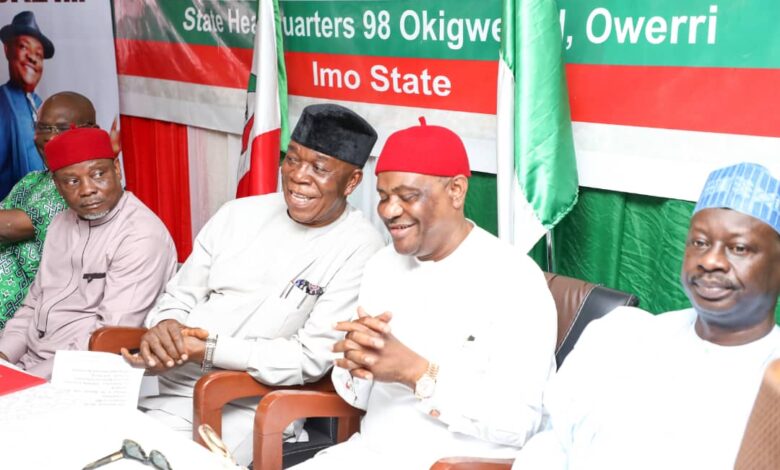
Rivers State governor, Nyesom Ezenwo Wike has told Imo State Peoples Democratic Party (PDP) delegates that his presidency will solve the leadership problem in Nigeria that has stunted economic growth.
Governor Wike gave the assurance when he met with the PDP delegates at the party’ secretariat in Owerri on Tuesday as part of his ongoing consultation ahead of the party’s presidential primary next month.
The governor said he has clarity of purpose and the capacity to galvanise, coordinate the abundant human talents, expertise and resources in steering the county to greatness.
“Each time, our party people will say but for Wike, the party would have died. Now the same person has come out.
“That Wike who has stood for this party, that Wike who has made this party not to die, that Wike who has made this party to be alive has come out to say I want to now lead this party.
“Nigeria is full of talents. Nigeria is full of people who are intelligent. What is the problem of this country today is leadership.
2023: I have the capacity to salvage Nigeria – Wike
“You require somebody who can galvanise , coordinate those resources and it takes leadership. If you give me the mandate of the party, I know I will win the election in 2023.”
Governor Wike stated that it is hard to believe that President Muhammadu Buhari is truly in charge of affairs of the country, given the intractable insecurity situation in parts of the country and poor performance of the economy.
He pointed to issues of insincerity in the fight against corruption because persons with such charges on them are either made chairman of the APC or shielded from the course of justice.
Governor Wike assured that his presidency will be in charge of the armed forces, provide them with requisite support, strengthen their capacity to gather intelligence and demand results from them.
This is because, he said any government that cannot protect life and property of citizens has failed. Governor Wike pointed out that it is such failure that he is desirous to reverse with the PDP ticket.
“If you cannot protect and property, governance is zero. This is because without life what are roads for? Without life, what are schools for and without life what are hospitals for? People must be alive to go to schools.
“You need a firm, courageous and fearless person. You can’t go to this election without you leading. You can’t be at the back. What I’m fully prepared for is this particular seat, to be the President of Nigeria.”
The governor asserted that without security, the economy cannot thrive and he is courageous to tackle the menace across the country.
Wike vows to tackle festering insecurity, ailing economy when elected president
He also stated that economists and experts shall be engaged as part of his presidency and be allowed to fashion out modalities and strategies that are required to set the road map in growing the nation’s economy.
Governor Wike said he is passionate about the development of his people and loves the provision of infrastructure as seen in Rivers State.
He assured of replicating the success record secured in Rivers State when elected president of Nigeria.
Governor Wike told the delegates that his winning chances would have been secured if they give him the party’s ticket because he is the only person who can take the power from APC for PDP on behalf PDP for Nigerians.
Former Gombe state governor, Dr Ibrahim Hassan Dankwambo, urged Imo state PDP leaders and delegates to support Governor Wike’s presidential aspiration because he is competent, fearless and above all, kind hearted.
Dankwambo described Governor Wike as a tested and detribalised Nigerian, who believes in development, having unrelentingly delivered dividends of democracy in Rivers state in the past seven years.
Earlier, Imo state PDP chairman, Charles Ugwuh, said Nigeria is in search of a great leader like Governor Wike at this critical juncture.
“The governor is a unique personage , very courageous, strong willed , clear headed and focused man. A man who is able to state his belief and conviction without equivocation. He represents a great resource for Nigeria and PDP. ”
Ugwuh commended governor Wike for offering himself to rescue and rebuild Nigeria.
According to him, “Imo state loves you because you’re very direct, you’re very outspoken, you’re not shy to define what you believe.”