By Olusegun Olanrewaju
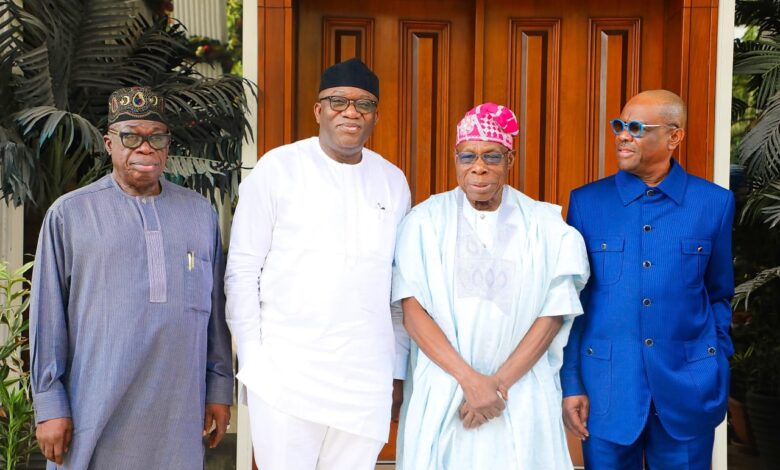
Former president, Chief Olusegun Obasanjo, has called for the deepening and sustenance of democracy in the country, ahead of the 2023 poll.
Delivering a paper entitled, ‘Respecting the Principles of Democracy’, the ex-president, who was one of the eminent speakers at the occasion, noted that Nigeria’s democracy has gone through twists, dives, and turns since political independence in 1960.
The venue was the 2023 Port Harcourt International Conference sponsored by the Rivers State Government, with the theme: ‘Deepening Democratic Culture and Institutions for Sustainable Development and Security in Nigeria”, held at the Obi Wali International Conference in Port Harcourt yesterday.
According to the ex-president, the best of the country’s history has been the sustenance of democracy since the military transfer of power to an elected government in 1999.
Presenting his keynote address, Obasanjo, however, observed that there may be reasons to doubt how many lessons the leaders and followers had drawn from the country’s past, and how far they are willing to go to deepen, widen and strengthen democracy and democratic practice in the country.
The former president declared that rather than expected, how the political class has practised democracy has deepened contradictions, negative coalitions, distrust, disloyalty, and unpatriotic tendencies within and between communities and constituencies all over the country.
The meaning of this development, according to him, is that there is a deep structural and philosophical problem that must be dealt with.
He informed that if the practice of democracy is superficial and opportunistic, as well as designed to pursue a struggle for limited objectives, it would precipitate variants of fractured engagements that cannot address the structural and philosophical contradictions and challenges.
Obasanjo’s words, “In fact, the order of the day would be community against community, religion against religion, leader against the leader. Ordinary citizens are then dragged into the directionless, meaningless, and opportunistic personal or narrow ambitions of leaders.
“The result will be confusion, diffusion, distraction, and possibly leading to separation and disintegration.”
He stressed that democracy is possible in Nigeria and the people can build a culture of democratization, despite the odds.
The ex-military and civilian head of state, however, insisted that Nigerians must recognise and accept the fact that it is an evolutionary process with principles.
“Without retracing our political steps in the right direction, the current process will either not produce the right leaders, or it will leave so many broken blocks on the path to governance and attract resources and energy away from the task of rebuilding Nigeria and consolidating our democratic practice.
“The result will be that democratic quagmire, increased corruption, insecurity, and survival of the fittest, richest, and better connected, with little or no recognition of merits,” he said.
The implications, Obasanjo stated, is that the cost of such a scenario to our present and future can best be imagined. I pray that God will grant us the wisdom to do what is right for our country and people at all times and more so now.”
Naira redesign: Gbajabiamila threatens Emefiele with warrant of arrest if…
Also speaking at the parley, Rivers State Governor, Nyesom Wike, urged Nigerians not to allow the 2023 general elections to fail.
Allowing such failure, he said, will increase political polarisation, exacerbate social fault lines, and set Nigeria’s democracy backward.
The governor noted that barely one month away, Nigerians are hoping and praying for the 2023 general elections to herald the deepening of democratic culture, the rule of law, and good governance in the country.
But the opportunity to elect a new president and 30 state governors, he stressed, should be a success “because it will consolidate and strengthen the roots of democracy in the national life of Nigeria.”
Wike said, “In a democracy, periodic elections are the only legitimate means for the peaceful transfer of power from one party to another. Since 1999, Nigeria has had six general election circles, but none was considered substantially clean and fair.
“The outcome of the 2003 general elections was rejected at different levels by the opposition and the losers and litigated up to the Supreme Court. The outcome of the 2007 elections led to protests, riots, the loss of several lives, and the destruction of property in particular sections of the country.”
The governor recalled that even ex-president Musa Yar’Adua had promised necessary electoral reforms when he publicly denounced the process that brought him to power “because it was severely flawed.”
Wike also stressed that the 2011 general election also suffered a similar experience and was litigated by the opposition to the Supreme Court.
He said, “None of the defeated contestants believed they lost fairly and blamed the umpire, the security agencies, and politicians for undermining our democracy with brazen electoral fraud.”
The governor noted that the 2015 general election, though considered rigged, recorded some improvements with the use of the smart card reader and the emergence of opposition candidates as the winners of the presidential election.
Wike added that the 2019 general election was equally problematic and rejected as highly compromised by the opposition and litigated up to the Supreme Court.
He noted, “In Rivers State, we battled the military in the 2016 and 2019 re-run and general elections with pure courage and determination to secure our victory and retain our mandate with the sweat and blood of innocent citizens.”
Wike pointed out that when the government compromises the integrity of elections through election management agencies, it denies citizens their constitutional right to elect the leaders they want and can hold them accountable.
Conversely, he emphasised, when elections lack integrity, the leaders who emerged from outside the people’s will are illegitimate.
Speaking further, the governor said the new electoral law, especially with the provisions of the use of technology, holds the prospect for a brighter democratic experience for Nigeria if implemented effectively.
However, he stressed that beyond the legal regime, political parties’ internal practices and external electioneering behaviour must conform to democratic norms and standards.
In his remarks, former Ekiti State governor, Kayode Fayemi, who was the chairman of the occasion, said the theme of the conference addressed itself to the imperative of enhancing democratic governance to the benefit of Nigerians and the country.
He observed that Nigeria’s democracy is bedevilled by a lack of party-based politics, issued-based politicking, untamed political violence, winner-take-all mentality, growing influence of money in politics, exploitation of loopholes to subvert the will of the people and social media, as well as spreading of fake news.