By Cross Udo, Abuja
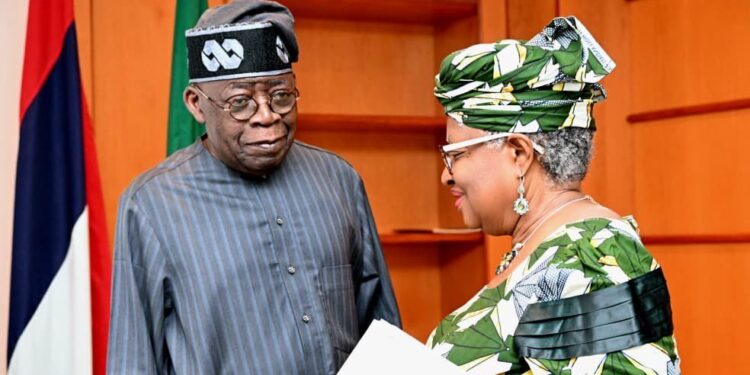
The Director-General of the World Trade Organisation (WTO), Dr Ngozi Okonjo-Iweala, has commended the administration of President Bola Tinubu for the economic reforms it has undertaken, describing them as steps that have helped to stabilise Nigeria’s economy.
She stressed, however, that the next crucial phase must focus on accelerating growth and building social protection systems to cushion the effects of ongoing reforms.
Okonjo-Iweala, a two-time former Minister of Finance and Coordinating Minister of the Economy under President Goodluck Jonathan, made the remarks on Thursday after a closed-door meeting with President Tinubu at the Presidential Villa, Abuja.
She had earlier joined First Lady, Senator Oluremi Tinubu, to launch a landmark Women Exporters Fund.
The fund, jointly managed by the WTO and the International Trade Centre (ITC) in Geneva, is designed to boost Nigerian women entrepreneurs by providing financial backing, technical assistance, and market access support.
*Discloses 146 Nigerian women entrepreneurs qualify for WTO exporters fund
According to Okonjo-Iweala, Nigeria’s inclusion in the initiative underscores the country’s competitive edge, as it was selected alongside only three other nations worldwide.
“Out of 67,000 Nigerian women who applied, 146 were chosen as beneficiaries,” she revealed. “This is just the beginning. The programme has the potential to expand Nigeria’s economic base, create jobs, and boost household incomes.”
Providing further breakdown, she explained that 16 winners, under the “Booster Track,” already operate thriving businesses that will be scaled up with 18 months of technical and business support from the WTO, ITC, the Federal Ministry of Industry, Trade and Investment, and the Nigerian Export Promotion Council (NEPC).
An additional 100 beneficiaries will each receive $5,000 in direct funding and one year of business development support, while the remainder will get tailored assistance to strengthen their enterprises.
On Nigeria’s economic direction, Okonjo-Iweala maintained that stability is the foundation upon which sustainable growth must be built. “You cannot improve an economy unless it’s stable,” she said.
“The President and his team have worked hard to stabilise the economy. The reforms have been in the right direction. The next step is growth, and alongside that, building social safety nets so those feeling the pinch of reforms can get support.”
Economic watchers note that since taking office in May 2023, President Tinubu has implemented far-reaching fiscal and monetary reforms, including the removal of fuel subsidies, exchange rate unification, and measures to attract foreign investment.
While these steps have earned praise from multilateral institutions like the IMF and World Bank for fostering market stability, they have also triggered inflationary pressures, particularly on food and transport, prompting calls for targeted relief measures.
Okonjo-Iweala emphasised that growth, job creation, and income expansion must go hand-in-hand with measures to cushion the impact of these policies on vulnerable Nigerians.
She expressed optimism that with continued reforms, robust safety nets, and sustained investment in sectors like digital trade and export development, Nigeria could unlock its vast economic potential.