From Cross Udo
The Federal Government yesterday said investigations carried out in different parts of the country showed that the problem of out-of-school children is not just a northern problem but a national calamity.
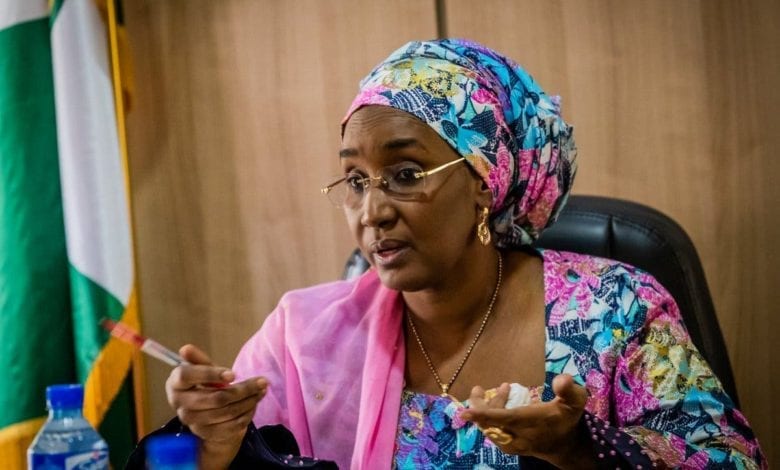
The Minister of Human Affairs, Disaster Management and Social Development, Sadiya Umar Farouk, stated this during the weekly ministerial media briefing organised by the Presidential Communications Team, at the Presidential Villa in Abuja.
The country has over 10 million out-of-school children that had been thought to be mainly in the north, but the malaise, according to the minister, cuts across the six geopolitical zones of the country.
She said a recent survey carried out in Makoko, Lagos, Enugu, and Jos, revealed that the situation is widespread as there are about 7,000 such children in Makoko alone.
Asked if the school feeding programme of the Federal Government had impacted positively on the country by reducing the number of out-of-school children, she said feeding programmes have led to increased school enrolment.
The position of the Minister was confirmed by the Coordinator of the National Social Investment Programme (NSIP) Umar Bindir, who provided the figures, saying there was the need to make people understand that it is a national problem.
He said, “Some people here if you talk about out-of-school children, they think you are talking about almajiri in the north. Some people think it’s a religious or a Muslim thing. But I can tell you in this programme, we have established it as a national issue.
“We sent a team to Lagos. They went to Makoko, they met 7,000 out-of-school children picking things from the dirt. The guy came shaking. We sent another chap to Jos, he came shaking also. We sent another guy to Enugu, and for the first time, everybody realised that out-of-school children are a national problem.”
Speaking further on the exit programme for N-Power, which has become a source of controversy recently, the Minister affirmed that government has a plan of putting about 300,000 applicants on a training programme, while the Central Bank of Nigeria (CBN) will provide them the loan.
She said: “We have 500,000 that have been on the programme with Batch A and Batch B being on the programme for four years and two years. Batch A was on the program for about four years and we were giving them N30,000 stipends monthly. And Batch B benefited for two years.
“So yes, the N-power beneficiaries have benefited because these are people who were not employed who had nothing to do, but were engaged and were being paid stipends to use to earn a decent living.
“On the exit programme. Yes, we have an exit strategy, which we partner with the Central Bank of Nigeria. And out of this 500,000, about 300,000 indicated interest to be put on an exit programme where you can be trained on different skills, skills of their choice, and they will be given loans by the Central Bank of Nigeria, for them to start their businesses.
“This we have gone far. We are in the process of training those that have indicated interest. And I’m sure before the end of this quarter, these people will be given these loans by the CBN. As a government agency the ministry, we do not give loans. So, we have to partner with those institutions that can do that.
“Unfortunately, some of these people were not very wise in their savings, but for anybody serious, most of them have saved. About 109,000 of the N-Power beneficiaries have become entrepreneurs. They are now employers of Labour and we have evidence of that which can be provided to you.
“This is a very laudable programme, and people have benefited and people are being supported. And we have an exit strategy. And we are on and it’s a continuous process.”
On the Northeast insurgency and other crises, around the country, Hadiza Farouk maintained that the issues have given rise to the need for more humanitarian assistance.
But she warned against allowing international donor agencies to lead the process, noting that the federal has now evolved a framework to ensure local control of the process.
She explained: “However, the internationally led humanitarian activities posed a challenge as the experience from other disaster-challenged countries had shown that a situation where international donors and international non-governmental organizations are drivers of international humanitarian responses in a country portends danger and future of uncertainty.
“Rather, ownership of humanitarian actions by national and local actors especially the government, local government taking the lead supported by other local actors is the way to a quicker, effective, result-driven and sustainable response to humanitarian crises. This birthed the localization framework
“This localisation framework will ensure locally-led humanitarian intervention in Nigeria, significantly shape the response of all stakeholders especially in forging the partnership that is most conducive to localisation.
“And it was developed as a result lessons learned by all stakeholders involved in humanitarian action in Nigeria in the last three to four years and in summary, engagement of local NGOs in the delivery of humanitarian assistance will ensure access in hard to reach areas as well as reduce associated fears by the United Nations agencies and other humanitarian organisations.”
WHO reports first polio outbreak in Africa in years
The Minister described as an elitist assertion that the administration’s N5,000 monthly national conditional cash transfer is insufficient to lift Nigerians out of poverty, adding that the government discovered through direct contact with the beneficiaries that the money has helped the poor and vulnerable of society to escape from their dire situation even as some have been able to save from the amount.
Fielding question on whether N5000 amid the present economic realities in the country, can lift anyone out of poverty, she said, “If you look at the people that you are taking this intervention to, N5,000 means a lot to them because these are poor and vulnerable households and it changes their status, but for you and me, N5,000 is not even enough for us to buy recharge card, that’s the difference.
“But for these poor people in the communities, you have seen, they were able to save out of that N5,000, if it’s not making any impact, if it’s not changing their economic status, I don’t think anybody will force them to contribute that N1,000 to provide that vehicle for their use. So, N5,000 goes a long way.
“When people say N5,000 does not save people, that is an elitist statement, honestly because we’ve had causes to go to the field, and we have seen these people that when you give them this N5,000, they cried and shed tears because they’ve never seen N5,000 it in their lives.
“So, it goes a long way, it changes their status and by that, it lifts them from one stage to another.”