Petroleum Industry Act: Oil of the Matter
Unending feud over new law

•Stakeholders, Niger Delta Groups allege marginalisation
•‘It’s an attempt to revamp economy’
By Kassim Omomia, Andy Asemota, Jude Idu and Ben Ogbemudia
Discordant tunes have continued to greet the Petroleum Industry Bill signed into law by President Muhammadu Buhari.
For some Nigerians, especially those who welcome the new law otherwise called the Petroleum Industry Act, the fresh initiative will help to lift the nation to loftier socio-economic heights.
They also claim that it remains the boldest attempt aimed at revamping the country’s petroleum sector.
However, many other stakeholders argue otherwise, positing that the PIA as presently packaged would not alter the ‘complexion’ of challenges facing the country unless it is rejigged.
In fact, this school of thought argue particularly that the three per cent allocation offered to the oil producing communities was not only paltry but would also not offer any significant change in the South-South.
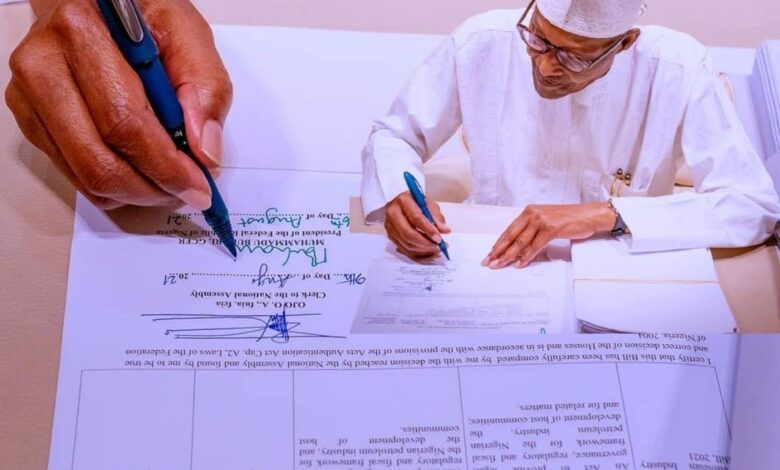
The President signed the controversial bill into law last Monday a few days after his return from medical vacation in the United Kingdom.
The National Assembly had last month, before embarking on recess, passed the bill which allows oil firms to contribute three per cent of their annual operating expenses to their respective Host Communities Trust Fund (HCTF).
Hitherto, the bill remained the longest piece of legislation in the annals of the country’s legislature, having stayed in incubation for about 20 years. It was first introduced in 2000 during the former President Olusegun Obasanjo administration.
Singapore to help with Afghan airlift but hopes to see U.S. ‘resolve’
Appraising the issue over the weekend, a university teacher, Prof. Uche Uwaleke, said the newest act in the country would open up the long troubled petroleum sector for more investments, boost economic growth, release more licences to operators in the sector, as well as facilitate the establishment of more refineries, among other benefits.
The financial explained, “I think the assent to the Petroleum Industry Bill at long last will open up the petroleum sector for more investments thereby boosting economic growth.”
“The Act makes provision for speedy granting of licenses to investors especially in the downstream sector. This is likely to translate to the establishment of more refineries in Nigeria which will go a long way to meet local consumption with prospects of ending fuel importation and the loss of foreign exchange associated with it”.
He noted that granting more licences and having more refineries would strengthen the value of the naira in the long run as well as create job opportunities in the petroleum value chain, if foreign exchanges are freed up.
Uwaleke, who said the law also provided for the application of cost reflective tariffs by operators and the commercialization of NNPC Limited, however cautioned on the overall implication which is removing fuel subsidy that has been causing incalculable damage to the nation’s economy.
The academic added, “The reality is that fuel subsidy is causing incalculable damage to the economy. A situation where the government spends close to N1 trillion subsidising fuel consumption is counter productive”.
He warned that government could not longer support financing fuel subsidy because of the rising fiscal deficit as well as the growing corruption in the scheme.
He posited, “First, the fiscal situation of the government can no longer support it given the rising fiscal deficit.
“Again, it has been one scheme that is fraught with corruption given the fact that there is no accurate figure of volume of domestic fuel consumption”
Also, an industrial expert, Mr. Michael Faniran, described the presidential assent to the bill as a welcome development.
According to him, many Nigerians are happy with the President and the National Assembly even though it took a long time to get this achieved.
Faniran, who said the Act would help to create a more efficient industry with independent governing bodies, added, “For the upstream and the downstream, the governing bodies have clear aims and objectives. It is my hope that this will promote transparency as one person will not be a policy maker and a regulator”.
He noted that the new law would attract the needed investments as the federal government direction had become clearer.
Faniran said, “Now, there is clarity. It is not whether it is good or not; it is now clear where the government is going. So, anybody who wants to invest now knows where the government is going”.
Similarly, the Centre for Transparency Advocacy (CTA), said the passage was a good news for the industry and the country.
Speaking through its Executive Director, Faith Nwadishi, the CTA congratulated Nigerians, especially, members of the civil society for their support, saying the initiative is a positive step towards having a reformed petroleum industry.”
Nwadishi said, “Generally, we are happy that sections, 83, 104 to 108 of the new bill (the House of Representatives version) make provisions for contract transparency, disclosure, and outlaws gas flaring, among other things.
“Section 83 sub 3-5 on contract transparency provides that ;3(a) the text of any existing contract, licence or lease and any amendment or side letter with NNPC shall – A) not be confidential.
“Section 104 of the bill makes gas flaring an offence except in the case of emergency exemption granted by the commission or for an acceptable safety practice. Offenders are liable to a fine and the fine will be used for investment in midstream gas infrastructure within the host community on which the penalties are levied”.
But eminent stakeholders and groups, including the Urhobo Progress Union (UPU) and the PAN Niger Delta Forum (PANDEF) have kicked against the Act.
Others, who expressed reservations about the new law are legal luminary, Chief Mike Ozekhome; President, UPU, Chief Joe Omene; former President, Ijaw Youth Council, Dr. Chris Ekiyo, and a federal lawmaker, Dennis Idahosa.
The Act, they insisted, particularly mortgaged the oil rich Niger Delta.
Ozekhome, said the Act was a ruse targeted at stalling the country’s progress.
He added,“The Act constitutes a direct assault on age-long cherished principles of federalism and the doctrine of separation of powers, most ably propounded in 1748 by Baron de Montesquie, a great French philosopher.
“How can an Act of Parliament, rather than assuage and ameliorate the sufferings of a beleaguered people, further compound them by reaffirming the people’s perilous status as slavish hewers of wood, drawers of water, masseurs of ego and sideline onlookers in the exploitation and use of their God-given wealth through their natural resources? The Act is nothing but a mere totalitarian and draconian piece of legislation designed to rob Peter to pay Paul”.
PANDEF, which spoke through its Publicity Secretary, Ken Robinson, described the Act as “callous”.
Robinson said, “It is quite unfortunate that President Muhammadu Buhari went ahead to assent to the Petroleum Industry Bill despite the overwhelming outcry and condemnation that greeted its passage by the National Assembly, especially with regard to the paltry three per cent provision for the Host Communities Development Trust Fund and the brazen appropriation of an outrageous 30 per cent of NNPC Ltd profit for a dubious, nebulous Frontier Oil Exploration Fund.”
Nigerians also expressed disappointment with the bill on the social media with @FS_Yusuf_ saying, ”So President Buhari went ahead to sign that unjust and insensitive Petroleum Industry Bill (PIB) into law? A bill that defrauds the people of Niger Delta whose environment and health are already destroyed? This is preposterous! This is unacceptable!”
The founder of BudgiT, Seun Onigbinde, said, “Congratulations Nigeria on the PIA. There are still issues in that PIA, especially on NNPC operational efficiency, liability management and divestment. The nebulous “host community” tag is also an issue”.
In the same vein, energy expert and national chairman of the Action Democratic Party (ADP), Yabagi Sani, who hailed the Act as a landmark achievement, however, declared that it would not lift the country to greater glory.
Noting that the country’s laws are rarely respected, Sani said that corruption had impacted negatively, especially on the petroleum sector.
He said, “Nigerians will be have opportunity to buy shares in the unbundled NNPC but the issue is who are going to run the companies when they eventually emerged? If we are going to run those entities where government has stakes the way we are running the agencies, believe you me, we will be back to square one.”
According to him, the substandard measuring system in the sector has been making the country a laughing stock in the international community while making a case for measures to plug the loopholes.
Sani added, “All the governance, legal and accountability aspects that have been put in glossy manner in the PIB are fine but what I am saying is what has the Department of Petrol Resources (DPR) been doing to ensure that we have working meters in the industry so that we can begin to know how much is being realized and how much we are spending.
“What have all these agencies been doing? It seems to me that the more things change, the more they remain the same. The people to run the the companies that will emerge is very important if you know the amount of losses coming from the industry.
“Until government wakes up and begins to do what all government do all over the world, we will still be where we are or in fact worst off because the problem lies in the people who are going to implement the PIA”.
The UPU president, Omene, who said he was not surprised that Buhari hurriedly signed the bill into law, however, blamed lawmakers from the South-South for not putting up strong representation for the region.
“Well, we have rejected some of the critical aspects of the PIA and we will continue to reject them. There is anger everywhere in the region. The truth is that they have had their way now, but with time we would laugh the last laugh”.
Also, a former President of the Ijaw Youth Congress, Dr. Chris Ekiyo, said the signing of the Act by President Buhari, showed the contempt the Federal Government had for the people of Niger Delta.
Ekiyo, who spoke to one of our correspondents, wondered why the President hurriedly signed the bill even when many Nigerians contested its content.
Ekiyo, particularly frowned on the three per cent allocation to the oil bearing communities, saying the gesture was unfortunate.
He said, “For 56 years, the region has suffered desecration of its sacred places like worship centres, lands, streams, lakes and severe environmental degradation without remediation.
“While the government and people of Zamfara State are allowed to control 100 per cent of their gold resource (fiscal federalism applying in Zamfara State), what the people of the Niger Delta could get from their own natural resource is a paltry three per cent for host communities and in contrast, a whopping 30 per cent for exploration of frontier basins”.
Expressing his displeasure, a member representing Ovia Federal Constituency at the National Assembly, Dennis Idahosa, said the House of Representatives, agreed on five per cent for the oil bearing communities.
He blamed the lapses on the Senate, which reduced the allocation to three per cent.
Idahosa said, “What we discussed in our chamber was five per cent to the oil producing communities. Unfortunately, the people in the Senate voted against it and made it three per cent. Even as the President has signed the bill into law, I still vehemently reject the three per cent for host communities.
Toeing the path of Idahosa and other stakeholders, Uwaleke, who faulted the three per cent allocation to oil bearing communities, noted that it was not properly tidied up.
Uwaleke said, “Though the PIA attempted to curb pipelines vandalism and restiveness in the Niger Delta through various provisions to host communities, unfortunately, that aspect of the law was not properly tidied up as the percentage of oil revenue initially proposed for these communities was reduced to three per cent”.
He also noted that the PIA did not make provision for eventual partial privatization of NNPC to guarantee a more efficiently-run company.
Meanwhile, as stakeholders seek the review of the Act, the Senate President Ahmad Lawan, said the upper legislative chamber would not return to the new law in a hurry.
He argued, “We will not rejig the brand new Petroleum Industry Act until its implementation reveals the need to effect some amendments.
“It is when we start the implementation, you will start to see where you need to rejig or bring some amendments but I will advise that, for now, we should not be emphasizing the problems.
“This Act is something we all have to address with some optimism and hope that it would be okay because we are human beings; no act of human beings can be perfect. So, when we are able to see issues, the National Assembly is there; bring them for amendment.
“Even the most difficult issues can still be brought to the National Assembly if it is worthwhile to do so but I believe that there is no need for us to be emphasizing the problems rather than the prospects.”
Recall that the Presidency last Tuesday said President Buhari by signing the bill into law was responding to the yearning of the majority of Nigerians.
It added that the new law was still open to review and amendments.
“The law is the making of all Nigerians and not the president alone. It is not cast in stone; it can be changed.
“As we move forward, there can even be more aspects of the law that recommend themselves to review”, presidential spokesman, Garba Shehu, had said.