By Cross Udo, Abuja
The emerging political rapprochement between Peter Obi and Oyo State Governor Seyi Makinde could face four major hurdles as opposition leaders explore a possible alliance to challenge President Bola Tinubu in the 2027 presidential election.
The obstacles, identified by Senior Special Assistant to the President on Media and Special Duties, Tunde Rahman, include personal ambition, zoning, party structure and a trust deficit among opposition political actors.
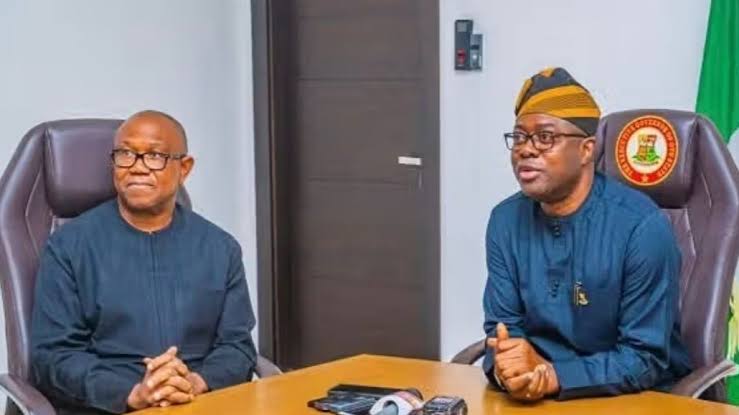
Rahman’s assessment comes amid growing speculation over a possible opposition realignment following a private meeting between Obi and Makinde in Ibadan and their subsequent joint appearances at political events.
Obi, the presidential candidate of the Nigerian Democratic Congress (NDC), recently attended the inauguration of Makinde’s Allied People’s Movement (APM) presidential campaign office in Abuja, an appearance that heightened speculation about possible cooperation between the two politicians.
Rahman described Obi’s appearance at the campaign office of another presidential aspirant as unusual, saying it had fuelled questions about whether the two politicians were working towards a common political objective.
He cautioned, however, that the development should not yet be interpreted as a concluded coalition.
“The Obi-Makinde rapprochement comes after a plan by G-100, an amorphous group of opposition stakeholders advocating a united opposition front,” Rahman said.
The emerging relationship is particularly significant because the two politicians followed different political paths during the 2023 election.
Makinde, then a Peoples Democratic Party (PDP) governor, was associated with the G-5 governors whose political position complicated the PDP’s presidential campaign, while Obi emerged as the Labour Party’s leading third-force candidate.
Rahman said the political realities ahead of 2027 could be prompting opposition figures to reconsider the consequences of contesting separately.
But he questioned whether the opposition could overcome individual ambitions and agree on a structure capable of translating political cooperation into electoral strength.
The first challenge, he said, is the advantage enjoyed by an incumbent president. According to Rahman, Tinubu would enter the 2027 contest with the benefits of incumbency and the ability to campaign on the administration’s economic reforms and infrastructure projects.
He cited initiatives including student loans, CrediCorp and compressed natural gas, as well as what he described as improvements in economic indicators, as issues the APC would likely deploy in its campaign.
The second hurdle is the historical difficulty of defeating a sitting president in Nigeria. Rahman noted that Goodluck Jonathan remains the only incumbent president to have lost a re-election bid, following the opposition coalition that produced Muhammadu Buhari’s victory in 2015.
He questioned whether the opposition could recreate such an alliance in 2027, given the different political interests and ambitions of the current actors.
Party structure represents another major challenge.
Rahman argued that the APC currently possesses an extensive grassroots structure and significant gubernatorial influence, factors he said could prove decisive during the election.
He also noted that the opposition’s calculation that votes secured separately by Atiku Abubakar, Obi and other candidates in 2023 could simply be combined in 2027 was unrealistic.
“Votes secured by different candidates in one election cannot automatically be added together in another,” he said.
For an opposition coalition to become electorally viable, Rahman said its leaders would need to agree on a consensus presidential candidate early enough, attract substantial gubernatorial support and build a nationwide grassroots campaign structure.
He suggested that an alliance capable of securing the backing of between eight and 10 governors would significantly alter the political equation.
The final hurdle is trust among the opposition leaders, whose political interests have often diverged despite their common opposition to the ruling APC.
The emergence of Obi and Makinde as potential collaborators therefore raises a larger question over whether the opposition can subordinate individual presidential ambitions to a collective strategy.
Rahman said the cost of living, food prices, transportation, electricity and insecurity would also be critical issues in the 2027 contest, potentially providing the opposition with powerful campaign issues if economic or security conditions deteriorate.
He nevertheless acknowledged that the Obi-Makinde rapprochement could represent a significant development if it develops beyond meetings and public appearances.
“If they can agree on a framework and bring in more governors, the coalition becomes serious. If not, it remains mere optics,” he said.
For now, the emerging alliance remains fluid, with no confirmed arrangement on leadership, zoning or the allocation of political positions.
Rahman said the 2027 contest would ultimately be determined not only by personalities but also by structure, strategy, economic conditions, security and the ability of political parties to mobilise voters.