INEC fully prepared for Anambra governorship election – Commissioner

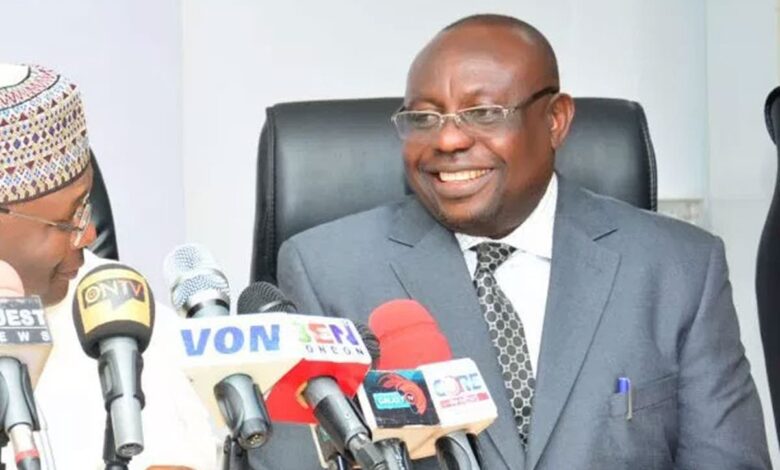
In this interview monitored by David Lawani in one of the national television, National Commissioner and Chairman, Information and Voter Education Committee, Festus Okoye, speaks on the recent empowerment of the Independent National Electoral Commission (INEC) by the National Assembly for electronic transmission of the election results, and preparations ahead of November 6 governorship election in Anambra State, among other issues.
Is INEC excited that the Senate has finally bowed to its wishes of approving re-transmission of election results?
You know the commission is a creation of the constitution and the law.
Whatever we do, we do it on behalf of the Nigerian people and many responsible corporate citizens. I believe that the Nigerian people wanted electronic transmission of election results.
And it is gratifying that the National Assembly, the Senate especially, reflected on the issue and also decided that it is important to accede to the request of the Nigerian people since sovereignty resides with the people. I think that credit should be given to the Nigerian people for whatever must have happened to civil society groups and organisations. And to the media.
We are just a responsible organisation trying to find ways and means of conducting free, fair, and transparent elections.
What is your view on Section 87 which deals directly with party primaries?
You have to look at the issue holistically, concerning where we are coming from. There were times when aspirants and candidates complain bitterly that their party’s primaries were opaque and not transparent, or that they were disenfranchised in terms of giving power to the party members.
And we now had a situation where we had direct and indirect primaries, yet they were still complaining because most political parties use the indirect method to nominate their candidates. Now, as far as the commission is concerned, the issue of the conduct of party primaries is primarily and fundamentally within the domestic compass and realm of the various political parties.
But in conducting their primaries, they are under the legal and constitutional obligation to conform to the law, especially Section 285 of the 1999 Constitution, and also Section 87 of the Electoral Act 2010, as amended. Now, the challenge here, I understand, is that from the point of view of the commission, issues around the conduct of party primaries surround the myriads of complaints that attend the conduct of party primaries.
If you look at the 27 bye-election and off-season elections that we conducted at the end of the 2019 general election, you will see that not even a single one has been upturned on the ground of INEC processes and procedures. Most of the challenges revolve around the conduct of party primaries and also around the nomination and qualification of candidates.
Now, the basic issue and challenge in the conduct of direct primaries and the mandatory nature of the provision that INEC must, or shall, is to monitor party primaries or conduct of direct primary, which is huge in cost outlay.
And also, the huge number of personnel that will be deployed for this particular exercise. Now, if you take, for instance, that a political party decides to conduct a direct primary and insists that every party member would vote and that this voting would take place in polling units created by INEC, the implication is that the commission must deploy monitors to 176,996 polling units to monitor the conduct of these direct primaries.
Not only that, if the party decides that it is going to conduct presidential primary differently, or governorship primary separately, National Assembly separately, and state assembly separately, the implication is that the commission must go back four times.
And if you multiply that by the number of political parties we have, which is 18, you will see the huge number of personnel that will be deployed and the huge cost outlay. The implication is that in political parties conducting direct primaries, we are conducting a major election, a full election. Because almost the number of personnel that you need for the conduct of elections is the number you need to conduct direct primaries.
But as an organisation, if the law is passed, because I understand that under Section 228 of the constitution, the National Assembly can make laws regulating and relating to the internal democracy of political parties; if the law is passed, we are under a legal and constitutional obligation to comply. And we will find ways and means of acceding to the dictates of the law.
When the NCC first met with the lawmakers, a lot of people thought they should have done so with INEC first, until your report came out…
In the entire conversation, as you know, concerning the e-transmission of election results, the commission was completely left out.
The view of the commission was never sought. People were trying to shave our heads behind our backs, and we said no. This is our position. This is our narrative. And let the Nigerian people look at our narrative, issues and what we have done in the past, and what we intend to do in the present. And also dispels some of the misconceptions relating to the issue of electronic transmission of results. It shows that the Nigerian people will have a clear idea.
Also, members of the National Assembly will also have a clear idea of where we are, what we have done in the past, and what we are capable of doing now. What we did was to join the debate and also push our narrative so that other people do not do the narrative on our behalf and misrepresent our position as a commission.
Don’t you think the removal of Clause 52 of subsection 3 was an attempt to erode and make a mockery of the autonomy of INEC? The commission has said more security will be needed to conduct the November 6 governorship election in Anambra.
As you are aware, on the 23rd of May, 2021, our office in Akwa Ibom was attacked. We lost over 60 per cent of non-sensitive materials already deployed. And we lost six of our utility vehicles. We lost over 300 generating sets mopped up from all the registration areas.
We lost our stores. Our offices were burnt and vandalised. We have either reconstructed or repaired all these facilities. So, the non-sensitive materials have already been moved back again to Akwa Ibom. We moved some of them from our zonal stores, and the ones that had to be replaced afresh have been replaced.
The non-sensitive materials have already been batched. They are being moved to the local government areas, preparatory to being deployed to registration areas. So, we are moving at pace for the conduct of the elections. All the electoral officers have been trained.
All the assistant electoral officers have been trained and security agencies that are also going to train the trainers cascading to that level have also been trained. We have begun the training of the presiding officers and assistant presiding officers. So, as far as the commission is concerned, we are moving ahead with the election.
Postponement is not even an option. Because postponement may lead to very grave constitutional consequences, and we are not ready to go in that direction. Now, the security agencies. We have had meetings with them both at the national, state, and local levels. We have also interacted and interfaced with the leadership of the political parties.
And the consensus is that everything should be done to make sure the election is held as scheduled. So, the security agencies are deploying professionally to our various offices, and we want to make sure that all the ad-hoc staff that will be deployed for this election are properly and fully protected; and that our materials are protected.
The commission said it has 2.5 million voters. How assured is their safety on that day, because most campaigns are now being done offshore?
I think the political parties and the candidates in this election also have a responsibility to show courage, determination, patriotism, and also to reassure their supporters that they can come out and vote and they will be protected on Election Day.
The security agencies at the lower level are to also reassure people at the local level that their safety is guaranteed on Election Day. I believe that the political parties should also do the needful because they are the primary beneficiary of this particular election; one of them will be declared as the winner of the election. A candidate of one of the political parties will be declared as the winner of the Election Day as governor and deputy governor of the state. So, they should show courage.
They should show determination. They should show some level of patriotism to make sure that they do whatever it takes to guarantee some levels of peace, stability, and some level of safety in the electoral process.
What are the certainties of technological devices?
What we have done is what I called technological convergence. We have introduced the INEC Voter enrolment device. That enrolment device is what we are using for the continuous voter registration exercise.
And we are using this particular device to capture the fingerprint of registrants, and also to capture their facials. In the Anambra governorship election, this INEC voter enrolment device will now become what we called the Bi-modal voter accreditation system.
We are going to use it for accreditation. So, when a voter gets to the polling unit, we will, first of all, see whether the Bi-modal accreditation will recognise the fingerprint, but if it is unable to recognise the fingerprint, it will now capture the facials.
In all of this, what should the electorate come to the polling units with on the day of the election with this new device?
A voter coming to the polling units must come with his or her voter’s card. Then we are also going to print the voters register for each polling unit. So, one of either assistant polling officers one or three will check the permanent voter’s card to be sure that the voter is in the right polling unit and then check the voters register to make sure the voter is properly registered.
Then, we will now use the BVAs to capture the biometrics of the voter. If the voter’s fingerprint passes, the voter will now be given a ballot paper to go and vote. If the fingerprint fails, then we will capture the facial. If the facial fails, the implication is that the person is either not the owner of the permanent voter’s card or the person wants to engage in multiple voting, or the person is engaging in identity theft.
We will ask the person to walk away from the polling unit. Unless a voter leaves his or her voter’s card at home, and her face at home and then comes to the polling unit other than that, we are going to capture all eligible voters on Election Day.
What measures are in place to protect the ad-hoc staff who are corps members?
As you know, we have 5, 520 polling units. And we are going to have a youth corps member as a presiding officer in these polling units.
Then the assistant presiding officer 1, 2, and 3 will be harvested from the higher institutions in the state. We have a responsibility to make sure that untoward happens to any of this ad-hoc staff that will be deployed and all other staff that will be charged with the responsibility of conducting this particular election.
What if the voters have their PVC and accreditation didn’t work with the BVAs?
You know each PVC holder has a CR code at the back. The BVAs also can read the Cr code at the back of the voter’s card, and that will help to bring up all the data relating to that particular voter. If your fingerprint fails and your facials fail, the BVAs will read the CR code at the back of the PVC. And if it doesn’t bring out your face and your biometrics, the implication is that you are not the person you purport to be.