Women-farmers in Oke-Ogun protest, allege diversion of inputs to non-farmers amid loss of produce
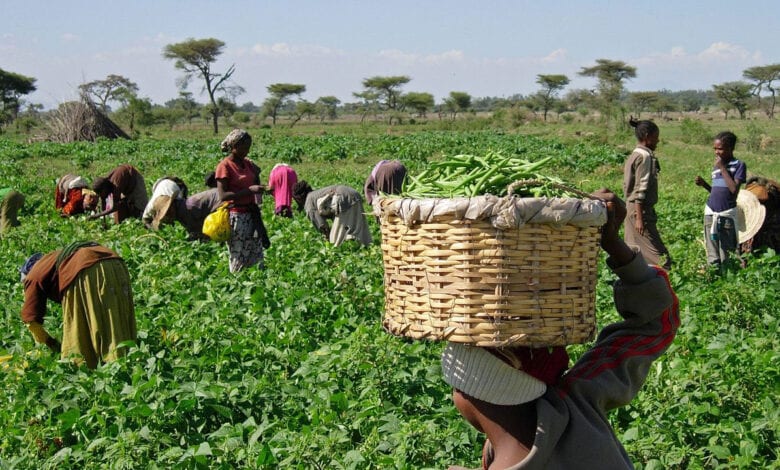
A Special Report by Ibukun Emiola, News Agency of Nigeria (NAN) Bad roads, lack of access to modern farm implements, lack of funds, insecurity and climate change notwithstanding, women-farmers in Oke-Ogun, Oyo State, have alleged that inputs meant for them are diverted to non-farmers within the area.
According to them, women farmers’ travails in this region are worsened by the COVID-19 pandemic, in spite of various programs and interventions the governments at both state and federal levels provided.
They claim they have yet to receive any form of support from the government at the state and federal level, insisting that the challenges facing smallholder women- farmers in the area are enormous.
But the Oyo State government Special Adviser to the Governor on Agribusiness, Dr. Debo Akande, said the state had provided palliatives for more than 9,000 farmers among other supports for smallholder farmers in the state.
“The budget is not just going into just anything. It is going into specifics in the area of agricultural infrastructure for us to be able to engage in the modern way of doing agribusiness.
“Much more in what is called agribusiness are the industrial hubs. But in addition to that, there is some support that has been allocated to smallholder farmers and also young people.
“More than 9,300 smallholder farmers were supported last year by the state government with inputs.
“They are farmers that we have their records and that are biometric within the state and they were supported,’’ he said.
The Special Adviser said that the government also initiated a scheme to mitigate the effects of the pandemic on smallholder farmers.
“In addition to that, Oyo State has also subscribed to a project called N-cares, which has to do with the mitigation of the impact of COVID-19 on Smallholder farmers that would be supporting more than 6,000 farmers this year, including youths.
During the COVID-19 pandemic, the Central Bank of Nigeria (CBN) rolled out interventions to cushion the effects of the pandemic on micro, medium, and large scale businesses in Nigeria.
The interventions included a one-year extension of the moratorium on principal repayments for the bank’s intervention facilities; regulatory forbearance was granted to banks to restructure loans given to sectors that were severely affected by the pandemic.
Other measures are the creation of an N100 billion credit facility for affected households and small and medium enterprises through NIRSAL Microfinance Bank.
A visit to some smallholder women farmers in the Oke-Ogun region of the state did not show any result of these incentives as many of them complained of neglect in the scheme.
Even in Iseyin, Iwajowa, Saki East, Irepodun, and Olorunsogo local government areas of the region, women farmers said that the palliatives meant for farmers were given to non-farmers.
But Akande insisted the state budget for agriculture for 2021 was the third largest of all the overall budget.
Gov. Seyi Makinde of Oyo State also said that his administration would remain determined to utilize agriculture to drive its economy and it had allocated 4.43 percent of the total budget proposal to the agricultural sector.
For the benefit of hindsight, in the 2019 budget, there was provision for the purchase of agricultural equipment worth N50 million and other equipment at N10 million but such provisions were not made in the 2020 budget in the Oyo State Ministry of Agriculture.
Also, production of farm seedlings was put at N350 million in 2019 but no appropriation was made in 2020.
In 2020, budget estimates under the Agribusiness Development Agency, N48.5 million was slated for special projects and assignment, while N130 million was budgeted for educational programs and N3.3 billion was for empowerment in the agric scheme and N68 million was for farm development.
Findings show that average provision for the agriculture sector from 2015 to 2019 in the state has hovered around four percent according to data by the Centre for Social Justice.
The Small Scale Farmers Organisation in Nigeria (SWOFON), therefore, argues that budgetary provisions for agriculture are too small and that this hinders productivity in the agricultural sector and affects the income of smallholder farmers, especially women.
Mrs. Latifat Muritala, a smallholder farmer in Olorunsogo Local Government of Oyo State, noted that her major complaints are on funds and farming inputs.
“We do not have funds for farming and we lack the implements for doing farming work in the modern-day; various programs rolled out by either the State or federal government didn’t get to us at all,’’ she said.
Muritala, a middle-aged woman who works with other nine smallholder female farmers, also complained about the huge losses on their investments.
“We have been at a loss in recent years due to low yield. I and my colleagues spent more than N150,000 on farming and we realize not up to 50 percent of the production cost.
“We buy seeds and fertilizer from the market or those who were not farmers but who got seeds and fertilizer from the government.
Anchor Borrowers: Unity Bank extends funding to 120,000 maize farmers
“We pray that this planting season will be better than the past. We need rain for farming to go well this year.
“As it stands now, rain ought to have fallen so that cultivation would go well but we have yet to have rainfall and that was the cause of devastation to crops during the planting season in 2020,’’ she said.
Similarly, Mrs. Jemila Yunisa, another smallholder farmer from Irepodun Local Government Area of the state, said that she and many of her colleagues did not receive anything from the state government and accused the state government of diverting support to people who had nothing to do with farming.
“We didn’t receive any support or palliatives from the government to the farmers. The real farmers are not the beneficiaries here but those who pretend to be farmers, take advantage of the real farmers to get the benefits from the government.
“They use Facebook, WhatsApp, and other social media technologies to pose as the real farmers and they get the benefit,’’ she alleged.
Yunisa further said: “We take loans from cooperatives and banks and we find it difficult to repay our loan because of the challenges we are faced with.
“We leased the land we use for farming at N5000 per acre. If we leased 10 acres it means we pay N50,000.
“Lack of adequate rainfall is the number one challenge we are faced with, in 2020; we are equally faced with the issue of cattle devastating our farmlands’’.
Musilatu Ashiru, a 55 years smallholder farmer in Saki East Local Government Area corroborated this, saying “we only hear of the various government interventions but we have never received any.
“I was part of the Anchor Borrowers Scheme but in the past, we have not benefited from the scheme and when we wanted to opt-out of the scheme, they appealed to us and promised that there would be a change and the benefits would go round but till now we are yet to receive any support or benefit.
“We do hear that the government gives out seeds, fertilizers, and other support but we have never benefited from these till now.
“Those who are not into farming business receive these support and gestures; they, in turn, sell whatever they were given to farmers. Those of us in dire need of this support doesn’t receive them’’.
Mrs. Alimotu Sulaiman, a smallholder farmer in Iseyin Local Government Area also said: “We have yet to receive any benefit from the government at both state and federal level’’.
“We are doing farming business with the little money we have. The microfinance banks that promised us loans kept failing us. We filled out forms, we exhausted the passport photograph we took and they kept saying next month till rainfall stopped.
“We know of the Anchor Borrowers Scheme but we have never benefited from it. We are part of the All Farmers Association of Nigeria (AFAN).
“In fact, I hold a woman leader position there but we have yet to get any benefit from the government, we keep hearing promises’’.
Sulaiman, a 60 years old smallholder farmer, recounted how she sent all her children to get formal education with the proceeds from her investment in agriculture.
“We experienced total loss on the maize we planted last season, the same for yam and termites devastated our cassava plantations, it was providence that made us have some yields; we experienced losses due to lack of rainfall.
“We pay N50, 000 interest rate on every N250, 000 loans we secured. So we pay back N300,000 but we barely realize N100,000 from our venture in a year due to the devastation we experience,’’ she said.
Mrs. Taiwo Okunlola, a 48 years old smallholder farmer in Iwajowa Local Government Area said that she and other farmers had to employ other means of funding their agric business when help failed to come from the government.
“We have yet to receive any support from the government at all levels. We make contributions or take loans to fund our farming business
“We buy fertilizers, chemicals, and seeds we use for our cultivation. We buy fertilizer at N8,000 or we buy at N9,000 if we need it in a hurry.
“We borrow tractors to do tilling and clear our land in preparation for planting. Last year, we hired a tractor at N6,000 per hectare but this year it goes for N7,000 and we farm on 10 hectares of land,’’ she explained.
Almost all the Smallholder women farmers interviewed said they lost a significant part of their investments, sometimes up to about 80 percent, in the 2020 farming season.
These women feared that the ripple effects of their losses might affect food production in the 2021 planting season as they do not have resources.
Beyond the issue of palliatives are climate change and insecurity starring smallholder women farmers in the face in the region.
Though they said they had received various training on irrigation farming and other modern farming practices, they are unable to practicalize them due to paucity of funds.
They appealed to the government to go through their unions in identifying and supporting real farmers.
Ashiru, the leader of SWOFON in Saki East Local Government Area, said the government could identify true farmers by going through the farmers association to know the true farmers such as AFAN.
“We urge our government in all that they want to do for farmers that they should include AFAN in their plans. AFAN should have certain benefits it gets from each local government per time.
“If it gets to AFAN then women farmers under SWOFON would get their due share,” Ashiru said.
Aside from the lack of funds, other challenges facing smallholder women-farmers who constitute 60 percent of the food production chain in Nigeria, are lack of modern and women-friendly farming implements.
In view of this, SWOFON, which has been at the vanguard of empowering smallholder women farmers in its charter of demand advocated zero interest on loans for female farmers, supply of gender-friendly equipment among others.
Part of the demands in the SWOFON charter stated that there should be a review of Customary land laws for small-scale women farmers to inherit the land for sustainability.
Others are that arable farmland should be allocated to smallholder women farmers’ cooperatives and the government should commit to smallholder women farmers in the area of implementation of policies, among other provisions.
However, there have been a number of partnerships with the Oyo State government to boost the agricultural sector; one of them was by German BMZ co-funded by the European Union, the Nigeria Competitiveness Project (NICOP), a four year €10m project commissioned in 2020 with focus on the processing of tomatoes, pepper, chili and ginger, among others.
Borno: FG distributes free agricultural inputs to smallholder farmers
Another one of such collaborations in February 2020 the African Development Bank (AfDB) selected Oyo State as one of the two Strategic Agro-processing Industrial zones and the hub for industrial cassava, poultry, fisheries, crop, and livestock production.
The discussion is ongoing and will be finalized for implementation within the year, the government of Oyo State said.
Observers, therefore, note that with all these and more in the offing, the smallholder women-farmers seem to have hope, even as the state government has said it will work with medium and large scale enterprising to boost the economy of the state.
un protest, allege diversion of inputs to non-farmers amid loss of produce