By Anthony Otaru, Abuja
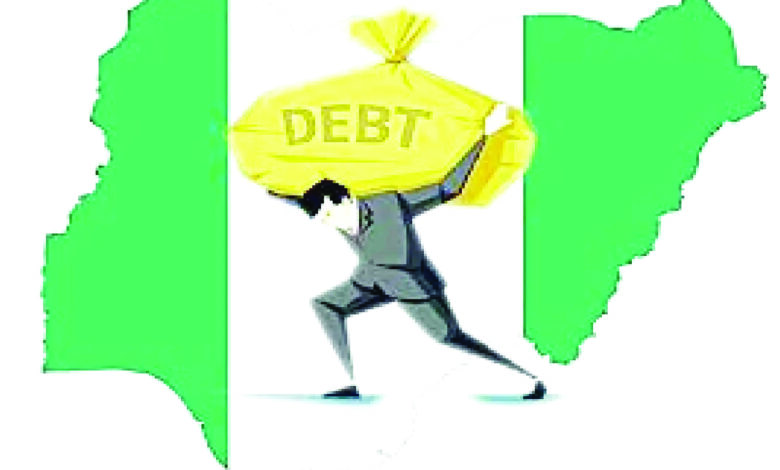
Two senior economists have described Nigeria’s reported $47 billion in external reserves as misleading in light of the country’s rising debt profile, warning that the growing fiscal burden could weigh heavily on future generations.
The economists, Prof Akpan Ekpo and Prof Sheriffdeen Tella, of the University of Uyo in Akwa Ibom State and Babcock University in Ogun State, respectively, said the focus on reserves without equal attention to mounting liabilities distorts the true state of the nation’s finances.
Nigeria’s total public debt stood at N152.39 trillion (about $99.65 billion) as of June 30, 2025, up from N149.38 trillion in the first quarter of the year.
The increase was attributed to a combination of fresh domestic and foreign loans and the impact of currency devaluation.
The country’s 2025 debt-to-GDP ratio rose to 52 per cent, exceeding the 42 per cent benchmark. Fiscal deficits, infrastructure financing and foreign exchange volatility were identified as key drivers.
In the proposed 2026 federal budget, yet to be passed by the National Assembly, debt servicing is projected at N15.52 trillion, while the budget deficit is estimated at N23.85 trillion, representing 4.28 per cent of GDP.
Although policymakers, including the Minister of Finance, Wale Edun, and the Governor of the Central Bank of Nigeria, Olayemi Cardoso, have stressed the need to reduce dependence on loans amid a hostile global financial environment, the country’s debt stock continued to climb through 2025.
Speaking on the development, Ekpo said the existence of external reserves should not be presented as a sign of fiscal comfort.
“An adage says, those who rely on borrowing go sorrowing, simple,” he said.
According to him, reserves cannot be celebrated when the economy’s structure remains fragile.
“So the reserves you have cannot be celebrated. If you have large product imports, the reserves will be depleted. Your reserves need to be protected by a massive industrial sector that produces for exports,” Ekpo stated.
He noted that the reserves largely accrue from crude oil exports, warning against dependence on a mono-product economy.
“You can borrow if you’ve done enough studies to finance capital projects that yield returns to pay back the debts. But the reserves you have accumulated over the period come from crude oil exports, and you cannot continue to rely on a mono-economy based on oil revenues because they are subject to market volatility. You have no control over it in the international market; it rises and falls,” he said.
Ekpo urged the government to promote a productive economy and reduce wasteful spending.
“All we are advocating in the long run is that government should encourage a productive economy where you assist the manufacturing sector to grow,” he said.
“What Nigeria needs now is to ensure that the government diversifies the economy, cuts down costs, is transparent and only contracts loans to finance capital projects that will pay back the debts. Unfortunately, we are not transparent and do not consider the next generation.”
He warned that the burden of current fiscal decisions would inevitably fall on younger Nigerians.
“In a nutshell, the money we are taking as loans will definitely bring a burden to the next generation because we are only servicing the debts. We must consider the next generation by using borrowed money to put in place viable infrastructure that will turn the economy around. Government must avoid frivolities,” Ekpo added.
On the new tax laws aimed at boosting revenue, he noted that while increased revenue is desirable, such funds should be used strictly to provide essential services.
Similarly, Tella expressed concern about the steady growth in both domestic and external debt, noting that the emphasis on reserves is incomplete without factoring in total liabilities.
“Those who facilitate loans and repayments have their own cuts officially, which in itself encourages support for borrowing by public servants,” he said.
He suggested that the pattern of debt accumulation appears deliberate.
“It seems that part of the agenda of this government is to accumulate debt with the way both internal and external debts have been growing,” Tella said.
He criticised what he called the selective presentation of fiscal indicators.
“Deliberately, the government projects rising external reserves but remains silent on rising debt. If we deduct the former from the latter, we’re likely to be wallowing in debt, which makes the reserves meaningless,” he stated.
While acknowledging the role of reserves in supporting economic stability, Tella questioned the rationale of maintaining high reserves alongside expanding liabilities.
“It is expected that external reserves determine and support a lot of activities in an economy. It determines the ability to import goods and services on credit; it supports appreciation of domestic currency; it can be used to earn foreign exchange if invested in foreign securities and metals like gold; it makes it easy for a country to obtain foreign loans, among others, depending on government objectives,” he said.
“But what’s the benefit of amassing external reserves and massively accessing funds in the international markets?” he queried.
The International Monetary Fund has also cautioned that elevated debt levels, which in previous years saw debt servicing exceed revenue, are constraining Nigeria’s growth prospects.
The economists maintained that unless fiscal discipline, transparency and investment in revenue-generating infrastructure are prioritised, the country’s rising debt could undermine long-term economic stability despite the headline size of its external reserves.