By Seyi Odewale
Rotary International President-Elect for 2026/2027, Olayinka Akeem Babalola, has announced that the global humanitarian organisation has committed $9.8 million to combat malaria and diarrheal diseases in Nigeria.
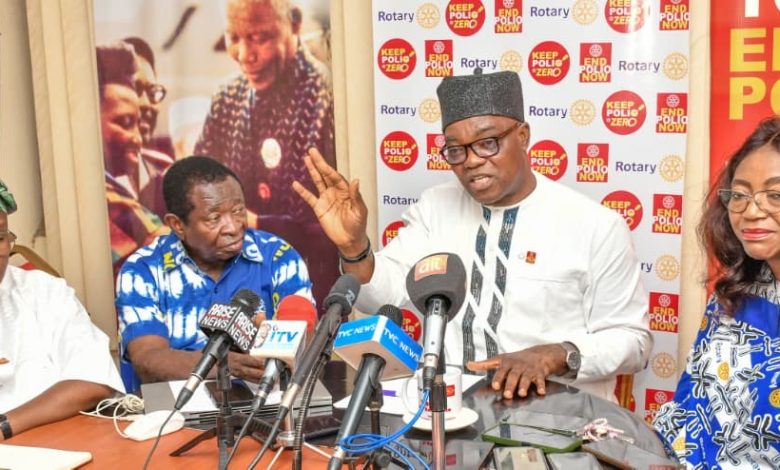
Babalola, who will assume office in July 2026 as President of the 119-year-old organisation, announced during an interactive session with journalists in Abuja.
Introducing him at the event, Past District Governor Joshua Hassan noted that Babalola is only the second African to hold Rotary’s top leadership position since the organisation’s founding in 1905.
A member of the Rotary Club of Trans Amadi, Port Harcourt, Babalola was elected by Rotary International’s Board of Directors to lead the 1.4 million-member organisation, which operates through 46,000 clubs in more than 200 countries.
Speaking at the briefing, Babalola said Rotary is scaling up projects to tackle malaria, diarrheal diseases, and gaps in immunisation coverage.
He cited a $9.8 million initiative already underway in Kebbi and other states, explaining that it builds on a successful $4 million pilot project in Zambia, which reduced malaria cases by nearly 50 per cent.
“We know what to do to finish the job. We’re committed to making a difference in Nigeria, and we’re working with the government to achieve our goals,” he said.
Babalola reaffirmed Rotary’s commitment to maternal and child health, disease prevention, education, water and sanitation, economic development, peacebuilding, and environmental sustainability.
On Rotary’s decades-long fight against polio, Babalola emphasised that while Nigeria has been certified free of wild poliovirus, variant cases continue to pose a threat due to low immunisation coverage in some regions.
“We need to continue to vaccinate our children. Until there are no more cases of polio, no child is safe,” he said.
He warned that herd immunity requires at least 80 per cent coverage, yet some states record as little as 13 per cent, while emphasising Rotary’s partnership with government agencies to close these gaps.
According to him, Rotary International has invested over $300 million in Nigeria to combat polio as part of a global $3 billion commitment to eradication, in addition to donating $14 million to strengthen surveillance and curb the spread of all poliovirus strains.
Babalola also highlighted Rotary’s $2 million Healthy Families in Nigeria program, which aims to reduce maternal and infant mortality by improving access to healthcare facilities.
In one district, he noted, the percentage of births in healthcare facilities increased from 11 to 33 per cent within a year of implementation.
He said beyond health initiatives, Rotary continues to invest in education and clean water, citing Rotary-supported classrooms, teacher training, and solar-powered lighting for schools, alongside a ₦100 million water and sanitation project in Rivers State.
Looking ahead, Babalola expressed optimism that his tenure would see Rotary expand its humanitarian footprint across Africa and globally.