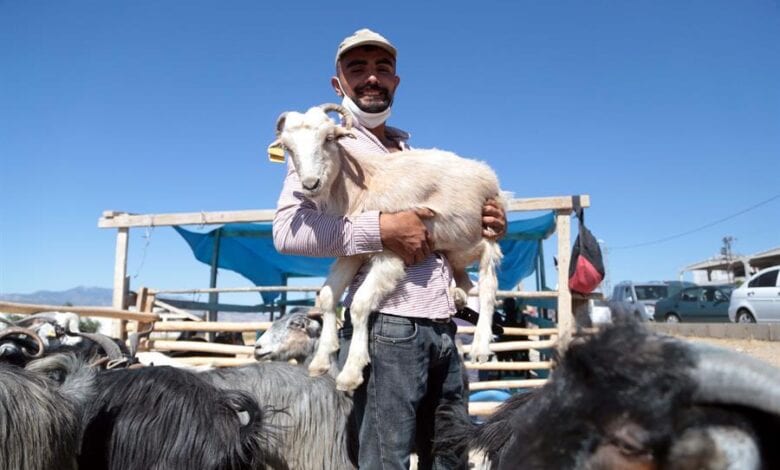
As the Muslim faithful prepare for the Eid-el-Kabir celebration, prices of rams and basic food commodities in various markets across Nigeria have gone up leading to widespread lamentation among Nigerians.
Different market surveys conducted in various states of the federation yesterday, showed that the situation is similar in Ondo, Ekiti, Osun, Edo, Kaduna, and Borno.
Other states where traders and customers have expressed their dissatisfaction with the high prices include Yobe, Kaduna, Kano, Zamfara, Bayelsa, Katsina, Lagos Oyo and Ilorin.
Muslim faithful traditionally sacrifice rams during the Eid-el-Kabir Festival, but the surveys revealed that the inflated prices made it more difficult for people to afford it.
Apart from the price hike of rams, the rising costs of food commodities have also contributed to the financial burden faced by many Nigerians.
On the other hand, ram sellers are bemoaning low patronage despite the high prices which they attributed to the affordability issues faced by potential buyers that led to decreased demand.
The combination of increased prices and low patronage has created a challenging situation for both buyers and sellers, affecting the festive spirit surrounding the Eid-el-Kabir celebration.
The price increase is also attributed to factors such as the removal of fuel subsidy by the federal government; the high cost of transportation of goods from the hinterland to the cities; unavailability of cash in circulation; as well as inflation in the country.
Muriana Balogun, a ram seller in Ikare-Akoko, Ondo State, said sales had been low and not encouraging for a few days to the Eid-el-Kabir celebration, attributing the high cost of rams to subsidy removal.
“Now, prices of rams vary. Some go for N100,000, N250,000 and N320,000, respectively, depending on the size, while the least one is N50,000,” he said.
Abdullahi Abubakar, another ram seller at Shasha Market, Oba-Ile, Akure, still in Ondo, said that selling prices are determined by cost price and the cost of transportation from the northern part of the country.
“It is not our fault; we are only selling based on the cost price of the rams we bought because transport fare is a bit higher now. People are not coming to buy like other years due to the price.
“We did not increase the prices arbitrarily. We are still hopeful that people will come to buy before Sallah,” Mr Abubakar said.
However, some traders mentioned that prices had already gone up prior to the removal of fuel subsidy, attributing it to arbitrary increases by vendors rather than the fuel subsidy removal.
Also, Christiana Ologunde, a rice seller in the same market, stated that a 50kg bag of Nigerian rice was sold at N28,500 in 2022, while the 25kg bag was sold at N14,000, while the same product is now sold for N36,000 and N19,000 respectively.
Mrs Ologunde, however, said that the fuel subsidy removal had no pronounced effect on the commodity, noting that” prices had gone up before the fuel subsidy was removed”.
In Ekiti, Abubakar Meleh, who sells foodstuff and rams at Shasha Market in Ado-Ekiti, said a big ram was sold for N200,000 last year, but now N250,000 or more.
“As it is currently, a medium sized ram is now N180,000, but was N120,000 last year, and small rams range between N50,000 and N100,000, depending on the size.
“We have limited stock of ram this year, compared to last year because there isn’t much money in circulation in the country.
“We are not expecting good profit this year because of low sales and high cost of transportation from the North,” Mr Meleh said.
Another trader, who sells yam at Okesa market, Aina Ogunyemi, said 100 tubers of yam were sold for N150,000, while five tubers of yam was sold for between N5,000 and N6,000 depending on the size of the yam.
She said yam was expensive now since the new yam was not yet abundant in the market.
A pepper seller, Elizabeth Olawale, said a basket of tomatoes was now between N58,000 to N60,000, as against N45,000.
“The small basket of hot pepper (scotch bonnet) that we were buying for N5,000 and N6,000 is now N10,000.
“Bawa (cayenne pepper) is now N30,000 a basket, as against N26,000 we used to buy it before,” she said.
A vegetable oil seller, Alhaja Zekinat Ayoola, said a five-litre gallon of King’ s vegetable oil was now N15,000, while five litres of Golden Penny vegetable oil now cost N9,000.
Shoppers at some markets in Lagos State, which include Mile 12, Karu and Ajah, also expressed concerns over the astronomical increase in prices of foodstuff and animal proteins, describing the 2023 situation as the highest in the last seven years.
An average large ram ranged from N150,000 to N600,000 against the N80,000 to N150,000 in the same period last year.
Cows ranged between N350,000 to N1,200,000 this year against the N250,000 to N600,000 in 2022.
Femi Odusanya, spokesman, Mile 12 market, described the sales situation in the market as poor noting that the purchasing power of residents was almost nonexistent.
Mr Odusanya said factors that contributed to the rising cost of foods include the increase in cost of premium motor spirit after the subsidy removal and poor investment in the agricultural value chain.
A trader at Ajah Market, Loveth Nwokedi, noted that sales had dwindled badly as people only bought what they needed for the day against the usual bulk buying of before.
At the popular Kara ram market along the Lagos/Ibadan expressway, the normal hustle and bustle whenever the festival draws near is at a reduced tempo this year.
A ram dealer at the market, who identified himself simply as Muhammad, said ram prices rose sharply because the prices of other commodities had also gone up.
Mr Muhammad added that the cost of animal feeds and their treatment when they fall sick had also increased, thereby affecting the prices of the rams.
The development was not different in Benin as residents in Benin, the Edo capital, have also lamented their inability to live within their earnings due to the recent hike in the price of fuel.
They expressed displeasure that the government did not make available palliative measures to cushion the effect of the subsidy removal.
At Swali Ultra-Modern Market in Yenagoa, Bayelsa State, small-sized rams are being sold from a range of N100,000 to N150,000, and medium sizes are sold within the range of N200,000 to N300,000, while the big-sized rams sell in the range of N350,000 to N450,000.
Muhammad Usman, a ram dealer at the market, explained that apart from high transportation cost because of expenses such as diesel and the distance to Bayelsa, dealers incur expenses for the animal feeds and veterinary care when they fall sick, requiring injections and other medications.
Also in Kaduna, Abubakar Lawal, a ram seller, said, “a ram we bought at N40,000 in the village market last year is now N65,000, transportation has gone up as we now transport each ram at N2,500 as against N500 last year. (NAN)