By Francis Ajuonuma
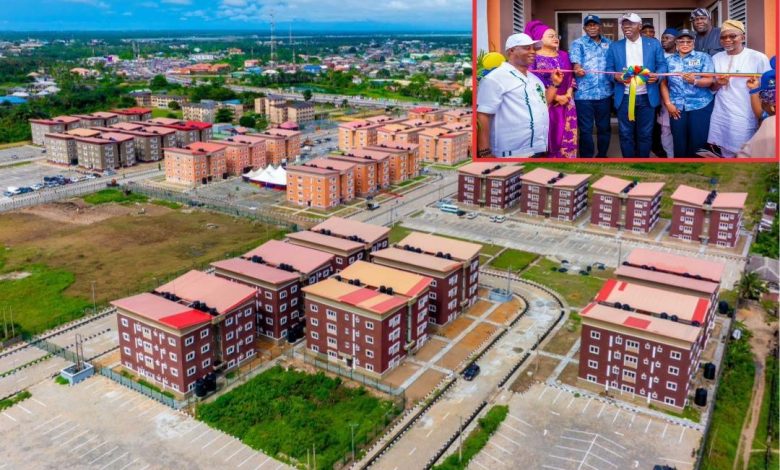
For many residents, the event symbolised more than the opening of 420 housing units, it was a promise finally kept, and a new chapter in the town’s long wait for inclusive development.
“Today is not just the commissioning of buildings,” Sanwo-Olu declared, cutting the tape amid applause. “It is a reaffirmation of our commitment to the welfare of every Lagosian. The true measure of our progress will always be the well-being of our people.”
The Ajara housing project, first initiated in 2013 by the New Towns Development Authority (NTDA), had languished for years before the Sanwo-Olu administration revived it.
By 2017, the project was transferred to the Ministry of Housing for completion; however, progress stalled due to funding and design challenges.
It took the governor’s directive in 2023 to breathe new life into the scheme, culminating in Wednesday’s inauguration of the 420-unit Phase I.
The estate comprises 35 blocks of 12-in-1 residential buildings, featuring one, two, and three-bedroom semi-furnished apartments with modern fittings.
Complementary facilities include paved roads, a water treatment plant, an electrification network, a drainage system, parking lots, and a sewage treatment plant.
Phase II, already flagged off, will feature seven-storey high-rise buildings designed to “dramatically transform Badagry’s skyline.”
For a region often overlooked in Lagos’ urban development agenda, the Ajara estate marks a significant milestone.
“Badagry is now better connected through the Lagos–Badagry Expressway,” Sanwo-Olu noted. “This project symbolises our resolve to bring progress to every division of Lagos.”
Sanwo-Olu’s housing policy, built on the T.H.E.M.E.S Plus agenda, seeks to provide not just roofs over heads but livable, sustainable environments.
Since 2019, the administration has delivered 24 estates, cutting across Lekki, Igando, Epe, Ikorodu, and now Badagry. Yet, the governor insists that “the goal is not just numbers but dignity in living.”
The Badagry estate, he explained, also reflects continuity in governance. “This is a project inherited and revitalised. Government is a continuum,” he said.
To enhance inclusiveness, 20 per cent of the units are reserved for members of organised labour—teachers, health workers, and civil servants—who will also enjoy price rebates.
The state is partnering with mortgage institutions and private developers to make ownership easier through flexible financing models.
For the Commissioner for Housing, Moruf Akinderu-Fatai, the Ajara project encapsulates the governor’s vision of turning Lagos into a 21st-century economy through infrastructure and social investment.
In his welcome address, he hailed the estate as “a beacon of hope and a symbol of unwavering commitment.”
“The project is not confined to the metropolis,” he said. “From Lekki to Igando, from Epe to Badagry, our goal is to ensure every resident, regardless of location, has access to decent accommodation.”
Akinderu-Fatai, however, highlighted one of the sector’s most formidable challenges: rising energy costs. Powering water treatment and sewage systems has become a significant burden for residents of the estate.
“We plead for urgent realisation of plans to install solar systems to power estate infrastructure and take them off the national grid,” he said.
He disclosed that the Ministry of Housing is ready to commence new projects in Epe Phase II, Ipaja Command, and Imota once approvals are secured.
“History will be kind to this administration for putting thousands on the housing ladder at prices far below construction cost,” the commissioner added.
Badagry’s local leadership sees the project as both a triumph and a challenge.
The Chairman of Badagry Local Government, Babatunde Hunpe, commended the governor’s “season of bountiful harvests” but quickly reminded him of unfinished business.
“Your Excellency, we thank you for completing the Late Sunny Akinsanya Ajose Housing Estate, but we appeal for completion of other vital projects, the VIP Chalet, Yafin Road, Agbovipe–Agadangba–Erekiti Road, and the Deep Sea Port,” Hunpe said, drawing nods from the crowd.
The Akran of Badagry, Aholu Menu Toyi I, represented by Chief Anthony Tunji, also thanked the governor but noted that “like Oliver Twist, our people are asking for more.”
His statement reflected a recurring sentiment among residents who see government projects as welcome but unevenly distributed.
Lawmaker Bonu Solomon (Badagry Constituency I) urged that “indigenes be prioritised in the allocation process.”
At the same time, the Chairman of the Lagos Assembly Committee on Housing, Abdulhafis Toriola, assured that “the interest of the people will be protected.”
Housing analysts say that while Lagos has made remarkable strides, sustaining this pace will require stronger partnerships, creative financing, and deliberate inclusion of the informal sector. Dr Adewale Ogunyemi, a housing economist at the University of Lagos, told ThisNigeria that “mass housing must go beyond ribbon-cutting ceremonies.”
“The real test is in maintenance, affordability, and community management. Lagos needs to balance aesthetics with affordability,” he said. “We’ve seen many estates decay within years because there’s no clear maintenance plan or energy sustainability.”
Indeed, the commissioner’s call for solar infrastructure hints at Lagos’ evolving approach. Sanwo-Olu confirmed that future housing estates would integrate renewable energy solutions, jointly managed by the Ministries of Housing and Energy.
“We will power sewage plants and streetlights through solar energy,” he said.
Observers see the Badagry housing estate as part of the continuum of Lagos’ transformation—one that began under former governor Bola Tinubu, whose urban renewal blueprint laid the foundation for today’s projects.
As Akinderu-Fatai noted, “The Ajara dream began over a decade ago, but it took a builder and a doer to make it a reality.”
Sanwo-Olu’s administration has continued this trajectory with 24 completed estates, dozens under construction, and a renewed emphasis on vertical expansion to overcome the limited land available.
“The second phase of Ajara will feature seven-storey high-rises—a bold experiment in high-density design within a low-rise region,” one ministry official revealed.
Still, residents and housing advocates remain cautious. “Every estate must not become an island of privilege,” said Mrs Bisi Oladele, a community leader. “We hope these homes will be accessible to ordinary workers who keep Lagos running.”
The Lagos State Government estimates that over three million housing units are needed to bridge its deficit. With population growth exceeding 3.4 per cent annually, experts say supply must outpace demand for progress to be visible.
Public-private partnerships (PPP) are thus crucial, and Sanwo-Olu has reaffirmed readiness to collaborate with developers and financiers “under the Renewed Hope Housing Agenda.”
But there’s also the issue of affordability benchmarks and transparency in allocation. The governor has promised an open process. “We will ensure fair and equitable distribution. No Lagosian will be left behind,” he said.
As the sun set over Ajara, newly handed-over keys glistened in the hands of proud beneficiaries. It was a day of joy, but also a time for reflection on what lies ahead.
For Lagos, the housing challenge is far from over, but in the quiet optimism of Badagry, the dream of a home for every family feels just a little closer.