By Mudiaga Affe
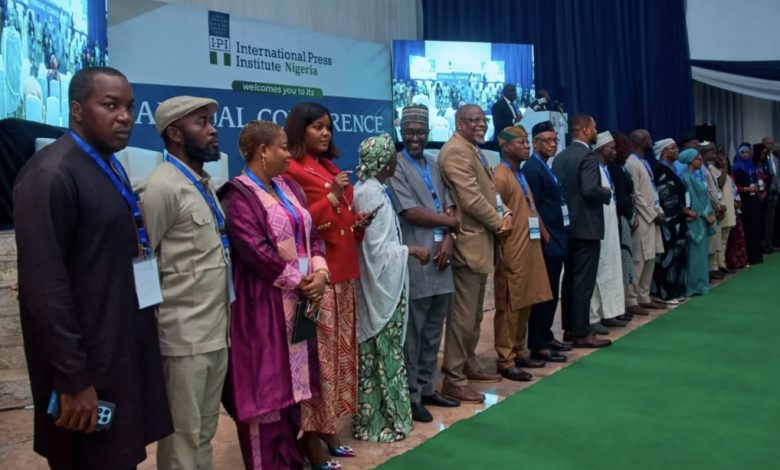
The 2025 International Press Institute (IPI) Nigeria Conference in Abuja was expected to be a sober dialogue on journalism and democracy. Instead, it became a dramatic public exhibition of the widening gulf between the Nigerian media community and the political authorities who insist they are safeguarding democratic freedoms even as evidence suggests otherwise.
With the theme “Addressing Media Repression and Safeguarding Democratic Accountability in Nigeria,” the event quickly revealed that the two sides no longer view reality through the same lens.
What emerged was a rare, unfiltered confrontation over the erosion of press freedom, the rising intimidation of journalists, the economic collapse of traditional media, and the constitutional crises arising from state-level abuses of power.
At the centre of the tension was Vice President Kashim Shettima, whose opening keynote, titled “The Nation That Defies Silence,” sought to celebrate Nigeria’s media resilience while warning that some practitioners are undermining public trust.
The Vice President hailed journalists as courageous defenders of democracy capable of toppling authoritarianism or, conversely, enabling national chaos when ethics collapse.
“It is impossible, utterly impossible, to have a successful dictator in Nigeria. You have outlived those who attempted to place their boots upon your freedom,” he declared.
But the praise came with a reprimand. Shettima lamented a growing faction of practitioners who fabricate stories, refuse accountability, and trade truth for online virility.
“Without ethics, journalism becomes a dictatorship of text and airwaves,” he warned.
Still, he conceded that the government bears an unequivocal duty to guarantee media safety:
“We owe you a space of practice devoid of intimidation or fear. That much is non-negotiable.”
His measured tone failed to soften what would become a much harsher critique from within the media itself.
In one of the conference’s most defining moments, IPI Nigeria President, Musikilu Mojeed, unveiled the inaugural Book of Infamy, listing top officials who have undermined press freedom.
He named: IGP Kayode Egbetokun- for enabling arbitrary arrests of journalists; Governor Mohammed Bago (Niger State), for shutting down Badeggi FM; and Governor Umo Eno (Akwa Ibom), for barring Channels TV journalists from Government House.
“These attacks are becoming more frequent and dangerous,” Mojeed said, adding that none of the officials reversed their unconstitutional actions despite appeals.
In contrast, the DSS Director-General, Adeola Ajayi, was named a friend of the media for his “responsiveness and professional conduct.”
It was the starkest public indictment of state power at any media event in recent years.
Attempting to shift the narrative, Minister of Information Mohammed Idris argued that the conference theme risked anchoring Nigeria to “a sad past” that the Tinubu administration has moved beyond.
“If the theme suggests an active policy of repression, then we must interrogate it against available evidence,” he said.
He highlighted a recent episode in which a false report about Nigeria signing an LGBTQ rights agreement went viral.
Rather than punishing the newspaper responsible, Idris said the government responded transparently by publishing the whole agreement and referring the issue to the media ombudsman.
“We rejected the old playbook of coercion,” he insisted.
He then announced the establishment of a regional Media and Information Literacy Institute in 2026, describing it as a long-term investment in combating disinformation.
Still, his defence did little to dispel the growing perception, strongly articulated by media practitioners, that violations of press freedom are increasing, not decreasing.
Former Daily Trust Managing Director, Isiaq Ajibola, shifted the conversation from repression to survival.
He warned that the Nigerian media faces existential threats far beyond government interference.
“The business models that sustained journalism for 100 years have disappeared,” he said.
He outlined three pillars for rebuilding media sustainability: innovation; digital-first newsrooms; AI, analytics, and mobile optimisation; multimedia storytelling; and cross-skilled teams.
He added that credibility is the single currency that outlives every technology cycle.
On revenue sustainability, he emphasised a three-tier model of primary, secondary, and future-growth revenue streams, with native advertising highlighted as the most profitable avenue.
“If you can measure it, you can monetise it.”
Ajibola’s analysis underscored that even the freest media cannot survive without structural reinvention.
Media Rights Agenda (MRA) Executive Director Edetaen Ojo delivered the hardest legal and philosophical rebuke of the day.
Quoting Section 22 of the Constitution, he reminded the audience, “The press shall at all times be free to uphold the responsibility and accountability of the government to the people.”
He emphasised that the Constitution does not merely endorse press freedom — it commands it.
“Harassment and intimidation of journalists violate the Constitution itself. National security cannot be invoked to silence accountability.”
Ojo’s remarks positioned media repression not just as a political failure, but as a constitutional crisis.
By the end of the two-day event, one conclusion was inescapable: Nigeria’s democracy is wrestling with itself.
Government insists the era of repression is over, but journalists say attacks are rising and impunity is worsening.
Experts warn that innovation, ethics, and financial survival are collapsing simultaneously, while advocates argue that constitutional guarantees are being undermined.
The IPI 2025 Conference did not bridge these divides; it exposed them.
But that exposure was the point. For in the words of the Vice President, “A nation where the media is silent is a nation where the people lose their voice.”
In Abuja, the media made it clear: it would not be silent, even when those in power insisted nothing was wrong.