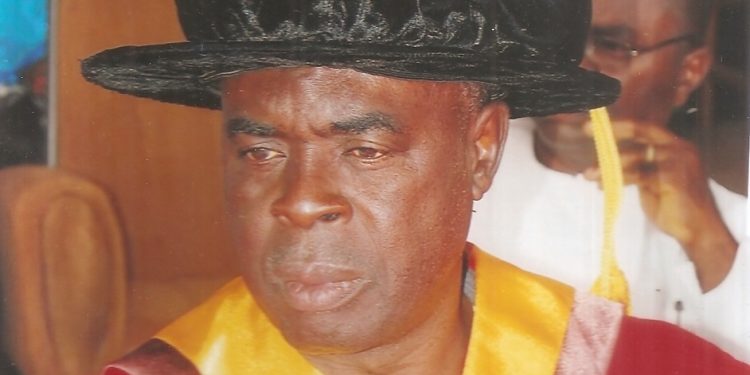
An emeritus professor of English and Literary Studies, University of Nigeria, Nsukka (UNN), Damian Opata, is a chieftain of the Peoples Democratic Party (PDP). In this interview with LINUS ALEKE, he speaks on the rising insecurity in the country, Igbo presidency, Biafra agitation, and contributions of scholars to development, among other national issues.
The security situation in the country is frightening, to say the least. As a citizen, how do you feel seeing that every morning you wake up, flip through the pages of newspapers, and listen to the radio, it is about how many people were killed, how did we get here?
You are even talking of pages of newspapers. The Anglican Bishop of Nsukka just told us how his wife ran into a group of kidnappers this morning and how she escaped. Yesterday at Nsukka, some people were killed. Security threats are everywhere and the worst aspect of it is that no part of the country is safe any longer. It used to be Northeast, up to Zamfara in Northwest and a few other places. But it is everywhere now. We saw what happened at Owo, the massacre of innocent worshipers. So, any Nigerian even the president who tells us that the situation is not extremely disturbing is not telling the truth, even to himself. Now the issue is not whether it is there but what we are doing to contain what is happening. The measures so far adopted by the government seem apparently to have failed. I think this is one reason why the former Minister of Defence, Gen. TY Danjuma (retd.) called for every state to weaponize her citizens because people have lost faith in the Nigerian state, in terms of security of lives and property. The other issue is that security is not just about physical safety. We also have food safety, emotional safety, job security, and others. The issue of this social revolution that people are talking about, in terms of voting during elections, is like giving the scorecard of the incumbent administration. This is because if the people are occupied, if they are busy, happy, and satisfied, then there will be no need for this type of reaction. There is now a determination to say if we register en masse and we actualize our dream by voting and the vote counts, then we may have a better regime. I think that is the logic for the upsurge in voters’ registration in the country today. If I am going to Leja now, I am not even quite sure of my safety. This brings us to road safety, when the roads are very bad, they constitute death traps. If we drive through our roads, we will see how bad they are. If we are going to Otukpa Junction, between Obollo Afor and Otukpa what do we see? Very terrible road. One day I counted about 150 checkpoints and security men are stationed where the roads are bad. They are not stationed at the good portion of the road. Even where the thieves and other non-state actors unleash mayhem on road users are those bad portions of the roads. So, it is an overall bad phenomenon everywhere. Unfortunately, all we hear from authorities is about rejigging the security architecture. I had read about that twice in the papers. They keep talking about rejigging security architecture, and what they mean by that is not clear to us most of the time. It is a very disturbing problem and I think all hands must be on deck to curtail this menace. Communities and individuals must find a way of succeeding where the government appears to have failed.
There are checks and balances in a democracy, the executive checks the legislature by withholding assent to bills considered to be un-progressive, while the legislature checks the executive through oversight functions or in the worst-case scenario through the impeachment of the president, governor, or local government chairman. Regrettably, the legislature in Nigeria seems to be sleeping on duty, if the scenario you painted above is something to go by. Does it mean we adopted democracy foolishly flowing from the fact that it has not helped us solve basic problems as you alluded to?
I think that is one of the reasons. We have not fully gotten used to the western democratic model, a capitalist model. We have not gotten adapted to it. When you have state actors, their powers are immense, it is not easy to impeach a governor let alone a president in a democracy. Not that the legislature cannot muster the effort or muzzle or whatever to impeach a governor but they will not be allowed. It is only a tree that you will say you want to cut down and it remains where it is without running away to save its life. There is this issue of interest in politics. If people are struggling for self-interest, either interest in the strength of the pocket, or interest in terms of the position you are going to occupy, a vintage position. It is easy to break the will of the people at any level. Even the local government chairman can break the will of the people, the system itself. It is only now that people have fought somehow for the independence of the legislature. But if they are dependent on the governor or president for salaries and allowances, there is a limit of power they can exercise because of their self-interest. Yes, resignation may be one option, but if they resign and quit and the situation continues? It can only be, having satisfied their conscience but they have not changed the system. What is critical, I think is that the legislature and the people should take a critical look at western democracy. Western capital democracy emphasized. This is because they said that it is the government of the people by the people and for the people. How is that true? When even the poor people don’t even come near. They don’t come near the formulation of policies, they don’t come near people who are in the executive, and they don’t also come near the legislature. How is it of the people, by the people, and for the people? But as I said in my lecture, the Igbo had consensual democracy, where everybody had a say. Where there was some kind of autonomy. At least you will be allowed to say something, then when there are negotiations, you will make your point and when your idea is rejected you will know why it was rejected. This one that we adopted, is it the idea that is working? What is uppermost in a capitalist democracy is interest and all of them know that. Even those who claim to be the conscience of the people. I don’t want to take a jab at journalism or the media. I don’t know how it is the conscience of the people when many people don’t even have a conscience.
If you don’t want to take a jab at the media which of course you had already done, I think I should take a jab at the academics
…well, I had said it, let me even help you. I have told people that if you are an academic, and you print a ten-page book and force it on students for N500, it is a sin. If you molest a female student over a grade, it is a sin. There are so many bad habits where lecturers write projects for students themselves, market them and engage easy supervisors to supervise them, it is also a sin. These rots are everywhere, it is not only in the academic. But I talk about journalism because they claim to be the conscience of the people, we in the academic do not claim to be the conscience of the people.
Cut in … but you claim to restore the dignity of man…and you help politicians rig elections. Is it not academics that serve as returning officers to INEC during elections that are often seen as fraudulent?
Aside from the rot in the academic circle, would you not agree that Nigerian academics are too lazy to a point that they adopted the western capitalist democratic model and had not done anything since it was discovered not to be serving us well, to come up with an indigenous model that is peculiar to our society and environment? No, Nigerian academics have written extensively on that. Afrocentrism, Africanist, and Africanism, there had been so many efforts in this regard. Especially, in what we call de-colonial studies in the literature that is, coping with imperial powers. There are so many African scholars on de-colonialism, that several scholars have proposed models, just as ASSU has proposed UTAS. One thing is for you to propose, and another thing is for what you have proposed to be adopted by authorities. Nigerian academics are not lazy, in terms of intellectual production, if they were lazy, they will not be excelling all over the world. From UNN to everywhere in terms of their publications, first-rate publications. Again, you cannot become a professor in an ideal system unless you have written extensively and are qualified for that. And even if it is for self-survival, academics are publishing for self-survival that academics are publishing, it may be for other things like some of us who left what we are doing to write things that could change the idea of people. Like when I wrote the book on Ekwensu, the Igbo imagination, which many people have come to accept but find it difficult to adopt even when they know that it has nothing to do with evil in the first place, not to talk of challenging God but people are used to that. They continue to still use it that way. Academics are not lazy, they have done lots of critical thinking in Nigeria. Even in elections, Professor Attahiru Jega and other upcoming scholars have made so many submissions. So many things had also been done in National Assembly. But when you have these tremendous outputs of intellectual materials and they are put aside, what do you do? There is nothing that you can do. Academics are not lazy in terms of writing publishable and standard papers. Just two days ago, the University of Nigeria, Nsukka (UNN), was adjourned one of the best in scientific publications, humanity, and others in Nigeria. Therefore, Nigerian academics are not lazy.
None of the major political parties in the country fielded an Igbo candidate for the 2023 poll, despite the loud clamour for the Igbo presidency by South-East political and socio-cultural leaders. Where did the Igbos get it wrong?
I would not say that they got it wrong or right. It is difficult for me to begin to postulate whether it is right or wrong. Whether we like it or not, the main issue is that elections are based on the majority of voters. An election is based on population, manipulated or actual, but we must have the population, either manipulated or actual. It then happened that those of us in the southeast don’t have the population, manipulated or actual. When you have a state like Kano having more than 40 local government areas and we have Enugu State with 17 LGA, and others with 16 or there about. Three states in the southeast may not be up to Kano alone in terms of the number of local government areas. We have delegates that are based on the number of LGA, Kano will naturally have more delegates. There is no doubt about that, it played out during the primaries. The southeast always has the least number of delegates. So, they have to negotiate with others. When we see our powerlessness, reality makes it mandatory that we have to adopt a strategy of lobbying, not noise-making. Not claiming that it is our right, yes, it is our right but the right must be claimed. Zoning is to make things equitable, the zoning is there but the zoning is to be claimed. And we don’t claim that zoning by noise making. We claim it by quiet lobbying and not noise in the media. I will try to illustrate what happened in Enugu State. We had a situation where Enugu-East Senatorial District has six LGA, Isi-Uzo is one, and one of our dear brothers, Chijoke Edoga, a gentleman was running for the governorship of the state. Unfortunately, the media management was too loud. The media management was almost blackmailing people from the Nsukka zone. “Odinma Nsukka is nothing, Vita Abba is nothing, Dan Shere is nothing, the governor is doing what he is supposed to do,” why? It is not a social media campaign issue, it is a matter of going underground to beg and lobby. It got to a point I was compelled to call Mr. Ben Onyishi, one of the social media warriors. I told him that he was ruining the chances of my friend Chijoke Edoga. I said it severally, and one day he called me because I supervised his Ph.D. thesis. He said Prof, let me assure you that any post I made on social media is read by 23 persons before it is uploaded on social media. So, I gave up on him. But let us come back to reality and look at our political muzzle compare to other zones in the state, viz-a-viz Isi-Uzo. We wanted to assert a muzzle that is powerless. It doesn’t work that way. We wanted to rely on the governor because he is from Nsukka. Now, reverse the situation, if the governor is from another zone, say Enugu West, and it is the turn of Enugu-East, will this type of noise be generated? People are just generating noise because the governor is our brother. We have not taken into consideration the power that this governor has amid other power brokers in other zones, where we have former governors, civilian and military administrators, former presidents of the Senate, and others who have all the money and political connections. It also happened at a time when Senator Ike Ekweremadu was also throwing his muzzle around. It had never happened in the history of the state that at the point of anointing a successor, another powerful politician in the state is challenging the incumbent. It happened in our own time that Ekweremadu challenged our brother. He openly disregarded zoning in the state and was promoting the cause of greater Ogu and all that. We can wish for something but what we wish must be realisable. If Governor Ugwuanyi went ahead to anoint Chijoke, it was possible he would have won. There is no doubt about that because once anointed, Nsukka has a population of over 51 per cent voting population to deliver majority votes. We would not have ruled out the issue of possible realignments from Ekweremadu and others. Who could go to the other party and the contest continue and they had already taken one of our own. The Coordinator of the Ekweremadu Campaign Organisation was from the Nsukka zone and most traditional rulers and statutory delegates were with him. The pragmatic reality on the ground must always be taken into consideration when we are making postulations. That is the same thing in the southeast. We must look at the reality on the ground that we are less in population and we are going to grow fewer and fewer. Because the religion we adopted preaches monogamy, other people are practicing polygamy and having many children. Islam is the fastest-growing religion in the world by population increase and we are going to compete with them on a man one vote basis. So, we must be very careful with them.
There are insinuations in certain quarters that Igbos are been denied the highest office in the land because they dared to fight Nigeria in 1967. Do you share this sentiment?
It is a possibility that because we fought the war, we should be kept away from the plum office. The wounds have not healed on either side. On the side of those who fought for Biafra and on the side of those who fought against Biafra. It does appear that the wounds are not fully healed. But having said that, power is not something we wait to be given to us. Power is what we strive to get and we don’t get it by noise making. The insecurity in the southeast is also a big problem. I respect IPOB, and I respect their own opinions but I don’t think that the way IPOB approached the issue of Biafra is the right way. Those of us of the new Biafra, I doubt if we knew Biafra? Because Biafra was known for ingenuity. Lt Col Ojukwu then, I was in St. Theresa College, went about from zone to zone mobilizing people for the Biafran cause. From zone to zone, even students from the University of Nigeria Nsukka (UNN), came to address us at St Theresa College to mobilise us for Biafra. There was well prepared ideological ground for people to accept Biafra. What ideological thinking has IPOB done to get people to key into their struggle, what have they done? The Igbos are not the kind of people you impose your will on. Leaders must arise from the people, not by imposition.
The measures so far adopted by the government seem apparently to have failed. I think this is one reason why the former Minister of Defence, Gen. TY Danjuma (retd.) called for every state to weaponize her citizens because people have lost faith in the Nigerian state, in terms of security of lives and property.