

By Nathaniel Zaccheaus, Abuja
Nigeria’s new service chiefs on Wednesday unveiled an ambitious defence reform agenda centred on technology, local arms production, and troop welfare, as the Senate confirmed their appointments after a tense, two-hour closed-door screening session that reflected growing concern over the country’s worsening security situation.
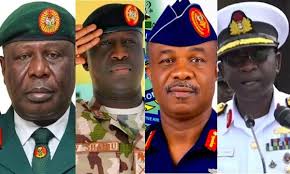
The Senate confirmed Lieutenant General Olufemi Oluyede as Chief of Defence Staff, Major-General Waheedi Shaibu as Chief of Army Staff, Rear Admiral Idi Abbas as Chief of Naval Staff, and Air Vice Marshal Kennedy Aneke as Chief of Air Staff, all nominees of President Bola Ahmed Tinubu, whose administration has repeatedly promised to overhaul Nigeria’s security architecture.
Presiding over the session, Senate President Godswill Akpabio described the exercise as a constitutional responsibility, urging the new service chiefs to deliver results that reflect Nigerians’ renewed expectations.
“This Senate will continue to support the armed forces, but the nation demands results. Nigerians are tired of excuses,” Akpabio said shortly after announcing their confirmation.
The closed-door screening, which lasted about two hours, was dominated by questions about the escalating insecurity in the North-West and North-Central, the resurgence of oil theft in the Niger Delta, and the slow pace of police reforms, which have left the military overstretched with internal security duties.
In his presentation, Lieutenant General Oluyede, a veteran of peacekeeping and counter-insurgency operations, outlined a bold plan to build what he called “a self-reliant, technology-driven defence system” capable of sustaining prolonged operations without depending on foreign arms suppliers.
“We cannot continue to rely on foreign suppliers for our weapons. It is economically unsustainable and strategically risky,” he said. “My focus will be on developing a local military-industrial base to produce what we need to defend the nation.”
Oluyede, who previously commanded key operations in Liberia, Bakassi, and the North-East, also promised to prioritise intelligence-led warfare and inter-service coordination.
“Our approach will be multi-domain and data-driven. We will strengthen night operations, train more special forces, and rely on real-time intelligence to dominate all terrains,” he added.
He pledged to improve troop welfare, describing morale as “the backbone of fighting power,” and called for a comprehensive reform of the Nigeria Police Force to enable it to take charge of internal security. “The military alone cannot secure Nigeria. The police must be empowered to handle internal threats effectively,” he said.
Rear Admiral Idi Abbas, confirmed as Chief of Naval Staff, outlined a strategy to combat crude oil theft and piracy through enhanced maritime surveillance and improved logistics.
He disclosed that the Navy was deploying drones and advanced radar systems to monitor remote creeks and waterways, particularly around the Niger Delta.
Abbas rejected the idea of establishing a separate Coast Guard, noting that such a move would duplicate existing responsibilities.
“The Navy’s constitutional role already covers what a Coast Guard would do. Rather than creating new structures, the government should strengthen the Navy with better logistics and modern surveillance technology,” he stated.
The naval chief also introduced a humanitarian dimension to his plans, insisting that deradicalisation and amnesty programmes must include victims and affected communities.
“Deradicalisation must include justice and healing. Communities that lost loved ones should be part of the peace process,” he said.
Air Vice Marshal Kennedy Aneke, confirmed as Chief of Air Staff, pledged to transform the Nigerian Air Force into a “combat-ready, disciplined, and intelligent” institution, driven by drone warfare, advanced surveillance, and modern research.
“Modern warfare is technology-driven. Unmanned aerial systems now perform many missions more effectively and safely than manned aircraft. We will invest heavily in them,” he said.
Aneke defended the operational status of Nigeria’s $1.2 billion Super Tucano aircraft, noting that they remain “fully functional and critical to ongoing counter-insurgency operations.”
He disclosed that “each missile costs about $100,000, the cost of peace,” adding that sustained funding was necessary for continuous air support and pilot training.
He also reaffirmed his commitment to personnel welfare, saying that the Air Force would focus on accommodation, family education, and prompt benefits to maintain morale.
While senators across party lines commended the professionalism and strategic vision of the nominees, they cautioned against “cosmetic reforms” and repeated the need for measurable results.
Senator Mohammed Monguno (Borno North) praised Oluyede’s combat experience but stressed that “Nigerians no longer celebrate plans — they want to see peace restored.”
Similarly, Senator Adamu Aliero (Kebbi Central) urged the chiefs to make troop welfare “a non-negotiable pillar of national security.”
Despite the upbeat tone, several lawmakers privately voiced scepticism over the feasibility of the promises.
“We have heard all these before, from local arms production to better welfare. The question is whether there will be political will and funding to follow through,” a senator from the North-West said.
The confirmation of the four service chiefs completes President Tinubu’s latest shake-up of the nation’s security leadership, which began earlier this year with the appointment of new heads for the Department of State Services (DSS) and the National Intelligence Agency (NIA).
Security analysts see the move as part of Tinubu’s broader strategy to align Nigeria’s military leadership with his administration’s “Renewed Hope” agenda. Still, they warn that genuine transformation will depend on tackling corruption in procurement, improving coordination among security agencies, and addressing the root causes of insurgency and banditry.
“The President has chosen competent officers, but without systemic reforms and adequate funding, these fine words may not translate into peace,” said defence analyst Group Captain Sola Akinwunmi (retd.), noting that “Nigeria’s real security problem lies in continuity and accountability.”
With their confirmation, General Oluyede, Major-General Shaibu, Rear Admiral Abbas, and Air Vice Marshal Aneke now form the backbone of Tinubu’s new national security strategy.
Their immediate task is straightforward: restore stability to the North-East, end banditry in the North-West, and secure Nigeria’s territorial integrity across land, sea, and air.
As one senator put it, “Nigerians have heard promises before. This time, the service chiefs must let their results speak louder than their briefings.”


