By Nathaniel Zacchaeus, Abuja
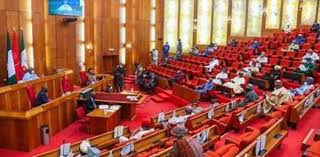
Two bills that seek to prevent a serving Governor of the Central Bank of Nigeria from partisan politics, scale second reading on the floor of the Senate yesterday.
The proposed amendments which were however consolidated into one bill equally sought to reposition the bank for efficiency.
One of the consolidated bills titled, “Central Bank of Nigeria (Establishment) (Amendment) Bill 2023” was sponsored by Senator Steve Karimi (APC, Kogi-West).
The second one was titled, “A Bill to amend the Central Bank of Nigeria Act 2007, and for matters connected therewith 2023” and was sponsored by Senator Darlington Nwokocha (LP, Abia-Central).
READ ALSO:Senate: Tinubu will present budget to N’ Assembly in November
The immediate past governor of the CBN, Godwin Emefiele, had attempted to contest the 2023 Presidential primaries of the All Progressives Congress (APC) while in office.
The move was widely condemned by Nigerians who wondered how a serving public servant could seek an elective office contrary to extant provisions of the Constitution.
Karimi, one of the sponsors of the consolidated bills explained that it was aimed at amending the CBN Act to allow for greater accountability and transparency in the running of the Bank and to prohibit the use of foreign currency in local transactions in Nigeria.
Karimi’s proposed amendment to section 9(2) of the CBN Act reads, “Notwithstanding the Provisions of this Act or any written law in existence, the Governor and the Deputy Governor of the Bank shall not participate directly or indirectly in partisan politics, nor contest any election, during their tenure in office.”
The Kogi West lawmaker’s Bill also seeks to prohibit the use of foreign currency for domestic transactions in Nigeria.
The Bill seeks amendment of Section 20 of the CBN Act, by inserting Section 20(A) immediately after the existing section 20, before the existing section 21.
The proposed amendment reads, “20(A) Prohibition of the use of foreign currency in democratic transactions: (1) No person or body corporate shall use any foreign currency as a means of exchange for goods, services and other transactions in markets supermarkets, hotels, restaurants, airports and other places of business in Nigeria except by a Bank, licensed Bureau De Change and other financial institutions duly authorized by the Central Bank of Nigeria to trade, deal and use such currency and no individual or business entity in Nigeria shall advertise, denominate or price its goods or services in any currency other than the Nigerian naira and kobo.
“(2) Any person who contravenes subsection (1) of this section commits an offence and shall be liable on conviction to: (a) in the case of an individual, to a fine of N250,000 or a term of imprisonment not exceeding six months or both such fine and imprisonment; (b) in the case of a corporate entity to a fine of N1,000,000 and a conviction of three months to its officers or directors who authorised or undertook the transaction.”
On his part, Nwokocha who sponsored the second bill, listed the general principles of this bill to include, “This Bill seeks to address all anomalies that have hindered the advancement of the apex bank to handle the ailing economy of our nation.”
He said, “The thrust of this amendment is to create a people-centred Central Bank by delivering price and financial system stability and promoting sustainable economic development.
“As the nation grapples with economic issues, we need to reposition the CBN to grow the economy, regulate the exchange rate, and un-authorised financial transactions and dollarizing the economy.
“This Bill seeks to provide for among other things: Separate the head of Management from the head of the governing Board in line with national and international good corporate governance practices; establish a proper governance architecture for the monetary authority for optimal policy and operational effectiveness.
“Enshrine real-time controls and effective accountability in the conduct of central banking in Nigeria. Reposition the CBN towards pursuit and advancement of its core mandates given the Bank’s pivotal role in the economy; and Position the CBN as an apolitical entity that will become a worthy example in national and international monetary policy, banking sector regulation, currency management, and supervision.”