By Nathaniel Zaccheaus, Abuja
The Senate on Thursday suspended further debate on the Electoral Act Amendment Bill 2025 following a stormy session that exposed sharp divisions among lawmakers over the scope and intent of the proposed changes to the 2022 electoral law.
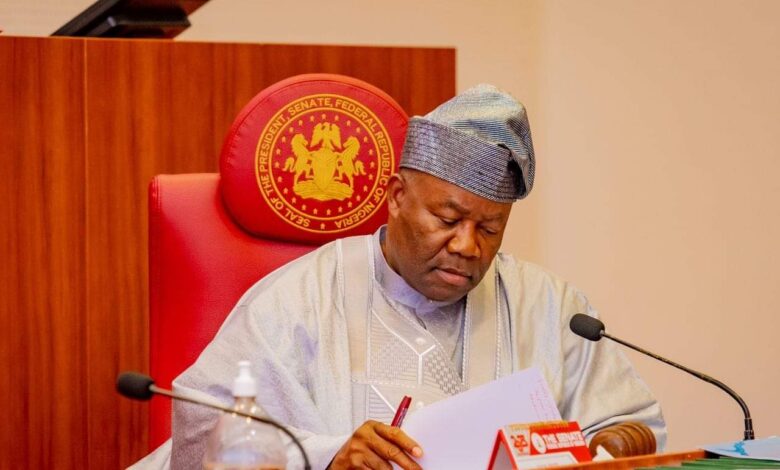
The decision came after Senate President Godswill Akpabio expressed dissatisfaction with the lack of clarity in the proposed amendments and digressed into a personal reflection on what he described as the “grave injustice” he suffered during the 2019 general election in Akwa Ibom State.
The deliberations had begun smoothly when the Chairman of the Senate Committee on Electoral Matters, Senator Simon Lalong (Plateau South), presented the general principles of the bill.
But proceedings soon took a dramatic turn when Senator Titus Zam (Benue North East) urged the chamber to pass the bill for second reading. Akpabio immediately intervened, questioning which specific provisions of the 2022 law were being targeted for alteration.
He demanded that the committee chairman provide precise details of the proposed amendments before the Senate could proceed with further consideration.
“We must understand the nitty-gritty of what we are about to amend before moving forward,” Akpabio insisted.
In the course of the debate, the Senate President digressed into a recollection of his 2019 election ordeal, alleging that he was a victim of selective justice by the Independent National Electoral Commission (INEC) and the judiciary.
Akpabio said, “What happened during the 2019 elections was unjust. The law was clear, yet those meant to enforce it acted otherwise.
“Professor Peter Ogban, who served for 34 years at the University of Calabar, was wrongly sentenced to three years in prison instead of those truly responsible for the infractions. If he was helping me, how come my votes were the ones affected?”
Akpabio also faulted INEC for what he described as inconsistent enforcement of electoral laws, saying the Commission often failed to prosecute the real offenders while punishing innocent officials.
The Senate President further criticised the extended electoral calendar, lamenting that lengthy campaigns and transition delays shorten the effective tenure of elected officials and disrupt governance.
“Campaigns last for months, and by the time appointees become ministers, the country loses valuable time for national development. We must find a balance between our electoral timetable and efficient governance,” he added.
Following the heated exchanges, Senate Leader Opeyemi Bamidele (Ekiti Central) moved a motion that the bill be stood down pending further clarification from the Committee on Electoral Matters.
The motion received unanimous support, effectively halting debate on the bill.
The Senate’s decision marks a temporary setback for the amendment process, which seeks to reform electoral administration ahead of the 2027 general elections.
The proposed legislation includes provisions to shift presidential and gubernatorial elections from February to November 2026, a move intended to create a longer transition window for resolving petitions and preparing new governments.
The suspension of debate came just three days after a joint public hearing by the National Assembly’s Committees on Electoral Matters, where key stakeholders, including INEC officials, civil society organisations, political parties, and legal experts, made extensive submissions.
At the hearing, participants advocated stronger provisions for the electronic transmission and collation of results, tighter control of campaign finance, and more precise mechanisms for the prosecution of electoral offences.
Many also urged lawmakers to harmonise election timelines to reduce post-election litigations and enhance administrative continuity.
Among the most significant proposals, the amendment bill seeks to adjust election timelines by moving presidential and gubernatorial polls from February to November to allow sufficient time for judicial review and orderly transition.
It also aims to strengthen the use of technology by giving statutory recognition to electronic transmission and collation of results, thereby eliminating ambiguities that hindered their full implementation under the 2022 Act.
In addition, the bill proposes the introduction of diaspora voting to enable Nigerians abroad to participate in presidential elections through secure digital channels.
It also contains provisions to tighten campaign finance laws by imposing new ceilings on spending and requiring greater transparency in political donations.
Another key aspect of the proposed legislation is the establishment of an Electoral Offences Commission empowered to investigate and prosecute electoral crimes independently of INEC.
The bill’s proponents argue that these reforms are essential for credible, transparent, and efficient elections in 2027 and beyond.
However, Thursday’s developments suggest that the Senate is not yet united on the scope of changes required.
For now, Akpabio has directed the Committee on Electoral Matters to furnish the Senate with a comprehensive brief detailing the rationale behind each proposed amendment before further consideration resumes.
Until then, debate on the Electoral Act Amendment Bill, 2025, remains suspended.