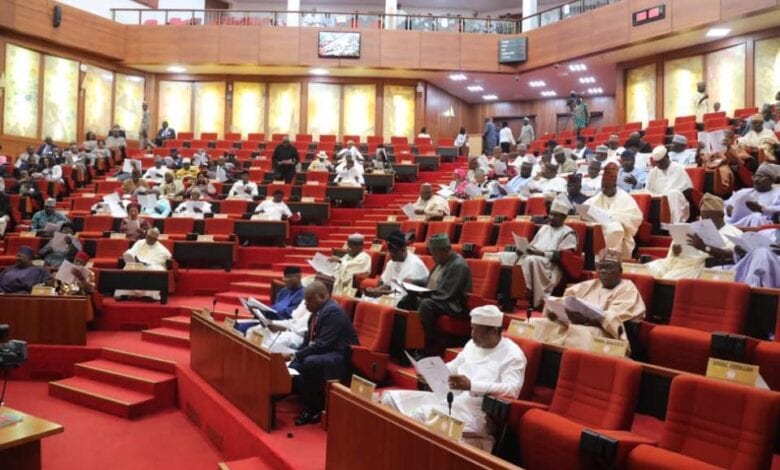
The Senate has commenced a sweeping investigation into trillions of naira reportedly generated from stamp duties since 2016, as part of a broader drive to promote fiscal transparency and block revenue leakages in the country’s financial system.
The probe, being spearheaded by the Senate Public Accounts Committee chaired by Senator Ahmed Aliyu Wadada (SDP–Nasarawa West), will scrutinize how much was collected from stamp duties on transactions involving individuals, companies, and government institutions, and how such funds were managed, remitted, or spent.
Speaking at a press briefing in Abuja, Senator Wadada said the inquiry was triggered by concerns over the opacity surrounding stamp duty revenues, despite the huge sums reportedly collected through banks and government agencies.
“The goal is to identify areas where revenue may have been lost and ensure that every naira collected is properly remitted and utilized for public good,” he added.
To this end, the committee has written to all commercial banks, the Central Bank of Nigeria (CBN), the Federal Inland Revenue Service (FIRS), and the Nigerian Governors’ Forum (NGF), demanding detailed records of stamp duty revenue from 2016 to 2024.
Each of these institutions is expected to submit comprehensive documentation — including figures, payment records, and remittance details, showing how much was generated, received, and transferred into the Treasury Single Account (TSA) or state treasuries.
According to Wadada, the committee’s letters direct commercial banks to disclose how much they collectively generated from stamp duty charges on individual and corporate transactions.
The CBN, he added, must provide evidence of remittances by the banks and transfers to the TSA.
The FIRS was also instructed to submit records of stamp duties collected on agreements involving federal agencies, private firms, and multinational corporations, particularly in the oil and gas sector.
Similarly, the Nigerian Governors’ Forum, through its chairman, Governor Abdulrahman Abdulrazaq of Kwara State, has been asked to disclose how much each state has received from stamp duty proceeds.
“This committee believes the exercise must be all-inclusive,” Wadada said. “We have written to the Governors’ Forum to provide information on all proceeds received by the states.
“This will help us understand what is where, and how effectively those funds have been used.”
Preliminary analysis by the committee’s consultants, he revealed, shows that “significant sums” were generated under the stamp duty regime, but he declined to cite figures until official submissions are verified.
He said, “We have a fair understanding of what is involved, but we won’t go public until we reconcile data from all sides.
“Only then can we make an informed statement on the true status of stamp duty revenue.”
The Senate committee has given all relevant institutions until November 25, 2025, to submit their documents. After that deadline, the panel will begin reconciling figures, investigating discrepancies, and summoning key officials for questioning.
Wadada emphasized that the probe aligns with President Bola Tinubu’s administration’s policy of maximizing national revenue and ensuring accountability in public finance.
He said, “It’s one thing to generate revenue; it’s another to ensure it is judiciously utilized.
“The amount being generated from stamp duties is humongous, and the legislature cannot afford to look the other way. Our responsibility is to ensure that every kobo works for the people.”
Analysts have long warned that stamp duties, a key non-oil revenue stream — remain poorly accounted for despite multiple reforms and policy directives.
The Senate’s latest intervention is seen as a decisive step to sanitize the process, close loopholes, and improve transparency.
Wadada dismissed any notion of political motivation, stressing that the committee’s work is driven by national interest.
He said, “This investigation is not about witch-hunting anyone,” he said. “It’s about ensuring that public resources serve public interest.
“Nigerians deserve to know how much has been generated in their name, and how those funds are being used to improve their lives.”
With the probe now underway, the Senate Public Accounts Committee has vowed to trace, audit, and reconcile every naira generated from stamp duties across all levels of government and the banking sector, a move many observers see as one of the most ambitious financial accountability drives in recent years.