By Seyi Odewale
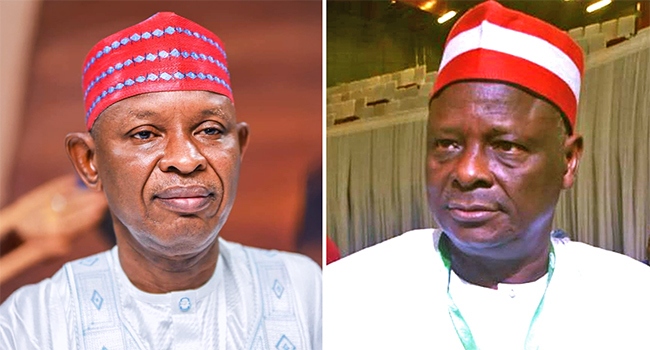
Kano State Governor, Alhaji Abba Yusuf, will today formally join the All Progressives Congress (APC), setting off what political observers describe as the most significant power struggle in Kano since the return to democracy, as he squares off with his former political benefactor, Rabiu Musa Kwankwaso, for control of the state’s estimated six million voters.
Yusuf’s defection follows his resignation from the New Nigeria Peoples Party (NNPP) on Friday, a decision he said was guided by public interest and the need to protect Kano from persistent internal crises that have weakened the party’s cohesion and effectiveness.
At the centre of the unfolding drama is Kano’s massive six million-voter population, the largest in the North and one of the most decisive on Nigeria’s electoral map.
Control of Kano has historically shaped presidential outcomes and regional power equations, making Yusuf’s move far more than a personal political decision.
It has now become a direct battle for the political soul of Kano.
Political strategists say the contest has crystallised into a struggle between Yusuf’s control of state power, the legislature, local governments and alignment with the federal government, on one hand, and Kwankwaso’s deep-rooted grassroots movement, emotional loyalty among supporters and long-standing political machinery, on the other.
With 2027 already in view, both men are positioning themselves as the authentic voice of Kano’s electorate.
*Gov joins APC today, registers with eight Reps, 21 state lawmakers, 44 council chairmen
According to a statement issued by his spokesperson, Sanusi Bature Dawakin-Tofa, Yusuf will formally register as an APC member on Monday alongside 22 members of the Kano State House of Assembly, eight federal lawmakers and 44 local government chairmen.
The governor is also expected to launch the APC’s e-registration exercise in the state, a move seen as the first step towards rebuilding the party’s grassroots structure ahead of future elections.
Yusuf had previously been a member of the APC in 2014 before defecting to the NNPP, under which he won the 2023 governorship election.
In his resignation letter addressed to the NNPP chairman of Diso-Chiranchi Ward, Yusuf cited leadership disagreements, internal legal battles and growing divisions within the party as reasons for his exit.
“This decision is in the best interest of the people of Kano State,” Yusuf said. “It is taken in good faith, without ill will, and with a continued commitment to peace, unity and progress.”
*Kano comes first, says Yusuf
Amid the political storm, Yusuf has sought to frame his defection as one driven by governance rather than personal loyalty.
Speaking during a Motorcycle Empowerment Programme for social media influencers at the Government House, Kano, the governor declared:
“Allah made me governor, not anybody else. Kano comes first, not loyalty to individuals.”
He said his administration remains focused on development, security, youth empowerment and economic growth, stressing that political alignment should serve the interest of the people, not political godfathers.
“My intention is purely the development of Kano and the well-being of its people,” he said, adding that the era of insults and disrespectful political language must end.
*Kwankwaso to supporters: ‘We remain resolute, victory assured’
Kwankwaso, the NNPP’s national leader and the face of the Kwankwasiyya movement, responded by projecting resilience and grassroots strength.
On Sunday, hundreds of his supporters stormed his residence in Kano in a solidarity visit, many arriving from Nasarawa Local Government Area and other traditional strongholds of the movement.
In a statement shared on his official Facebook page, Kwankwaso thanked the crowd for standing with him during what he described as a trying moment.
“Despite the recent trials that have tested the faith and fortitude of many, they have chosen to stand firmly with us, not for personal gain, but for the collective progress and well-being of our people,” he said.
“Together, we remain resolute in upholding and advancing the timeless ideals of Kwankwasiyya. The journey continues, and victory is assured by the grace of God and the will of the people.”
Earlier, Kwankwaso had described the day Yusuf resigned from the NNPP as “World Betrayal Day”, warning that betrayal in politics often attracts the harsh verdict of history.
The NNPP’s National Working Committee condemned Yusuf’s action, describing it as the biggest betrayal in the party’s history and rejecting his claim of unresolved internal crises.
The party insisted it recently conducted congresses and won supplementary elections, arguing that Yusuf’s explanation was an afterthought.
“We deeply regret that Governor Abba Kabir Yusuf, who benefited from the Kwankwasiyya movement, has chosen this path,” the party said, warning that his defection could reverse Kano’s political gains.
*Sacks ex-benefactor’s ally from govt
Meanwhile, in a move widely seen as part of the unfolding realignment, Yusuf sacked his Political Adviser, Sunusi Surajo Kwankwaso, a known loyalist of the NNPP leader, citing poor performance and rising internal tensions.
The governor said the decision was necessary to restore focus, unity and effectiveness in governance, stressing that loyalty must be to the people of Kano, not political factions.
He subsequently appointed Hon. Mustapha Hamza Buhari Bakwana as the new Political Adviser.
Several aides and political appointees believed to be loyal to Kwankwaso have since resigned their positions, opting to remain with the NNPP rather than follow Yusuf into the APC.
In the 2023 election, Yusuf won the governorship with 1,019,602 votes, defeating the APC’s Nasir Gawuna, who polled 890,705 votes, mainly on the strength of Kwankwaso’s grassroots mobilisation.
Three years later, the equation has shifted.
With Yusuf now commanding state institutions, the legislature, most local governments and the backing of the ruling party at the centre, analysts say the key question is whether institutional power and federal alignment can neutralise Kwankwaso’s emotional grip on the streets.