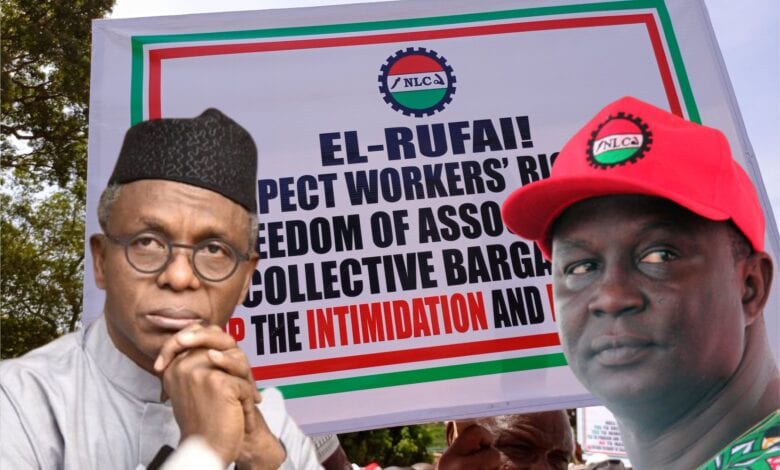
That announcement has come with a sigh of relief for all, but with it also came to a question, how often should Nigerians be expecting strikes from workers, who are always banking on such strikes, for creating bargaining leverage?
The legitimacy of strikes has always been a contentious issue between employers and employees, particularly the state governments, who see strikes as a challenge to their authority, power, and interests. For the government, work stoppages are often the most damaging, especially when done with surprises.
I want to put aside the legality or otherwise of the “when and how” workers should go on strike. I am more interested in the morality or otherwise of using such strikes to achieve missions, particularly in a weak capitalist economy, like Nigeria.
The Economists say Capitalism is a form of economic, political and social organisation that enables investors and traders to have a form of security, guaranteed by the State, based on individual initiative, and favours market mechanisms over government intervention.
So Capitalism is a major driver of innovation, wealth, and prosperity in the modern era, because, competition and capital accumulation combine to give incentives to businesses, to maximize production efficiency, or the capacity of a worker to do more or better work, or even both, during a specified period of time.
On the other hand, Socialism, which is where workers and our “comrades” tend to lean more, is based on government planning and limitations on private control of resources. So, while the central characteristics of capitalism are capital accumulation, through competitive marketing that permits the making of maximum profit, socialism, with its limitations on private control of resources, is more inclined to, and protective of workers wages.
Under socialism, wage labour becomes the socioeconomic relationship between a worker and an employer, where the worker sells their labour under a formal or informal employment contract. It is, for the pursuit of the essentials of such contracts that labour unions are formed, in order to represent the collective interests of workers, by bargaining with employers over such concerns as wages and working conditions.
So while serious governments are coming with an out of the box planning, that would enforce efficiency, representatives of labour would always be a spanner in the wheels, in order to ensure limitations on private control or use of resources.
And precisely that is where people like Mallam Nasir El-Rufai, who has arrived at the government house with a reformist mindset, would continue to clash with the labour unions. Mallam wants productivity driven by efficiency, while labour is fearful of forceful eviction because of the cruelty of capitalism.
FMDQ admits BUA cement N115bn bond, largest on debt capital market
But then, Nigeria is a capitalist country that has gotten everything coined and captured in the constitution after the American style. The country’s drive, albeit poorly, is to imitate America. Maybe that’s why it dropped from its national anthem, “Nigeria We Hail Thee”, which has been in use since independence in 1960, and adopted “Arise, O Compatriots,” in 1978, to sensitize the citizens to rise towards the propensity for capital accumulation.
In attacking Mallam Nasir El-Rufai, for seeking efficiency and productivity in the public service, some have missed the point, by thinking that the twin terms are supposed to be resident only in the private sector. No, capital NO.
The government’s basic functions are providing leadership, maintaining order, providing public services, providing national or state security, providing economic security, and providing economic protection. You cannot provide any economic protection if your leadership style is tilted towards the truncation of the treasury. An inefficient workforce cannot provide an efficient public service, or maintain any order in society.
Much as I subscribe to some of the submissions of Yusuf Shehu Usman, former Attorney-General and Commissioner for Justice of Nasarawa State, in his article, captioned, EL RUFAI AND THE PLANNED MASS SACK OF CIVIL SERVANTS: An Appeal For caution, my views differ, where he said, “El Rufai is trying to test the efficacy of textbook economic theory by proposing to lay off workers from the civil service on account of lack of productivity or funds to pay their salaries. One thing Mallam should know is that the civil service does not and can’t operate on the same principles of profiteering as the private sector. In classical economic theories, you will be right to argue on concepts like value for money, productivity and results from investment. However, the civil service is not strictly and originally based on such principles. It is seen largely as the benefits those who suffered themselves to go to school should derive from the system to the resources of which, they are co-owners.”
I particularly like his use of the word co-owner. This means there are other people with an equal stake in the resources. I am also in love with the phrase, “the benefits those who suffered themselves to go to school should derive.”
For someone to rise to the position of a commissioner, from Nasarawa state, which was created in 1996, I believe he must be above 20 years of age. Anyone that came to this world around that time, even if his parents are wealthy, must have enjoyed one form of educational assistance or the other, by way of scholarship, subsidy, or some sundry school services. If he checks amongst his peers, some have not gotten those privileges. Were they destined to be so denied? With the scholarship, you were paid and pampered to school, not suffered, I think.
If you devote 90% of the state’s resources to service the taste of only 10% of the people, whose “suffering in school” was paid for by the resources of the other co-owners, are you being just to them? If you say someone is a co-owner of a car, but the car is mostly, or almost always, driven by the other person, are you being just to him?
The failure of the elites, or those who benefitted from the system, to visit their conscience, and see what the less privileged would get if they make a sacrifice is a major problem we are having. And most of it is driven by sentiment and hypocrisy; the two evils a reformer would be quick to confront.
One Bayo Onanuga, put forward the question, “How much of state resources should be spent on governance, in paying salaries, pensions and other emoluments of civil servants and political appointees? 40%, 60%, 80%, 90% or even all?” In summary, he said, “Governor Nasir El-Rufai is fighting a new war that both the Federal and other 35 states and the FCT are shying away to confront, choosing instead to cower in fear of the blackmail of labour.”
While it is imperative for government to think out a solution on how best to serve the public interests, especially after learning from the covid pandemic, when workers were ordered to stay at home and the state did not collapse, labour leaders should learn to play within the latitude of the law, by staying away from politics, and remaining responsibly responsive.