By Mudiaga Affe, Kassim Omomia, Ben Ogbemudia, Andy Asemota and David Lawani
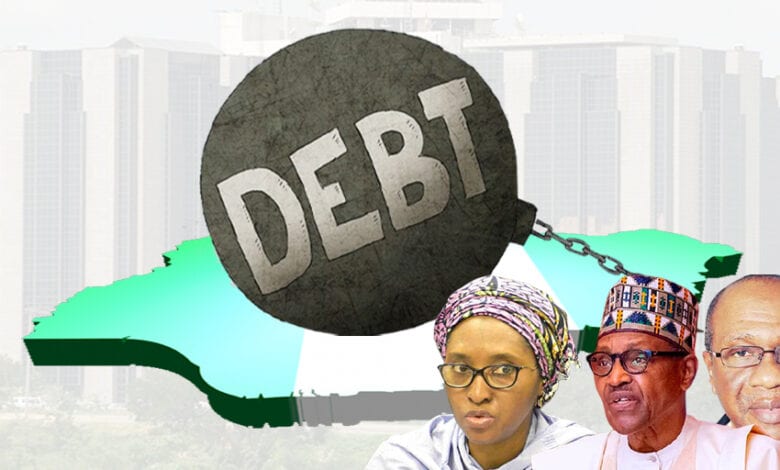
Nigeria is currently grappling with a heavy loan burden, many Nigerians, including economists, have declared.
Their verdict is coming on the heels of Senate President Ahmad Lawan’s statement that the country cannot stop borrowing because of its ‘poor’ financial standing.
Lawan’s comment has generated mixed reactions with many concerned Nigerians kicking against continued external borrowing to finance key projects, while others canvass that such an initiative is not out of order.
The Senate, on June 1, had approved a loan request of $5.513bn less than one week after receiving a letter from President Muhammadu Buhari.
The Upper Chamber, had last April also approved $2.7 billion external loan to fund critical projects in the country.
The President had last year also approached the National Assembly, seeking permission to obtain $5.5bn external funding to help finance budget deficits.
Nigeria’s debt profile as of December 31, 2020, stood at N32.915trn, representing a 20.13 per cent rise from N27.40trn recorded in December 2019, according to a Debt Management Office (DMO) report.
Despite the rising debt chart, the senate president insists that Nigeria being a poor country has no option but to continue to borrow to fund her infrastructure development.
But economic experts, Taiwo Akerele, and Tope Fasua, as well as a chieftain of the Nigerian Economic Society, Ganiyant Adesina-Uthman, among others, argue that circumspection should be the watchword for the country while seeking loans.
According to Akerele, Nigeria has not been able to mobilise up to 40 per cent of its capacity to mobilise local/domestic resources.
Akerele, a former Chief of Staff to Governor Godwin Obaseki of Edo State, said, “For us to borrow more, we need to audit the impact and performance of our previous borrowing and its effect on the economy so far.
“What area are we channelling the borrowed resources into and who manages them? Is it the government or private sector? For me, the government should guarantee the private sector to borrow while the private sector invests in key economic activities such as infrastructure, agriculture, production, marketing, and packaging.
“We need to FastTrack the reforms in the maritime sector so that Nigeria can be more competitive than its neighbours in terms of ease of doing business and therefore earning more resources from that sector.
“Our debt today as a ratio of our GDP is less than 30 per cent which is good but we need to match our capacity to mobilise local resources with debt sustainability.”
For Fasua, with the volume of projects and infrastructural deficit in Nigeria, she has to borrow to finance these projects.
Borrowing for projects, according to the economist, should be done in such a way that the projects can finance themselves after a particular stage.
Fasua, a former Presidential candidate of the Abundant Nigeria Renewal Party (ANRP), noted that if Nigeria intends to ramp up its infrastructure, then there is a need to borrow.
The economist said, “Certainly, with the kind of volume of projects that we need and our huge infrastructural deficit which is put at the region of $10trn. We will need to borrow. However, borrowing must not be done recklessly.
“We should borrow for projects that can pay themselves back with some degree. For example, the rail project. All over the world, the rail system is still subsidized but, at least, you get some balls in terms of people paying for tickets; you can still sell up on that and cover some ground.
Nigeria: How not to gag the media by Dan Amor
“There is a need for caution no matter what the case may be in that regard. For how long shall, we continue to borrow? Well, every nation borrows almost forever. But what we have not done is that in physical management in terms of revenue generation. Nigerians do not want to pay taxes, especially rich Nigerians.
“I saw a piece of advice recently from World Bank that says Nigeria should try and do more in the area of what it calls syntaxes. Taxes on luxury goods and what have you. Of course, we know that no matter what they say about Nigeria, Nigerians love to enjoy. They like enjoyment. That is an area of expansion that we can explore.”
On whether there are no alternatives to external loans, he said.
“It is indeed not an alternative for any country. What we should be doing even if we can move our taxes from six per cent of our GDP where it lies now. At $2.4bn, the FIRS can collect about N4trn in all of their areas of jurisdiction, including petroleum profit tax. Maybe taxes come to about NItrn. But if we can take that to N5trn, by serious work and what have you, we should also up the ante by trying to achieve more.”
Also, Adesina-Uthman, who urged the Federal Government to be cautious, noted that there was the need to seek alternative ways of financing major projects in the country.
Adesina-Uthman, an ex-head of the economics department, National Open University of Nigeria (NOUN) and now at the Nile University, appealed to the authorities to seek more interest-free financing as well as to tap into the capital market.
She said, “This is what most countries are using nowadays not just borrowing. Use your capital market, develop the market by issuing such bonds. Germany has tapped into it; the US has tapped into it; the UK has amended its tax laws to accommodate what it tags as alternative financing which refers to interest-free financing and banking, it also uses SUKUK.
“Different countries are using SUKUK for many things including funding of aircraft, hydrocarbon plants and many other things. So, why can’t Nigeria look into that instead of going outside to borrow? Let’s look at something domestic as the SUKUK and even international SUKUK that other countries can also invest in”.
On borrowing, the academic, who is a member, International Institute of Islamic Professionals, said, “Every nation borrows and borrowing is not a death toll. Even the US is borrowing up till today. Japan is the most indebted nation in the world today and the country is developed. Yes, when you look at their debts to GDP ratios, they are very high.”
Adesina-Uthman further noted that China is also borrowing but the issue is what nations expend such money on, adding that Nigeria may not be able to exit debtor nations club unless its loans are expended on projects generating more income.
She added, “When you borrow, you should plan how the projects you are expending the money on should be able to repay its loan and even generate more income.”
On whether Nigeria is poor or rich, the economist declared, “I can’t say Nigeria is poor. We are rich in human and material resources but there is a kind of resource gap because if a country is unable to manage her endowment very well, it will affect her productivity and she will become a consumer.
High cost of government’s overhead killing
Meanwhile, a Lagos-based lawyer and economic expert, Omoruyi Edoigiawerie, has attributed lack of infrastructure, wrong policy frameworks, hostile environment, backwardness in technology, unemployment and over-dependence on imported products among hindrances to the country’s development.
He said, “Based on the above, the question then becomes, despite the huge loan portfolio, why have these loans not accelerated the pace of economic growth in the country? The answer is simple, misplaced priorities, lack of strategic investment and high cost of governments overhead.
“No doubt borrowing is essential to the growth of the developing countries because most of them are consuming nations and lack the ability to save or invest. To be able to close these gaps, it is imperative for them to borrow.
“But when the country borrows and channels the same for a wrong purpose, it becomes a problem for the country to service her debt. This also affects the required growth and that is one of the problems that have affected our country.
“As far as I am concerned, the impact of foreign borrowing is lost on the average Nigerian and we are left with a burden that continues to weigh heavily on every government in power.
“So, rather than repeated borrowing without a constructive and attainable plan, I will rather recommend that we honestly audit our loan portfolio to see if truly they are serving the right purpose and more importantly, if really they are necessary.”
Lawan, Budget Office stand on loans
However, Lawan, who spoke against the backdrop of the nation’s current challenges said it was inevitable that the country should borrow.
The Senate president said, “What I want to assure Nigerians here is that we are not going to be frivolously supporting or approving loans for the executive arm of government. Whenever we must approve any loan, we must insist on the details of what projects will be funded by those loans. We will have to look at the conditions that are attached to the loans. They must be favourable conditions before we approve, and we will be up to date with our oversight to ensure that what we have approved is directly deployed and in those projects approved for implementation.
Abandoned project: Senate orders Fashola to recover N145m from contractor
“Our options are extremely limited as a country. First, we do not have the necessary revenues. Nigeria is poor, we should not deceive ourselves. Nigeria is not rich, given the circumstances we live in, given the challenges we have; our resources are so low. Our revenues are so low, and therefore the option of not doing anything, just to sit because we have no money, we should not go for infrastructure development is not even an option worthy of consideration. You cannot keep the economy stagnant.
“Two, you cannot, in my view and judgement, tax Nigerians further for you to raise the money for infrastructure development. Other countries do that, but we have serious situations across the country, so you cannot put taxes on people.
The lawmaker, who canvassed Public-Private Partnership, as an option, nonetheless said that the the security situation in the country was a big drawback.
Meanwhile, the Director-General of the Budget Office of the Federation, Dr. Ben Akabueze, also did not frown on borrowing.
He said, while featuring in a television programme on Thursday, “It is important, first of all, for that point to sink into Nigerians that we are not a rich country; we are a potentially rich country. But the reality today is that we are a poor country because looking at the definition of poverty is, when the resources you have simply cannot cover your needs you are poor. At the level of individuals, sometimes the decision as to what you do is easier. But at the level of a nation, it is not that straightforward.
“At the level of a nation, the government has certain mandatory obligations. For instance, the Constitution says the primary duty or function of government is the security and welfare of the people. So, if the security of the people is threatened, the government cannot say or throw its hands in the air and say we don’t have money, therefore, nothing should go on.
“It will be hard to find that country around the world that does not borrow. So, borrowing per se is not an issue; and sustainability is simply about putting your eyes on making sure that when it is time to pay up the debt that you borrowed (sic), that you can do so.”
On Nigeria’s current debt profile, Akabueze noted that the exchange rate between naira and dollar before and now is not the same.
He said, “It is also true that the government has taken loans substantially since 2015. First, there was a recession in 2016/2017. If you recall in 2015, oil prices sank, leading up to 2016. That triggered recession for many oil-producing and oil-dependent economies. That creates the need to borrow.
When an economy goes into recession – and that is part of what I was saying that a nation is not the same as an individual – nations tend to act counter-cyclically. When you find yourself in a recession, the time-tested way to get out of recession is to what we call ‘spending your way out of recession.”