By Nathaniel Zaccheaus, Abuja
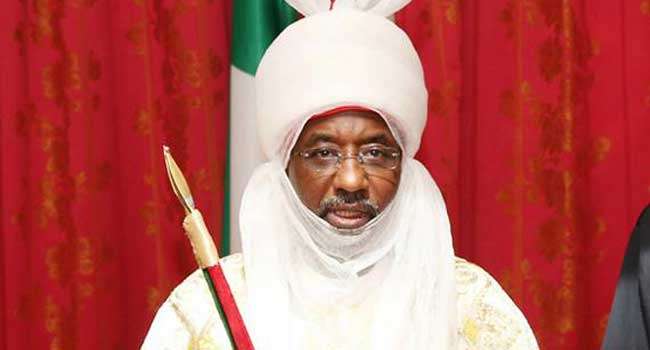
The Emir of Kano and former Governor of the Central Bank of Nigeria (CBN), Muhammadu Sanusi II, on Thursday warned leaders of the Economic Community of West African States (ECOWAS) against launching the proposed ECO common currency without first establishing strong economic foundations across the sub-region.
Sanusi said monetary integration would remain unattainable if member states failed to achieve macroeconomic convergence, fiscal discipline, institutional independence and political cohesion, stressing that a common currency cannot succeed where economies remain weak and fragmented.
Speaking at a one-day Policy Dialogue on “ECO Currency and Monetary Integration in West Africa: Implications for Nigeria,” organised by the National Institute for Legislative and Democratic Studies (NILDS) in Abuja, the former CBN governor cautioned against allowing political ambitions to override economic realities.
“A currency is only as strong as the economy behind it,” Sanusi declared.
“History shows us that successful monetary unions are built on economic convergence, institutional credibility and shared prosperity, not aspiration alone.”
While acknowledging the potential benefits of the ECO project, including lower transaction costs, expanded trade opportunities and improved competitiveness, he maintained that the proposed currency should emerge only after the region has achieved deeper economic integration.
According to him, West Africa possesses enormous economic potential, with a population of about 450 million people and a combined Gross Domestic Product estimated at nearly $900 billion.
“All over the world, you are having cooperation and collaboration. Africa is still insular and fragmented, and we need to take that step towards greater economic integration,” he said.
“The challenge before us is transforming this population into purchasing power, productivity and market integration.”
Sanusi described the region’s youthful population as a strategic advantage that can drive economic growth if properly harnessed.
“These children have been born. These youths are alive. We are not going to bury them. What do you do with them? Do you turn them into economic agents that add to your productivity, or do you leave them as idle bandits, terrorists and thugs?” he asked.
He argued that a common currency could significantly enhance West Africa’s attractiveness to foreign investors by creating a larger, more integrated market and eliminating exchange-rate barriers among member states.
“Investors are better off looking at a West African economy with a single currency and no trade barriers than looking at Nigeria, Ghana or Sierra Leone alone,” he said.
However, he stressed that the ECO should be viewed as the final stage of integration rather than its starting point.
“The common currency is often the most visible feature of a monetary union, but success depends on deeper economic and institutional foundations.
“While the common currency is listed as number one, it is actually the last step at the top of a pyramid,” he stated.
Sanusi identified political commitment, strong institutions, trade integration, labour mobility, financial integration, fiscal discipline and economic convergence as critical conditions for a successful monetary union.
He expressed concern over the strained relationship between ECOWAS and the Alliance of Sahel States (AES), comprising Niger, Burkina Faso and Mali, warning that regional divisions could derail efforts toward monetary integration.
“You cannot be talking about a common currency with Niger, Burkina Faso and Mali when you are threatening them with force in their internal matters. They will not even listen to you,” he said.
“Politics is so dominant in world affairs. If we do not manage the politics well, the economics can never work.”
The former CBN governor urged ECOWAS leaders to rebuild trust and pursue reconciliation with the three countries, insisting that regional unity remained indispensable.
“The unity of West Africa is sacrosanct. Whatever issues you have, you resolve them within the framework of a united ECOWAS,” he said.
Drawing lessons from Europe, Sanusi noted that the Eurozone did not begin with a common currency but first achieved substantial convergence in economic fundamentals and institutional standards before introducing the euro.
He also defended central bank independence, warning that governments must resist the temptation to finance expenditure through excessive money creation.
Sanusi further warned against unsustainable borrowing, saying many countries in the region, including Nigeria, must exercise greater fiscal prudence.
Presenting data on inflation, fiscal deficits and trade patterns, he argued that West Africa remained ill-prepared for a common currency.
According to him, intra-regional trade within ECOWAS currently accounts for only about 10 to 12 per cent of total trade, compared with roughly 60 per cent within the European Union.
Sanusi concluded that the ultimate objective should be regional prosperity rather than the symbolic adoption of a common currency.
Earlier, the Director-General of NILDS, Professor Abubakar O. Sulaiman, described the ECO initiative as a far-reaching economic and political project that requires rigorous and evidence-based evaluation.
He said the proposed monetary union carries significant implications for the sovereignty, stability, and prosperity of ECOWAS member states, particularly Nigeria, the region’s largest economy.
“The quest for a common currency within the ECOWAS sub-region is not merely a technical pursuit; it is a profound economic and political undertaking with significant implications for the sovereignty, stability and prosperity of member states,” Sulaiman said.
He added that the dialogue was convened to generate practical policy recommendations to guide lawmakers and policymakers as they navigate the opportunities and challenges of regional monetary integration.