By Cross Udo, Abuja (with agency reports)
Nigeria’s diplomacy was in full gear on Tuesday as the Federal Government, the Economic Community of West African States (ECOWAS), and China closed ranks in rejecting what they described as “provocative and unjustifiable” remarks by the United States President Donald Trump, who threatened military action against Nigeria over alleged killings of Christians.
The statements of solidarity, one from Beijing and the other from Abuja’s sub-regional allies, came just hours after Minister of Information and National Orientation Mohammed Idris briefed State House correspondents following a closed-door meeting with President Bola Tinubu at the Presidential Villa.
Together, the reactions painted a vivid picture of a government refusing to be rattled by external rhetoric, a region rallying around its biggest democracy, and a global ally, China, reinforcing Nigeria’s sovereign right to manage its internal affairs without coercion.
In a show of regional unity, ECOWAS on Tuesday rejected the narrative of a religious genocide in Nigeria, warning that such falsehoods threaten the fragile stability of the entire West African sub-region.
The regional bloc, in a communiqué from its Abuja Secretariat, emphasised that terrorism and violent extremism in the region have no religious face and that the killings in Nigeria and neighbouring states are “indiscriminate acts of terror targeting Muslims, Christians, and traditionalists alike.”
“ECOWAS stands with the Government and people of Nigeria at this time,” the statement read.
“External powers must exercise restraint and avoid interventions that could destabilise our region. West Africa’s collective security cannot be safeguarded through threats of force or unilateral declarations.”
The bloc stated that it would continue to collaborate with Nigeria and other member states through joint security operations, intelligence sharing, and cross-border initiatives aimed at defeating terrorist networks operating across the Sahel and Lake Chad Basin.
Diplomatic observers see ECOWAS’ statement as both a moral and strategic alignment with Nigeria, given the country’s pivotal role in peacekeeping missions and regional economic stability.
Addressing journalists after meeting with the President, Information Minister Mohammed Idris dismissed the allegations of anti-Christian genocide as “a dangerous fabrication designed to inflame division and weaken national unity.”
He said President Tinubu remained composed and measured despite the alarming comments from Washington, and that the matter was discussed extensively during the Villa meeting.
“The President is calm, deliberate, and diplomatic. He is handling the matter with the seriousness and depth it deserves,” Idris told reporters. “Nigeria is engaging its allies through proper diplomatic channels to ensure that the true picture of our internal security situation is well understood.”
According to Idris, the renewed propaganda suggesting systematic persecution of Christians is being pushed by extremist groups, “some of whom operate outside our borders, manipulating religion to sow hatred and instability.”
He emphasised that President Tinubu’s administration remains committed to national cohesion, noting that both Christian and Muslim leaders continue to engage with the President to foster deeper understanding and cooperation.
“Our constitution guarantees freedom of worship,” Idris reiterated. “No Nigerian is denied the right to practice their faith. The Tinubu administration protects all citizens equally, regardless of religion, region, or ethnicity.”
The Minister also pointed to the government’s ongoing security reforms—including the appointment of new service chiefs and the recalibration of the defence architecture—as evidence of its determination to defeat terrorism without bias.
*China steps in: Sovereignty first, interference rejected
Far from Abuja, Beijing’s corridors of diplomacy also reverberated with support for Nigeria.
At a press briefing in the Chinese capital, Foreign Ministry spokesperson Mao Ning stated that China “firmly stands with Nigeria” and condemned any discussion of foreign military intervention.
“No country has the right to threaten invasion or use religion and human rights as excuses to interfere in another nation’s internal affairs,” Mao declared.
“China opposes coercion in international relations and supports Nigeria’s efforts to maintain stability, unity, and development in line with its national realities.”
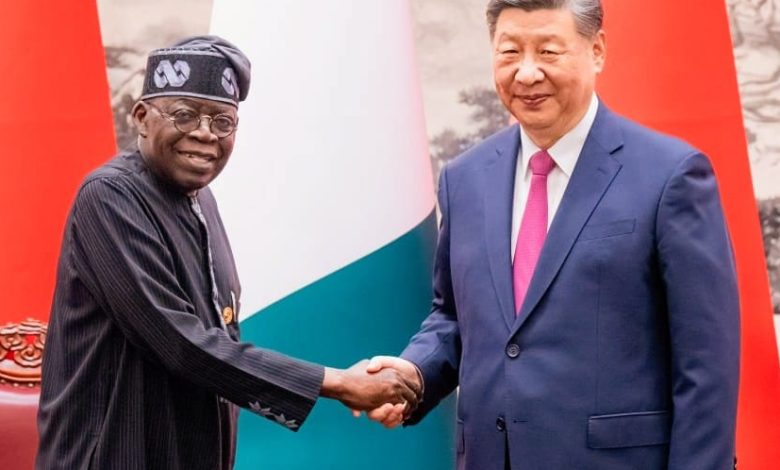
Beijing described Nigeria as a “comprehensive strategic partner,” noting that both countries share mutual respect, non-interference, and a commitment to development cooperation.
With Nigeria serving as Africa’s largest economy and a key supplier of energy and resources, Beijing’s voice carries strategic weight at a time when Western rhetoric appears increasingly confrontational.
The diplomatic storm began when President Trump, in a series of posts on his Truth Social platform, accused Nigeria of allowing “the killing of cherished Christians” and threatened to authorise military strikes against the country.
The remarks, made over the weekend, provoked widespread condemnation across diplomatic circles, with commentators calling them “reckless, dangerous, and unbecoming of a former leader.”
When pressed by journalists aboard Air Force One if his comments were serious, Trump replied cryptically, “Could be. I envisage a lot of things.”
Nigeria’s Presidential spokesperson Daniel Bwala told AFP that while Abuja values its partnership with the US in counterterrorism efforts, it would “reject any form of interference that undermines its sovereignty.”
He said both countries have open diplomatic channels and that “facts, not emotions,” would guide any future discussions.
“We are confident the truth will prevail,” Bwala said. “Nigeria welcomes support in combating terrorism, but always within the bounds of mutual respect and territorial integrity.”
With ECOWAS’ solidarity and China’s vocal backing, Nigeria is repositioning itself as a confident regional power determined to resist coercion and misinformation.
“The characterisation of Nigeria as religiously intolerant does not reflect our national reality,” Tinubu was quoted as saying recently. “Ours is a country of shared hope and mutual respect. We must not allow our diversity to be exploited by those who seek to divide us.”
Behind the scenes, government sources confirmed that Abuja has launched discreet consultations with the African Union, the United Kingdom, and the United States to de-escalate tensions and reaffirm Nigeria’s commitment to democratic values and religious harmony.
A senior presidential aide summed up the government’s approach, “We are handling this through dialogue, not confrontation. Nigeria has nothing to hide. What we need is understanding, not threats.”