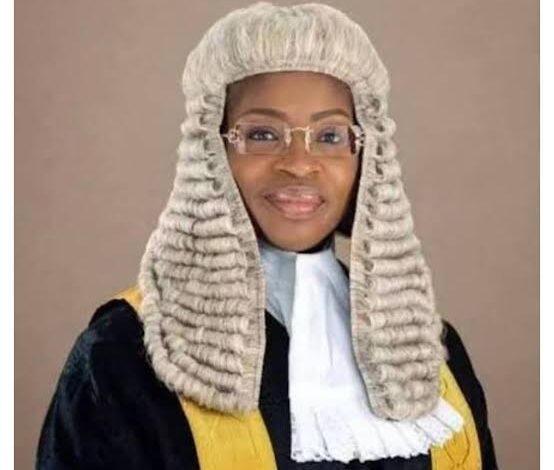
The President of the Nigerian Bar Association (NBA), Oyinkansola Badejo-Okusanya, SAN, has pledged to make technology-driven justice delivery, efficiency and greater inclusion central to her administration. She says Nigerian lawyers should no longer waste valuable man-hours waiting endlessly for cases to be called in court, while promising an NBA that responds more effectively to the professional and welfare needs of its members. She spoke on Channels Television’s Politics Today programme, monitored by David Lawani
As the 33rd President of the NBA, how does it feel to assume the position finally?
I feel humbled, and I think it’s about time. And here we are. So, yes, it feels good.
Have you settled into office?
I’m settling in.
Are you finding the experience as you expected it to be?
Yes, because I’m not really a stranger to the workings of the NBA or the secretariat. I had the privilege of chairing a national committee for two years running, and in that capacity, I had to spend a lot of time at the secretariat with the secretariat staff. So, it’s almost like a homecoming. I had ideas of what I would meet on the ground, and luckily, I’ve been able to hit the ground running. I also have a wonderful team of executive committee members supporting me. So, it’s been tasking but fulfilling so far.
You are leading a very important and strategic body. When you assumed office, what state did you find the NBA in?
In a very healthy state. As a matter of fact, we have a very healthy bank account, which my predecessor in office announced very publicly. So, that has put me under a bit of pressure because everybody is expecting, “Okay, we have a very healthy bank balance, and so we expect a lot from you.” Beyond that, and that’s by way of a light-hearted comment, there were no surprises. I mean, I campaigned because I understood the NBA, and I understand, I think, what members want. I designed a manifesto to help to meet members’ aspirations. So, there were no surprises, really. Just the scope of the work that needs to be done and a determination to do it.
What gave you the conviction that you could win the election, especially considering that the NBA has traditionally been a male-dominated space, and are you correct that you are the first woman to be elected president?
Yes. First woman elected. We’ve had a female president before—a female before.
So, what gave you that conviction, and can you also take us through the process leading up to your election?
Okay, so my conviction, first of all, I would say, stemmed from belief in myself. Belief that I could do it and a refusal to see gender as a barrier. So, just like any other person, any man, let’s take a man, for example. Any man who decides, “I want to do something,” and then nothing stops him; he goes for it. That’s exactly what I did. But I realised that in a male-dominated society, as you say, I would need to do more. So, I was very strategic. I realised that, first of all, I don’t like tokenism. And I realised that relying on gender was not going to cut it. It’s not even my style. It’s not who I am. So, I needed to make the members understand that I’m a capable lawyer and a potentially excellent president before they saw me as a woman. I needed them to take away the toga of, “A woman is running. Can she get the job done?” And so, that was what I intentionally focused my strategies on: showing members that I understood what the Bar needs at this time and that I was capable enough to execute it. And I think, to a large extent, with the help of my wonderful public relations practitioner husband, who was my greatest strategic director, I think, to a very large extent, I was able to show that. And, I mean, I’ve won now. So, to a large extent, I was able to show that this was not about gender.
Was the journey to the presidency easy or difficult?
No, no, no, no, no. I mean, it wasn’t easy. It wasn’t—I wouldn’t say difficult. It was challenging, like every serious endeavour is. It was challenging, but I wouldn’t say it was difficult. And, you know, that presupposes that maybe I feel it was difficult because I was a woman. I like to move away from those kinds of suggestions. It was challenging, as it should be. It’s not a joke to aspire to lead the largest Bar in Africa, and a Bar that consists of members who are extremely sophisticated in their thinking, know exactly what they want and know who they are. And so, I designed strategies to meet the challenge of the enormity of the aspiration. So, it wasn’t difficult. It was challenging, and I overcame the challenge.
When we consider that it took about three decades for a woman to emerge as an elected NBA president, what do you think explains that long gap?
Not 33 years, if I recall. The last time we had a female president was 30, not 33. I’m not talking about the election. She won an election as first vice president.
First vice president?
First vice president, exactly. And if she had—she actually contested to be president immediately after. But we went into a crisis, which is a totally different story. But she did win an election and probably could and would have won the election for president if we hadn’t had a crisis.
So, how long ago was that, and what do you think could have been responsible for the long period before another woman emerged to lead the NBA?
No, not how long ago. It was more about what could have possibly been wrong in this long period of time. So, I wouldn’t say wrong, right? I would say the same challenges that confront many otherwise capable women, but this socio-cultural environment makes it difficult, right, to aspire quite as easily as, say, a man would. And so, it’s not for the lack of capable women, but perhaps more the lack of an enabling environment to help any but the most determined of women to push through. So, we’ve had people try to run in the past, and a much-respected member of our profession, a senior lawyer, a very senior lawyer, Mrs Funke Adekoya, Senior Advocate of Nigeria and chartered arbitrator, tried twice to run and went the whole hog both times and, unfortunately, didn’t succeed. Perhaps the Bar wasn’t quite ready for a female president at the time. I don’t know. But she pushed and pushed very hard. And it is on account of efforts like hers that people like me dared to try again and get it done. And I’m hopeful that this has also inspired a lot more women to push beyond whatever challenges there are. Because almost like once you break past that barrier, it becomes easier. And I’m also hopeful and consistently praying that we will succeed spectacularly so that people who are sceptical of female leadership will become less sceptical. And then the ultimate goal is for gender to no longer be part of the conversation. And let’s just see capable people, whether they’re male, whether they’re female.
You campaigned on a promise that your NBA would not be afraid to speak truth to power. What exactly do you mean by that?
Okay. So, our motto is to promote the rule of law, right? So, I like to say we promote and we protect the rule of law. That’s our motto. It’s a no-brainer. That’s who we are. That’s the obligation that we owe to society for the right to be called learned gentlemen. We know the law. And so, we know what a society that is governed by rules and regulations should look like. And therefore, because we know the law, we should be the quickest to protest any time those rules and regulations are being violated because then we descend into anarchy, and we don’t have a society anymore. And so, when power, as it often does, infringes on rules and regulations, power will always test the boundaries, right? There must be a group of people who are alive to the responsibility of ensuring that power is contained so that anarchy does not reign. So, that’s what I mean by speaking truth to power. Now, do I think that the most effective Bar is the Bar that is combative? No. I think the most effective Bar is the one that responsibly discharges its obligations, which means commending government when they do well, collaborating with government when partnership is required, and coming down hard on government when they make infractions that suggest that we are no longer operating a democracy. Because if we don’t, then we won’t have a nation that we can be proud of. So, that’s what I mean by speaking truth to power.
Against the background of executive lawlessness and disobedience to court orders, what will the NBA do differently under your leadership to hold government accountable?
So, flowing from what I just said, right, differently is a matter of opinion. The NBA has never shirked in its responsibility to call government to order, to point out infractions, to issue statements on things that are going on. We’ve never shirked in that responsibility. Some might argue that it’s not always effective and we just make all these statements and nothing happens. That’s why I said differently. So, what I would do differently, if I could even call it that, is just to continue what successive NBA presidents and their sessions have always done: engage. See, engagement takes various forms. For me, I am result-oriented, result-driven. When the occasion calls for issuing a strongly worded statement, and that strongly worded statement will get the desired results, that’s what we’ll do. When it comes to seeking an audience to engage verbally, eye to eye, we will do that too. All the time, we’ll be guided by the results that we want to achieve. Because at the end of the day, if you are taking steps that don’t result in any tangible action, then it’s as good as not doing anything. So, if you ask me what I would do differently, it would be that I would be result-driven. I want to see the results of whatever engagement we have and ensure that what we’re doing is not just platitudes. It’s actually resulting in something tangible.
Let me take you back to the NBA conference that just ended in Port Harcourt. There have been public reactions to some aspects of the conference, particularly the invitation of social media influencer VDM, especially in light of comments by Senior Advocate of Nigeria, Femi Falana. Do you have any regrets about that invitation?
First of all, you make a presumption that I have been following the public outcry and the comments. I’ve been far too busy trying to get inaugurated and to settle into office to follow the public commentary. That being said, everybody is entitled to their opinion. The conference has come and gone. Whether anybody likes it or not, VDM has been invited, and the conference has gone on. In fact, I think the conversation and people’s comments about it are quite healthy. Let people express themselves. It’s unhelpful right now, though, for me to make any comments about it because it’s come and gone. So, let’s just move on from it.
Is the NBA standing by its decision to invite VDM, or could the association reconsider such invitations in the future? More broadly, what is the NBA’s official position on that invitation, and has it reacted publicly to the criticisms?
No.
So, would it be fair to say that you are indifferent to the controversy surrounding the invitation?
Indifferent is not a word that I would use in this context. I think it’s not really an issue. And it’s really, to the extent that it’s come and gone, not really worth discussing. It’s really a non-issue now. It’s what we call moot. So, there’s really nothing to say.
Have you followed the conversations about the alleged politicisation of the NBA? The FCT Minister made allegations against former Rivers State governor Rotimi Amaechi, who attended your conference, accusing him of locking up the courts. He also questioned why a reputable organisation like the NBA would invite someone with such an allegation hanging over him. What is your response?
Again, my reaction would be the same as what I said earlier with regard to the invitation to VDM. Now, Mr Rotimi Amaechi, as I understand, is a candidate in the forthcoming election. The NBA had a session during its conference, as it rightly should, inviting the people who seek to govern us in the next dispensation to share their plans with Nigerian lawyers and, by extension, with the Nigerian public. Absolutely nothing wrong with that, just as the Honourable Minister is entitled to his view. And that’s politics for you. And we’ll see a lot more of that between now and 2027. So, I mean, we will continue to do what we’re meant to do. Our conferences will always be a platform for discourse about the things that affect us as a nation.
But does the allegation that Rotimi Amaechi locked up the courts in Rivers State while he was governor not raise a legitimate concern about his invitation to an NBA conference?
Well, why don’t we allow Rotimi Amaechi to answer that question himself? I would have imagined that that question should be put to him. So, that’s the opinion that the Honourable Minister has expressed. I think the next thing you should do is invite Mr Amaechi onto your programme and then ask him, “You heard the Minister’s comments. What’s your reaction to the fact that you locked up the court for two years?” I think that would actually make for very interesting watching.
Let’s now turn to your priorities for the NBA. You have experience working on justice-sector reforms in Lagos State. How do you intend to bring that experience and those reforms to the national level?
Working in the secretariat administration is one of the greatest privileges of my life and a distinct advantage in this new role. Because, as you said, I was involved in justice-sector reform. And the NBA right now stands at a pivotal time. We need significant reform within the profession. And so, I feel so prepared to lead that charge because of that experience. And so, when you say, what are my priorities? Inclusion, inclusion, inclusion. We have an association that is made up of diverse types of lawyers, people who practise in various areas, perhaps much more than before. We have lawyers in academia, we have law officers, we have lawyers in the armed forces, we have in-house counsel, we have the barristers, we have lawyers who practise in other areas outside of the law. And all of them are members. All of them require the support of a modern professional association that puts their needs first. That is the exciting time I find myself in. I’m looking forward to helping to build on the foundation that has been laid, an association that meets its members’ needs, that is relevant to its members at any stage of their professional life. So, my priority is inclusion. The lawyer that practises in the remotest area of the remotest state to the lawyer who practises in the most urban of centres in Nigeria—to feel that the NBA cares about them, sees them, understands their challenges and is doing things to help them progress professionally, to earn better.
That brings me to remuneration for lawyers, which has been a major concern for many practitioners. Some now feel that the profession is no longer financially rewarding and that one almost has to pursue it purely out of passion. What is your view?
But it’s not true of everything in life. It’s not true of everything in life. You have to have some level of passion for everything you do. Otherwise, is it worth it? I’m sorry to have cut you short. To answer the question that you were about to ask, yes, remuneration is a challenge, particularly for our most vulnerable members, the young lawyers. And for too long, we’ve been steeped in what some call tradition and the culture of the profession. You know, you do pupillage. I’m training you, and so I don’t have to pay you. To be honest with you, it feels and looks like modern-day slavery. But I don’t think it’s coming necessarily from a place where senior lawyers want to oppress junior lawyers. I think what we need is a paradigm shift. Now, what we hope to achieve in this administration is to engage in robust communication, right, to help to shift these mindsets, to do everything we can to ensure that younger lawyers are paid living wages by any means possible—by coercion, by communication, by engagement, by incentives. You know, we need to shift those views because, at the end of the day, the younger lawyers, particularly in areas of traditional practice, carry the bulk of the work. They should be properly remunerated. The notion of not paying because you’re under-populated is really an outdated one. And sometimes I think we haven’t done enough to engage with our senior lawyers so that they understand the challenges that younger lawyers are going through. It’s too easy to dismiss because perhaps it’s been too long since you were there, so you no longer understand or you no longer empathise. Many of our colleagues, they’re bright, they’re driven, they want to succeed, but they simply can’t because the cost of living or getting from one place to another is just too high. We need to bridge the gap between understanding that and, you know, making sure that this is better understood.
What, in your view, needs to be done to speed up justice delivery in Nigeria?
It needs collaboration from all the stakeholders. The NBA is in a pivotal position to help drive that. I hope that we can achieve that. You see, two years is a short time, and I don’t want to sound like I’m ready to take on the world and do everything. What I hope to achieve at the end of this administration, along with the wonderful members of the executive committee with whom I’ve had the privilege of being elected, is to put in place the building blocks for us to build on a more robust foundation in the legal profession. That all the aspirations, all the places we should be in various aspects of justice delivery, access to justice, speedy dispensation and all of that, the NBA strengthens its role in that ecosystem to continue to push and ensure that the things that need to change happen. So, one of the things that I hope that we’ll be able to do very quickly is to have an engagement with the judiciary to try and achieve some quick wins, some low-hanging fruit. Things as simple as having a nationwide policy on sitting at nine as a matter of course, because all these have their impact on access to justice, right? Sitting at nine, like having communication channels whereby we ensure that if a court, for the remotest of reasons, is not going to sit, then lawyers are informed in advance so that we don’t have to bear the cost and the clients don’t have to bear the cost of going all the way to court only to find out that court is not going to sit. We want to try and see how we can partner with the judiciary to take advantage of all that technology has to offer. So, shuttling, for example. I don’t have to go to court from 9 a.m. when my matter is not likely to be called before 1 p.m. It’s a waste of man-hours. At the end of the day, if we had tracking devices, we would be astounded at just how much is being lost in terms of money and human resources. So, these are the kinds of things that we’d like to use the instrumentation of the NBA to help drive, as a catalyst for moving ourselves more and more into the 21st century. You know, as far as technology is concerned, we’ve seen other countries take advantage of remote sittings.