By David Lawani
For decades, residents of Igarra, the administrative headquarters of Akoko-Edo Local Government Area of Edo State, have lived with the rains as part of the rhythm of life.
The rains nourished farms, replenished streams and cooled the rocky hills that define the landscape of the ancient community. They marked planting seasons and promised harvests. They were familiar companions.
But on the night of July 13, the rains arrived carrying a different message. They brought destruction.
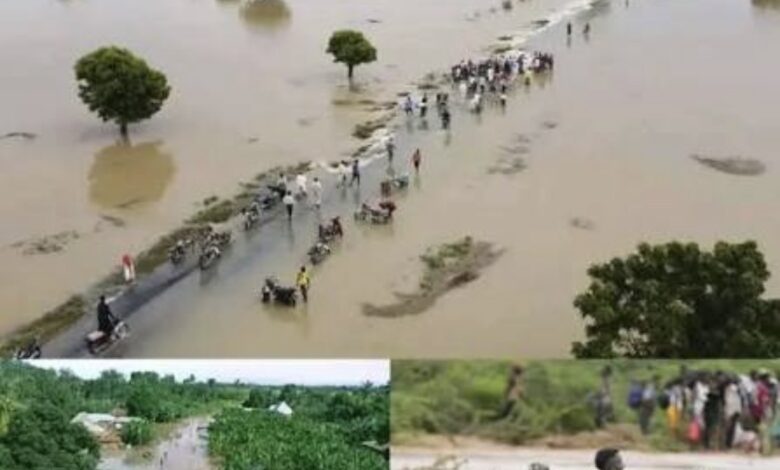
What began as a heavy downpour quickly turned into a torrent that overwhelmed drainage channels, submerged roads and swept through homes and businesses with frightening force.
By dawn, a town known for its quiet charm had become the scene of one of the worst flooding incidents in its recent history.
Market Road disappeared beneath muddy water. Old Shege and Upper Lawani Street became impassable. Police Station Road and Rest House Road were cut off, while the Success Road Bridge suffered extensive damage, isolating sections of the community and disrupting movement.
Families watched helplessly as mattresses, electronics, food supplies and household belongings floated away in the current.
Shop owners stood outside flooded premises, unable to salvage goods accumulated over years of labour. For many, the flood was not merely a natural disaster; it was an economic catastrophe.
Then came the news that transformed the tragedy into something more personal.
A resident, identified only as Uche, reportedly mounted his motorcycle to retrieve valuables from his flooded home along the Igarra-Somorika Road.
Like countless Nigerians confronted by sudden disaster, he was trying to save what represented years of sacrifice and hard work.
He never returned. His body and motorcycle were recovered from the floodwaters the following day. For his family, the flood was no longer about damaged roads or submerged homes. It was bereavement.
Behind every flood statistic lies a human story, and behind every death is a family learning to live with a space that can never truly be filled.
The Paramount Ruler of Igarra and Akuku Clan, Oba E.A. Saiki II, described the disaster as one of the worst to hit the community in recent memory and appealed for urgent intervention from both the Akoko-Edo Local Government Council and the Edo State Government.
According to the monarch, the destruction exceeded what affected residents could handle without external support.
“Many homes lost their roofs while businesses suffered heavy losses beyond the capacity of victims to rebuild without government support.”
The royal father warned that rebuilding roads and bridges may prove easier than helping families rebuild their lives and livelihoods.
Former Protocol Officer to the Akoko-Edo Local Government Chairman, Ojo Lawanson, struggled to find words to describe what residents witnessed.
“Roads turned into rivers and bridges collapsed under the force of the flood.”
His words captured the helplessness of residents who watched years of public investment disappear within a matter of hours.
For another resident, Ajugu Michael Monday, nature alone should not shoulder the blame. He argued that poor environmental habits worsened an already dangerous situation.
“Indiscriminate dumping of refuse into drainage channels and poor environmental practices worsened the disaster.”
His observation echoes concerns repeatedly raised by environmental experts across Nigeria.
Rainfall may be natural. Disaster often is not. Blocked drainage systems, unchecked construction and poor waste disposal habits frequently determine whether communities survive heavy rainfall or succumb to catastrophe.
Community leader, Chief Oseh Azayirama, believes the response cannot end with sympathy visits and condolences.
“We need immediate clearing of waterways, reconstruction of damaged bridges and humanitarian assistance for affected families.”
His appeal reflects sentiments increasingly heard in flood-ravaged communities across Nigeria. Several hundred kilometres away in Lagos, residents were confronting a remarkably similar reality.
The geography was different. The skyline was different. The suffering was not.
In the Eti-Osa Local Government Area, floodwaters invaded homes, submerged roads, and paralysed businesses in communities including Ogombo, Awoyaya, Sangotedo, Gbetu-Iwerekun, and Chevron.
Families abandoned ground-floor apartments. Vehicles stalled in flooded streets. Businesses shut their doors. Economic activities slowed dramatically.
Governor Babajide Sanwo-Olu spent several hours moving through affected communities, listening to residents recount stories of displacement and loss.
The governor acknowledged the severity of the flooding but argued that human activities had compounded the effects of the heavy rainfall.
“We have observed constriction and impediments arising from developments along the natural flow of water.”
According to him, aerial assessments revealed that several structures had been erected directly on drainage channels and natural waterways leading into the lagoon.
Water, experts often say, never forgets its path. Eventually, it returns to reclaim it.
Sanwo-Olu announced plans to dredge and open critical water outlets to relieve pressure on affected communities.
“If we can open these two water outlets, this will significantly relieve the pressure.”
Residents welcomed the intervention, but many quietly wondered whether the measures would arrive before the next major rainfall.
The story unfolding in Igarra and Lagos is increasingly becoming Nigeria’s story.
In Lokoja, residents brace for the annual meeting point of the Rivers Niger and Benue.
In Makurdi, farmers watch nervously as floodwaters threaten crops approaching harvest.
In Bayelsa and Rivers states, seasonal displacement has become almost institutionalised in some riverine communities.
In Kebbi and Jigawa, homes and farmlands disappear beneath water with disturbing regularity.
In Borno, floods have repeatedly compounded humanitarian crises already created by years of insurgency and displacement.
Different geography. Different cultures. The same fear. Destroyed roads. Collapsed bridges. Submerged schools. Displaced families. Lost livelihoods. The economic implications are enormous.
Floods destroy crops and contribute to food shortages. They damage roads and increase transportation costs. They disrupt businesses and reduce household incomes. They strain already overstretched public resources.
For poorer households, recovery can take years. Some never recover at all.
Climate scientists warn that rising global temperatures are increasing rainfall intensity across West Africa, making extreme weather events more frequent and less predictable.
But climate change explains only part of the problem.
Poor urban planning continues to expose millions of Nigerians to avoidable risks. Drainage infrastructure remains inadequate in many cities. Construction on waterways persists despite repeated warnings. Environmental regulations are poorly enforced while waste management systems remain weak.
Many experts now argue that flooding in Nigeria is becoming as much a governance problem as an environmental one.
The country already possesses institutions responsible for flood forecasting and early warning systems. The Nigerian Meteorological Agency regularly issues rainfall predictions, while the Nigeria Hydrological Services Agency publishes annual flood outlooks.
Yet warnings often arrive in communities as newspaper headlines rather than actionable plans.
Preparedness remains the missing link. Communities frequently receive warnings. They rarely receive protection.
For residents of Igarra, however, debates about climate adaptation and urban planning feel distant.
Their immediate concern is rebuilding homes. It is replacing damaged property. It is reopening shops. It is helping children return to school.
And for one family, it is learning to live with an empty chair at the dinner table. The tragedy in Igarra is therefore bigger than a local flooding incident.
It is a mirror reflecting a national vulnerability. It is Lagos. It is Lokoja. It is Makurdi. It is Yenagoa. It is Maiduguri.
It is every Nigerian community that looks nervously towards gathering clouds and rising rivers.
The waters that swept through Igarra carried away more than roads and property.
They carried away certainty. They carried away security. They carried away the illusion that flooding remains somebody else’s problem.
Nigeria cannot stop the rain from falling. But it can stop rainfall from becoming a national tragedy.
That requires better planning, stronger institutions, responsible environmental practices and greater urgency from governments at every level.
Because somewhere in Nigeria today, another community is watching the skies. Somewhere else, another river is rising.
The question is no longer whether floods will come. The question is whether Nigeria will finally be ready when they do.