In five years and six months, four service chiefs appointed by President Muhammad Buhari’s administration manned the Nigeria’s military defence from July 13, 2015, until January 26, 2021. They are the immediate past Chief of Defence Staff, General Abayomi Olonisakin; Chief of Naval Staff, Vice Admiral Ibok-Ete Ekwe; Chief of Air Staff, Air Marshal Sadique Abubakar; and the Chief of Army Staff, Lt-Gen. Tukur Buratai.
Although the Public Service Rules and the Harmonised Service and Condition of Service of Military Officers, Section 26 of the Armed Forces Act, clearly defines how the service chiefs are appointed, the President has the discretionary power to choose them. The fact that Buratai, so far, has the record as the longest- serving COAS in Nigerian history despite the precarious security situation, did not sit well with many citizens.
The only army chief that came close to Buratai’s record was the former head of state, the late Gen. Sani Abacha, who spent about five years as COAS. In fact, a cursory glance at the history of army chiefs from 1999 to 2015 shows that Nigeria has had nine COAS with each of them serving an average of one year and six months.
By many accounts, the Buhari administration should have done a lot more in the area of security, given that the President rode to power in 2015 on the mantra of being the best man to fight insecurity, including corruption and boost the country’s economy.
However, many individuals and groups, including members of the National Assembly, have frowned at the worsening security situation across the country and therefore canvassed the sacking of the former service chiefs.
For these concerned Nigerians, the supposedly ‘enduring peace’ the President promised has eluded the country
Finally, last Tuesday, the Buhari administration yielded to the demand of Nigerians, sacking the service chiefs and appointing fresh hands to cater to the nation’s hydra-headed security challenges. The torrent of reactions the action elicited from the citizenry showed that it was a welcome development.
THISNIGERIA recalls that the National Assembly had passed several motions and resolutions, calling for a change of the service chiefs. Even members of the opposition party, the Peoples Democratic Party caucus in the chamber also initiated an impeachment move against Buhari for “failing to fire the service chiefs.” Clearly, many other stakeholders put pressure on the President to change the service chiefs. But in all this, Buhari remained unperturbed.
Interestingly, the handwriting on the wall was obvious that the military brass hats had lost the battle to maintain the confidence of Nigerians in a parlous security situation. Even the President later acknowledged as much a few days ago while decorating the new service chiefs, noting that the security situation required an ‘emergency.’
No doubt, many people are convinced that if the President, who doubles as Commander-in-Chief of the Armed Forces, had acted expeditiously on the calls for the retirement of the outgoing service chiefs, he would have come up with a crop of fresh hands that would re-invigorate the war against insecurity and by extension foster an enabling environment for the economy.
Almost daily, the media is inundated with news of kidnappings and killings. The tempo of the reports and most times, the accompanying ugly statistics, evidently reflect a scary trend that is a threat to the citizens.
It is our considered opinion that the unwholesome activities, if not promptly and effectively addressed, could lead to problems whose outcome would be unpalatable to many, irrespective of creed, tribe and status.
The appointment of new service chiefs, comprising first rate theatre commanders of military operations in the North East and Niger Delta, among others, is welcome. Though the appointment is coming almost belatedly, it is better late than never.
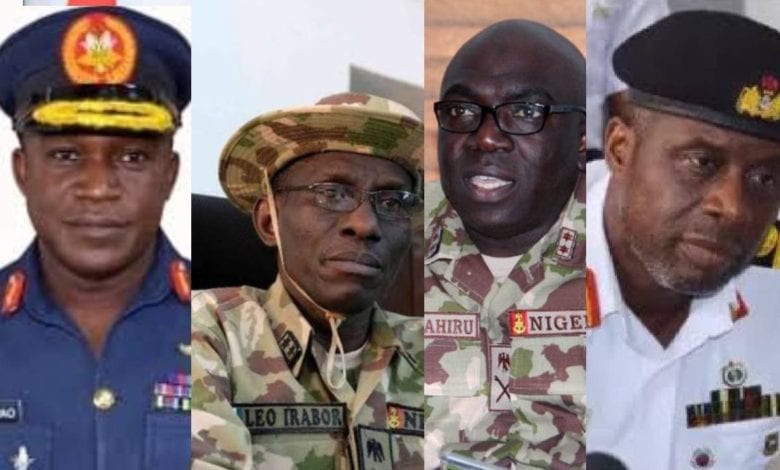
So as the new service chiefs comprising Chief of Defence Staff, Maj.-Gen Leo Irabor; Chief of Army Staff, Maj.-Gen. Ibrahim Attahiru; Chief Naval Staff, Rear Admiral Awwal Gambo, and the Chief of Air Staff, Air Vice Marshal Ishiaka Amao, assume duties, we look forward to seeing them alter the complexion of the country’s security architecture, for the good of all.
Again, whether they will succeed or not in checking the security challenges will depend in no small measure on the political will of the President. They also need the overwhelming cooperation of the citizens.
We also appeal to opinion leaders, including political elite, to desist from inhibiting the nation’s battle against insecurity. We note that many cases of kidnappings, killings and banditry would have been averted if influential leaders are more circumspect in their commentaries. Especially comments that tend to demoralise and demotivate our troops.
The task of securing all Nigerians from insurgents that has been fighting the nation for more than a decade needs a lot more than replacement of few military chiefs. It requires massive changes in strategies and tactics.
It is also our view that the high expectations of Nigerians for radical changes in the nation’s security architecture cannot be taken for granted. For the new service chiefs, ThisNigeria welcomes them. We assure them our unalloyed support in the arduous tasks ahead. They certainly cannot afford to fail. Nigerians are waiting for them to literally perform the magic, by dealing decisively with the terrorists and bandits, who have made life hell for other citizens in double-quick time.
Given their pedigree, we are optimistic that the new chiefs in the saddle will deliver. We can only but wish them the best of luck as they settle down to their new jobs, which in a manner of speaking, will count as the toughest battles of their lives!