
2022 budget proposal, a joke – Ezeh Onyekpere, rights activist

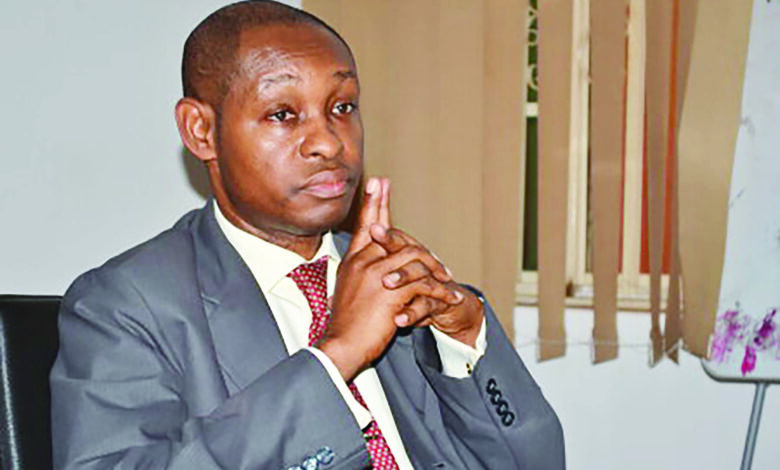
A rights activist and Lead Director, Centre for Social Justice, Barrister Ezeh Onyekpere, takes a critical look at the economy, especially the 2022 federal budget, with a damning declaration that it deviates from being far reaching in solving the nation’s long term goals, in this interview with IDU JUDE. Excerpts.
Can we take a critical look at the 2022 budget proposal, with reference to the borrowing pattern of the present administration?
Let me start by saying that we have a budget that is not well articulated in the sense of achieving the critical and core objectives of growing the economy, reducing poverty, increasing value addition, and adding more value to the economy. It is also deficient in terms of reducing indebtedness and generally helping the Nigerian economy getting out of the woods.
We still have a budget that is suffused with what is called frivolous, inappropriate and wasteful expenditure in so many sectors. We had thought that the president will lead by the sheer force of example and that the request from the State House will be realistically moderate, but we still have a situation where there are so much unexplained budget figures lined up in the State House votes. We still have money, about N76.6 million for residential rates, and that question has come up repeatedly: Who is the landlord of the State House, and who is this money paid to? That question has not been answered, and is often repeated year after year.

In the State House, the president is asking for N2.309 billion for travels and transportation, which we think is quite excessive, and in the circumstances, we do not need as much as that. We also have for the replacement of vehicle papers the amount of N1.789 billion, which we also think is on the high side because the Presidency already has a fleet of vehicles, and he doesn’t need all that. And come to think of it, we have annual routine maintenance.
So, what we saw cannot be called a major maintenance because it happens to be annual. Then we talk of maintenance of electrical appliances in the Villa, N5.176 billion, and maintenance of office appliances is about N106 billion. You ask yourself; how much does it cost to build a new house, if maintenance of electrical and electrical can cost this much?
And I can tell you that this is something that can be done with less than ten or twenty per cent of the request. You see a situation where these things are going on in an administration, because we are frugal, and we are fighting corruption. We are delivering value for money, so there is a huge challenge in this budget because we talked about the presidency leading by example, and we also have about N21 billion to construct the presidential wing of the State House medical centre. If you recall, this is the same medical centre that the wife of Mr. President had cried out that she couldn’t even find
paracetamol. And this is an administration that severally allowed doctors to go on strike, and at the least prompt, the president enters flight and proceeds for medical tourism abroad. You cannot justify voting N21 billion for a State House medical centre. This would have been used for the maintenance of the entire population. It should be for a hospital that will serve the entire Nigerians, not necessarily for the presidency that is not even interested in using those facilities. Those are just practical examples.
If you take a look at the agricultural sector, which is an area that touches the lives of Nigerians, year after year that we have a situation where a huge sum of money is voted. Now, let’s start with National Land Development Authority, NALDA. It has a vote of about N1 billion for the purchase of land preparation equipment, for example, tractors, tillers. They budget for about 70 tractors for the NALDA integrated farm project. The same NALDA that needs N1 billion to purchase land equipment now goes on to say land development budgets for bush clearing for the establishment of NALDA farms about N300 million and N500 million for farmers. That is a total of N800 million. Then, we ask, why are you buying equipment worth N1 billion, and you are voting another N800 million for land clearing?
We’ll recapture all escaped inmates who escaped, says Aregbesola
And if you recall, Nigeria had borrowed N1 billion or so to order for tractors from Brazil. If we have done that now, waiting for 10,000 tractors to come, why are we budgeting for more? And remember, we have already incurred the debt, but the question is when the tractors will come. We know that the National Assembly has given them the go ahead order to procure the tractors; so, when will they come? What I’m saying is that in an agency, you voted money to buy tractors for land clearing, which has been approved and is in the pipeline, only for you to budget for another amount for land clearing separately, is it not a duplication? And some of us are asking why the work of NALDA, which should have been collapsed into the activities of the Ministry of Agriculture, has not been done. These agencies repeat the same job the Federal Ministry of Agriculture is doing.
Why I am very interested in the budget of the Ministry of Agriculture is that it is a sector that touches the lives of the poorest of the poor. If you go to the Ministry of Agriculture, there is a budget running into N800 billion. The ministry is suffused in very large and unclear, large expenditures. And if you look back, this has been the trend over the years. If you say you are spending these amounts year after year, for the period of 15 years, then the question is, where is the evidence of value for money? Where is the evidence that the money has been judiciously used?
That is the challenge we have with that ministry. So, if you come to the ministry, there are things that sound very big, but where are the evidence that they are being done? For instance, you said you achieved self-sufficiency in wheat production with the rate of N138 million; commercialisation of soya beans, N650 million, maize production and self-sufficiency, N5.8 billion, development of tomatoes and production, N1.60 billion, aquaculture and fish, N675 billion, and this has been the trend year after year.
On the issue of commercialisation of NNPC, as well as the recent appointment of persons to head the new agencies, do you see a round peg in a round hole?
The challenge of realising what is in that act is not the commercialisation of the sector or whatever; the challenge is the quality of human beings that have been appointed to manage the new agencies. Unfortunately, some of those that have been appointed recently, including the chairman of the new NNPC, do not inspire hope. We were expecting that the government would appoint technocrats, but unfortunately, that has not been the case. We had Ibe Kachukwu who has broad knowledge about the sector, they yanked him off. We have brilliant people, and if I were the president, I would just go and get people like Prof. Pat Utomi. He has been talking, and he thinks he knows it. I will tell him to come and do it. Even if it means hunting across the globe, there are many Nigerians in major corporations in Europe and America, bring them home and tell them to come and turn things around.
To the best of my knowledge, the Act is promising a lot of reforms, but to realise those policies will depend on the quality, calibre and knowledge base of the individuals who are wanted to run the new outfits. But from the present body language so far, the people he has appointed, we are still going round in circles, because even with the amendment Mr. President proposes, he is not bringing people who are going to work, but representatives of the geopolitical zones. And once you are bringing people who are going to work there based on geopolitical representation, then we are in for another round of political representation, not merit and people with knowledge.
Recently the National Assembly recanted on the issue of electronic transmission of results, what do you make out of this sudden twist, despite denials of lack of network in various parts of Nigeria?
You see, the National Assembly had earlier made it clear that they wanted continued election rigging in Nigeria, until Nigerians shouted at them and told them that they cannot do that because the country belongs to all of us. I have never seen such a shameless set of human beings, who were declaring upfront that they want to rig, and were insisting that they want to rig, and they were bold faced about it. But Nigerians actually told them that they can’t. As you can see that Buhari has been actually slippery. You know that the electoral act was amended several times before the 2019 election, but because his administration wanted to manipulate the election, he kept giving reasons until the election took place. But this time around, whether he likes it or not, he must bow to the wishes of Nigerians.
As Nigeria prepares for another round of general election, is it right for us to continue to use unofficial census figures and also use the same in determining federal allocation?
No, we need an update in census figures. But I dare say that the environment is so polluted and that this is not the right time to have a census in the sense that we are so divided. Divisions, religious, ethnic and geological issues play up everything we do, and any attempt to carry out a census. Today, it is like a keg of gunpowder. Generally, various communities have been inflicting numbers that have no meaning to the Nigerian population. So, it is just like in the biblical injunction when Davis wanted to build a temple for the Lord. He said, no your hands are full of blood, the temple will be built by another person. This administration is not qualified to organise a census because it is too divisive and parochial. And if they conduct it, the result will be rejected because there will be no trust in terms of national interest. The leadership is pandering to sectionalism. So, I personally won’t advise any national census now because definitely, ab initio, they cannot seem to be fair towards the good of the country.
Speaking about your own area of specialisation, the CSOs, what do you think you can be done to ensure that you contribute to the hitch-free 2023 general election?
Well, for holding an election to be free and fair, it is not only to be transmitted electronically. It is all about ensuring internal democracy. What we have is that they don’t throw up credible candidates because what we have is charlatans vying for elections. We don’t have credible candidates in terms of who can make policies, as far as the two major parties are concerned.
It is all about monitoring to ensure that internal democracy is ensured, according to the 1999 Constitution, as amended in party constitutions and INEC guidelines. So, we should be very much interested about that, and at least monitoring of campaign financing, and to ensure that public finances are not being used to influence votes to parties, as well as state resources are unduly mobilised in support of the incumbent against the opposition.
Rightly or wrongly, there is this perception that election observers are being influenced or bought over by the incumbents to slant their observatory reports?
Hmmm? I have never heard of this one, where did you get this idea? Well, not to my knowledge. Mostly, the election observers I have seen are never bought over. And if you have been reading election observers’ reports, does it look like they are bought over?
What are some of the things CSOs always put on the ground differently from observatory jobs they do perform before?
Well, everything that happens is a product in terms of experiences, and in trying to improve, different groups are here trying to improve on those challenges we met. So, there are things that may be different. But I cannot speak for other organisations. For me, we are more interested in campaign financing. We are going to track and work with stakeholders to know how we can put that against them by reducing the influence of money and use of state resources in electioneering. That is where we have more interests.
PIA: FG’s sacking of agencies’ head and survival of downstream sector
Let’s look at Chief Raymond Dokpesi’s submission that no one in the south is capable of leading the country, come 2023. The issue is, does it mean that Dokpesi, if given the opportunity to lead Nigeria come 2023, is incapable, and that is why he has disqualified himself also? I think Dokpesi can talk for himself, not for others. And if he knows that he does not have the capacity, then he can talk for himself, and not for other people from the south.
Do you think anyone is qualified in the South for the 2023 presidential election?
This question should not have arisen in the first place. By the way, where do you find people with leadership capacity? Where do you find people with knowledge for innovation and development? And let’s talk of where the capacity is coming from. Is it in terms of academic qualification, entrepreneurship or what, money? Is it on how to manage the country? What capacity is he trying to say, I don’t get it?
Looking at the 2022 appropriation, teachers’ salaries and allowances are on the increase. What is your take?
It is a wrong move. It is improper to borrow money to pay an increased salary to teachers. What I will recommend is that the president should seek ways to improve the economy so that the little money in people’s hands can have this purchasing power, more especially now that we are in a very high inflation. You can also say that the education sector has been mismanaged like other sectors. You don’t need to create new institutions. Even if you listen to the news, you can see that the National Assembly is creating new institutions, and it shouldn’t be so. It is about increasing the carrying capacity and competence of the existing universities.
There are universities like UNN, UI, Ife. ABU. they have over a hundred thousand students, but how many of our universities can boast of 2,00 students? So, all you need to do, instead of creating new universities, is to increase more lecture halls, increase more laboratories, employ more teachers, so that you reduce the overhead cost of running entirely a new institution. You are quarrelling with ASUU over unpaid allowances, and you are busy establishing entirely new ones. And if you have a department or courses that are not available, you can go to UNN, ABU and get teachers to establish a department or hire professors to establish a faculty or department. And they still fall under the existing ones, instead of setting up new ones.


