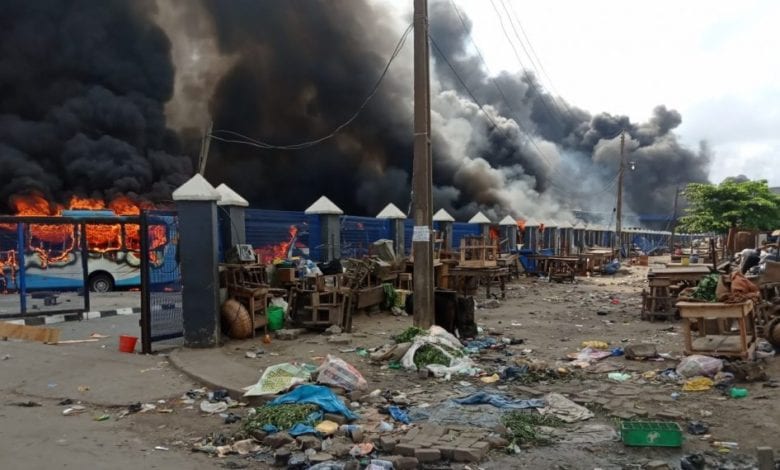
It was a killing spree across Nigeria last week.
From Lagos to Abuja, Benin, Asaba, Enugu and Port Harcourt smoke billowed from police stations, courts and even prisons.
When the sky cleared, scores of persons had died. Thousands of vehicles and properties had been reduced to rubbles. Millions of Nigerians were traumatised.
In Osogbo, capital of Osun State, Governor Gboyega Oyetola and some members of his cabinet escaped by the whiskers on Saturday, October 17. Hot lead drilled holes on their bulletproof cars as they were being spirited away from Olaiya Junction where he had gone to calm frayed nerves of angry youths.
The situation was chaotic, very much unlike when Oyetola began his engagement with the protesters. Soon, some men started shooting and hurling stones at the governor’s car. He was taken away from the scene by security operatives. Several protesters were also attacked by the armed men.
Mrs Funke Egbemode, Commissioner for Information, who was worried by the sad turn of events said: “This was certainly beyond the #EndSARS protest. The people who launched the attack were not protesters at all.
“Protests have been going on in the State for some days now, and there has been no attack on any government official since the beginning of the protest. However, today’s attack changed the narrative.
“It was not a spontaneous attempt. The attackers had it all planned. They had guns and other weapons. In fact, it was a woman who smashed the windscreen of the vehicle of the Secretary to the State Government, Wole Oyebamiji where I was.
“It is really sad that these people infiltrated the ranks of the peaceful protesters and took advantage of the Governor’s walk with the youths to execute their sinister intentions.
“It was simply a street coup to take out the Governor, his Deputy and the Secretary to the State Government, all of whom were exposed during the protest and had to be smuggled into vehicles when the attack was launched.”
By October 20, the #EndSARS protest had snowballed into a Black Tuesday of lawlessness, violence and bloodbath in Lagos State.
Hoodlums who had infiltrated the protesters torched police stations in Panti, Adekunle, Yaba and Orile Iganmu, Mushin, Pako, Ojo, Ketu, Ikorodu, Ilemba Hausa, Amukoko and Ajegunle. They set ablaze Television Continental and The Nation newspapers, two media houses believed to be owned by Asiwaju Bola Ahmed Tinubu, national leader of the All Progressives Congress, APC.
They set on fire the BRT bus station at Oyingbo and the Nigeria Ports Authority, NPA, building on Marina, among several banks, private and public properties. And in the evening, the Lekki violence and shooting happened.
One account said the Lekki incident, where some protesters were bloodied, was a planned work.
The closed-circuit cameras at the Toll Gate were allegedly removed at about 3 pm while the lights at the gate were turned off at 7 pm. Then, armed soldiers arrived, spraying hot lead into the sea of heads reportedly for not less than an hour even as protesters defied the invaders and waved the national flag.
Many people were injured according to a viral video. The Toll Gate had been occupied by protestors for several weeks, since early October #EndSARS demonstrations. Their leadership frequently reminded those present not to give the police any excuse to intervene.
Their occupation had cost the state government around $600,000 in losses because of the closure of the toll gate.
The protesters had accused Tinubu of holding stakes in the toll plaza and a number of businesses including the Oriental Hotel which was torched. But he denied in a television interview that he did not have any investment in the two ventures.
The sad development set the social media a new hashtag, #Lekkimassacre and angry youths sacked the palace of the Oba of Lagos and took his staff of office.
They also laid siege to Tinubu’s residence but the politician had reportedly already left the country along with his family. His son, Seyi, narrowly escaped mob action as he made his way to the airport.
In Lagos, Nigeria’s commercial capital, no fewer than 45 people, including policemen, were killed last week.
Some lost their lives when thugs clashed with protesters and the police shot live bullets to disperse protesters, who barricaded busy roads and obstructed traffic, in different parts of the state.
Following a general breakdown of law and order many policemen were killed as hoodlums attacked and burnt over 10 of their stations. Scores of patrol vehicles were also burnt while arms, ammunition and Police uniforms were carted away.
Guesstimates put total casualties since the protests started peacefully two weeks ago at over 150 persons, among them 35 police officers. Over 40 police stations have been razed while over 250 police and private vehicles were destroyed.
Two people died after the violent encounter. But in Gombe protesters attacked and injured journalists covering the demonstration. In Sokoto, Kebbi, Zamfara and Katsina, youths said the protest was anti-Buhari. The protesters in Kaduna got the ear of the government which set up a judicial panel.
The protest recorded marginal success in Plateau State. The ongoing Jos Trade Fair was shut down by the protesters.
In Nasarawa State protesters peacefully demonstrated and ended at the Government House to submit a letter with their demands to the governor.
In Kogi and Benue states there were no casualties while in Kwara, the governor cautioned youths against dividing the country.
#EndSARS Protests in the South East
In Enugu, protesters grounded the state capital, as motorists were prevented from getting to their destination on time. Two persons were killed and the government promptly announced a 24-hour curfew.
In Abia State, two policemen were allegedly killed during clashes with protesters while the police stations at Ogbor hill and Eziama were set ablaze and their armouries looted.
In Ebonyi, Imo and Anambra, a total of four police stations were razed, forcing the governors to announce 24-hour curfews and set up judicial panels of enquiry into the crisis.
South-South
In Rivers State, social and economic activities came to a standstill following the protest. The government later set up a judicial panel like in many other states. Some persons died and three police stations at Oyigbo, Afam and Umuegbulem in Oyigbo and Etche local councils of the state were razed.
Three police officers were said to have been killed by rampaging hoodlums, who invaded the Police Area Command along the Port Harcourt/Aba Expressway and set the armoured tank ablaze. They subsequently thereafter burnt the building.
At Oil Mill Junction, three persons were feared dead after the protesters clashed with some traders who obstructed their procession. Also, two persons died at Emenike Junction in Mile 1, Diobu, Port Harcourt, after bullets.
In Bayelsa State, protesters carried a mock coffin painted in the green- white-green colours of the Nigerian flag, barricaded major roads and prevented movement of vehicles, with the government setting up the judicial panel on Police brutality. A boy who fell off a moving truck died.
Consequently, the state government announced a 48-hour curfew as we set up a judicial panel of enquiry to probe the crisis.
In Delta, Asaba, the state capital was the hotbed of the crisis. Angry youths torched many public buildings, forcing the government to impose a curfew.
For many days, Edo state boiled. Not less than 10 persons allegedly lost their lives in Benin City, the Edo state capital. The protesters who dumped one of the corpses at the Office of the State Governor, draping it with the national flag took to the streets in Benin.
They barricaded the busy Lagos Road at the University of Benin main entrance, set bonfires and halted vehicular movement. They invaded the two major prisons in the ancient city and released over 1000 inmates serving various jail terms.
The rampaging youths and hoodlums torched eight Police stations, removed police uniforms, arms and ammunition as they freed suspects in custody. The police responded by attempting to enforce a 24-hour curfew announced by the state government, which also closed all schools and businesses.
The Inspector-General of Police, Mohammed Adamu, had to deploy riot policemen nationwide to protect lives and property. He ordered the commissioners of police in the 36 states of the Federation and the FCT to identify and isolate lawbreakers from peaceful protesters. He said they should immediately arrest and diligently prosecute such perpetrators of violence in their respective commands.
Similarly, the Nigerian Army last week said it would begin “Operation Crocodile Smile VI” as a strategic security measure.
Acting Director of Army Public Relations, Colonel Sagir Musa, said the Army was “ready to fully support the civil authority in whatever capacity to maintain law and order and deal with any situation decisively.”
Operation Crocodile Smile is expected to last till the end of the year. Soldiers and policemen, in the early hours of Tuesday, were deployed in some communities near the Nnamdi Azikiwe International Airport, Abuja, apparently to prevent the #EndSARS protesters from converging.
But the protesters still converged.
The protest soon assumed a violent dimension when armed thugs attacked them at Waru, Wumba, Kubwa, and Wuse 2, all in the Federal capital, Abuja on Tuesday killing six of them.
As the nation burned last week, the leadership of the Senate and the House of Representatives moved to calm frayed nerves.
Minister of Sports and Youth Development, Sunday Dare, explored several avenues to douse tension. He repeatedly sent messages of the President to the youths to allow the government to work on their requests.
Nigerians staged solidarity protests in Pretoria, Rome, Washington, Nairobi, Accra, New York, China, Dublin and London with thousands calling for an end to police brutality.
Last week, eminent Nigerians including former President Olusegun Obasanjo, Professor Wole Soyinka, Bishop Matthew Kukah, Professor Attahiru Jegga and Professor Auwalu Yadudu also called on President Muhammadu Buhari to take immediate steps to address the widening trust deficit between him and the government on the one hand and the Nigerian people on the other as well as identify and arrest those who gave instructions for soldiers to shoot protesting youths at the Lekki toll- gate on October 20.
Senator Olu Adetunmbi and 44 other Senators and Representatives across the political divide in the National Assembly condemned the killings at Lekki and the violent mode the #EndSARS protests assumed on Black Tuesday.
In a statement, they said the protests have been the most elaborate that have united young Nigerians across geography, ethnic nationality and religion, and are as a result of frustration by Nigerian youths who have seen governments at all levels fail to provide public good and opportunities for them to lead a meaningful life.
The International Community has equally condemned the killings by armed soldiers. British Foreign Secretary, Dominic Raab, said the “Nigerian government must urgently investigate reports of brutality at the hands of the security forces and hold those responsible to account.”
The US Secretary of States Mike Pompeo said the United States strongly condemns incidents of military forces firing on unarmed protestors in Lagos. “Those involved should be held to account under the law. We extend our condolences to the victims of the violence and their families,” he said.
The European Union’s foreign policy chief, Josep Borrell, also condemned the killing of protesters and called for justice even as UN human rights chief, Michelle Bachelet, called on the Nigerian authorities to take urgent steps to deal decisively with persistent breaches by the security forces, and work harder to bring police and army personnel guilty of crimes against civilians to justice.
Meanwhile, the Nigerian Bar Association and Africa Bar Association have threatened international criminal proceedings against the Federal Government over the shooting of unarmed protesters by security agencies.
The NBA, President, Olumide Akpata, in a statement described the shooting as reckless and lawless, and demanded that the military high command “immediately identify and name the officers involved in this gross professional misconduct for immediate prosecution and dismissal in line with extant laws.”
The Africa Bar Association President, Hannibal Uwaifo, in his own statement, vowed to “immediately file formal criminal complaints before appropriate international bodies to open an international inquiry into the irresponsible behaviour of the Nigerian Government masquerading as a democracy.”
Presidential Broadcast
In his broadcast to the nation on Thursday, October 22, President Buhari warned those who have hijacked and misdirected the initial, genuine and well-intended protest of the youths in parts of the country, to remember that government also has the obligation to protect lives and properties, as well as the right of citizens to go about their daily businesses freely and protected from acts of violence.
He said: “I acknowledged the genuine concerns and agitations of members of the public regarding the excessive use of force by some members of SARS,” adding that, “As a democratic government, we listened to, and carefully evaluated the five-point demands of the protesters. And, having accepted them, we immediately scrapped SARS and put measures in place to address the other demands of our youth.
“Sadly, the promptness with which we have acted seemed to have been misconstrued as a sign of weakness and twisted by some for their selfish unpatriotic interests.” The result of which he said are loss of human lives; acts of sexual violence; attacks on correctional facilities and convicts freed; public and private properties completely destroyed or vandalised; the sanctity of the Palace of a peacemaker, the Oba of Lagos violated with protesters invading an International Airport and in the process disrupting the travel plans of fellow Nigerians and visitors.”
The President reaffirmed the Federal Government’s commitment to preserving the unity of this country, continuing to improve good governance and the nation’s democratic process, including through sustained engagement while ensuring that liberty and freedom, as well as the fundamental rights of all citizens, are protected.
He then called on the youths to discontinue the street protests and constructively engage the government in finding solutions.
An end in sight to the protests and agitations, after the broadcast? It is anybody’s guess.
What is certain is that the last one week has been a hell of a time in Nigeria. A week of rage, arson, violence and deaths.
In particular, the last 72 hours, anarchy, of a frightening dimension, held sway. And the nation is still counting her loses, the day after…