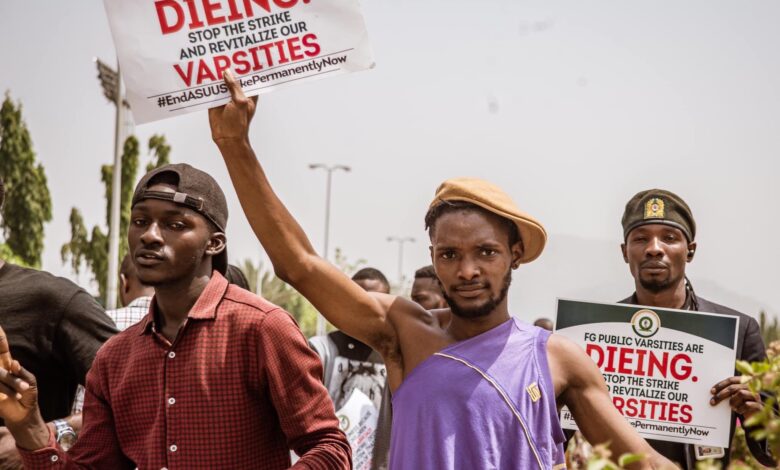
By Olusegun Olanrewaju
The almost yearly strike by the Academic Union of Universities (ASUU) has peaked with another drama of reconsideration, this year.
The usual trade-offs ASUU crises include warning of, and execution of real strikes, payment or non-payment of wages, as well as allegations and counter-allegations of budgeting perversion or diversion.
Others are ‘walk-outs’ by officialdom, alleged collection of bribes and gratifications against union officials, among others, to manage the fallouts of such issues.
But now, the President Muhammadu Buhari administration has taken a further step with a killer punch: ‘Re-examination’ of the highly contentious ASUU agreement of 2009, because of an alleged paucity of funds.
Education minister, Adamu Adamu, who has been in the eye of the storm over this year’s version of allegations of ministerial walking out, this time on aggrieved students piqued at their lecturers’ apparent penchant for going on industrial action at the slightest ‘chance’, announced that the government is considering reviewing the 2009 agreement with lecturers on their collective welfare and state of educational infrastructure in the country.
The minister announced the constitution of a seven-man panel headed by Prof Emeritus Nimi Briggs-Pro-Chancellor, Alex Ekwueme Federal University, Ndufu-Alike Ikwo, as chairman, to renegotiate the 2009 agreement it had with ASUU.
Other members of the renegotiation committee include Lawrence Patrick Ngbale- Pro-Chancellor, Federal University, Wukari -Member (North East); Prof. Funmi Togunu-Bickersteth (Pro-Chancellor, Federal University, Birnin Kebbi), member (South-West); Senator Chris Adighije (Pro-Chancellor, Federal University, Lokoja, member (South-East); Prof Olu Obafemi (Pro-Chancellor, Federal University of Technology, Minna, member (North-Central); Prof Zubairu Iliyasu, Pro-Chancellor, Kano State University of Science and Technology, member (North West); and Mr Matthew Seiyefa, Pro-Chancellor, Niger Delta University, Wilberforce Island, member (South-South).
Reconstituting the team, Adamu noted that there is a need to speedily bring to a conclusion, all outstanding issues in the 2009 agreement to achieve the desired industrial peace on our campuses.
*The problem
Tongues are now wagging as to the real import of the latest move: whether it represents a shift forward towards the resolution of a lingering crisis, or a ‘diabolical response’ to further cage the lecturers’ alleged Oliver Twist tendencies.
The university education sub-sector has been in turmoil, as usual, over the fallouts of the academic union’s 2009 agreement with the Federal Government, whose interpretation and execution has always been at a dead end ever since.
ASUU had embarked on a month-long warning strike to press home demands it said was bordering on universities’ revitalisation funds, as well as the implementation of the Integrated Personnel Payrolls and Payment Systems (IPPIS).
Since the commencement of the strike on February 14, academic activities in the entire Nigerian university have been shut down.
The latest development comes after members of the National Association of Nigerian Students NANS took a protest to the ministry in Abuja to express their displeasure over the strike.
In a very controversial sequel, the educator was alleged to have walked out on the students that came to seek his help in aborting the strike they say always leaves them stranded. The walkout seriously infuriated some of the protesters.
*Tainted by nonchalance’: Ngige’s no money to pay
Since the commencement of the strike, government officials have been accused of nonchalance in their approach to the resolution of the strike so that lectures can begin.
It started with the Minister of Labour and Productivity, Dr Chris Ngige, who claimed that the Federal Government does not have the money to meet some of the demands of ASUU.
ASUU embarked on a one-month warning strike on February 14, citing what it called the Federal Government’s delay to implement their agreement on issues on salaries, revitalisation fund for universities, and the adoption of the University Transparency Accountability Solution (UTAS) payroll software.
On a television programme, the labour minister argued that when former President Goodluck Jonathan made a promise to pay the N1.3trillion revitalisation fund while in office, the finances were more stable.
Ngige said the Buhari administration had earlier informed ASUU of its inability to honour the previous revitalisation fund agreement, but promised to explore other options to fund universities.
According to him, “The N1.3 trillion you are talking about was promised by the (Goodluck) Jonathan government. Oil was selling for between $100 and $120 per barrel then, and the revenue of the federation was rich.
“It was promised by that administration and they promised to kick-start the payment. They paid N200 billion, which they borrowed from TETFund. They did not take it from the Federation Account. That payment spiralled even into 2016 — to our regime.”
The minister added, “A committee was set up with ASUU as members. Government said, “we are going to drop N25 billion for you to show you in good faith that we are not talking nonsense.”
“That one was dropped. Again, another money was paid last year because the committee couldn’t come up with anything that will generate funds.
“We don’t have it. The government didn’t say we are going to pay N1.1 trillion that is remaining. They said we don’t have this money and under the principle of capacity and ability to pay, let us renegotiate it because TETFund is still there.
“Unless you want us to take money from TETFund and deceive you like it was done in that period.”
*Adamu’s line of fire
As the face-off between the Federal Government and ASUU members continues unabated, the Students’ Wing of the Coalition of Northern Groups (CNG) urged education.
The issue had been inflamed when NANS president, Sunday Asefon, visited the minister in his office to air the grievances of the students’ bodies over the ongoing one-month warning strike by ASUU.
Reports say Asefon had warned that if the government failed to meet the demands of ASUU within the period of their warning strike NANS would take actions “that would make the historic #EndSARS protests of October 2020 a child’s play”.
The students’ union leader was also quoted to have made a very brilliant suggestion’ that NANS should represent the students in resolving the protracted issues between the lecturers’ union and the Federal Government.
However, for some alleged personal reasons, an angry minister Adamu reportedly stormed out of the meeting when the youth leader reminded him that his children were enjoying unfettered education in universities abroad. He also averred that their parents could not afford to send them abroad.
However, further reports said the minister tempered down his anger, to later meet with the NANS leaders at the National Universities Commission (NUC) secretariat ‘with appropriate equanimity’.
This prompted later, it was believed, induced Adamu to announce that, perhaps for the first time in history, the controversial issues in the Memorandum of Understanding (MOU) signed with ASUU in 2009 and Memorandum of Action MOA (2020) were being repackaged for possible endorsement by both parties, with the inclusion of NANS.
But that was after the students had been joined by other forces accusing him of incompetence to end the ASUU strike. Students had told Adamu that nothing short of him quitting the office was good enough to douse the flame of the raging strike.
This followed further reports that Adamu could have only had a change of mind following intervention by the minister of labour, Ngige.
The northern students described the minister’s action during his meeting with the National Association of Nigerian Students (NANS) as a gross show of “unconscionable immorality, insensitivity and abhorrent to the collective sensibilities of the students and their parents.”
Speaking at a press conference in Katsina yesterday, the national coordinator of the CNG students’ wing, Jamilu Charanchi, accused the minister and the Federal Government of ‘lacking the capacity and political will to end the prevailing industrial action.
He issued a veiled warning that should the federal authorities fail to resolve the ASUU strike within the stipulated time, the students’ wing of the CNG would join forces with the NANS to shut down the country.
Charanchi directed all the national executive members of the coalition, as well as state and campus structures, faculty senators, and departmental ambassadors, to start what was styled “massive public mobilization” in readiness for “an impending national day of action”.
The students’ union leader added, “The Students’ Wing of the Coalition of Northern Groups (CNG) is worried that the four-week warning strike declared by ASUU is already in its third week, with no hope for a resolution in sight, even as our universities remain shut.
“We are concerned at the frequency of the disruption of the Nigerian education system that keeps frustrating the ambitions and aspirations of the youths to acquire knowledge.
“Sadly, this strike is the second industrial action embarked on by ASUU in less than two years, and the 16th since the inception of the fourth republic in 1999.
“Regrettably, despite all these disruptive actions, the university system, the innocent students, and their parents are in all cases made the victims.
“The government, in particular, the Minister of Education, lacks the political will, capacity and willingness to bring the matter to an end, and as such, he should resign with immediate effect.”
*Politics of ‘educating children abroad’
It is not right for us to wash our dirty linens in the media, Matawalle warns APC, Akeredolu
While another controversy raged, a new national talk emerged on the CNG students’ leader’s claim of government officials educating their children abroad.
Speaking at the reconvened meeting with the Federal Government, being conciliated by the Minister of Labour and Employment in Abuja, ASUU president, Prof. Emmanuel Osodeke, lauded Ngige “for having faith in Nigerian public schools”.
It would be recalled that, recently, the labour minister celebrated the graduation of his third child, as a medical doctor, “from a Nigerian university”.
*ASUU wants law prohibiting government officials’ children from schooling abroad
The Academic Staff Union of Universities, ASUU, has asked the National Assembly to enact a law that will make it mandatory for the public office holders to send their children to public schools in the country.
ASUU also commended the Minister of Labour and Employment, Senator Chris Ngige for demonstrating an uncommon faith in the university system by sending his children to public schools in Nigeria.
Speaking at the reconvened meeting with the federal government, being conciliated by the Minister of Labour and Employment, Senator Ngige in Abuja, ASUU President, Professor Emmanuel Osodeke commended the Minister for having faith in Nigerian public schools.
Osodeke said Ngige’s commitment to the growth and development of the country’s educational system should be emulated by other ministers.
“I hope other ministers will follow the same step as you. I think you are the only Minister whose children are in the country. We see others standing by their children outside the country during graduation. But, we saw you standing by one of your children who graduated in Lagos, proudly.
“We hope all others will emulate you and that the Government will make it mandatory that if you accept a government appointment, your children must attend universities in the country.
*National Assembly wades in
Calls made to the National Assembly to void the sending of children to school abroad got public attention.
They were to the extent that “The National Assembly must formulate a law that if you take an appointment, your children must study here. If you know that your children cannot be here, don’t take a government appointment.”
Lamenting the decay in the public universities, Osodeke summarised the arguments of all stakeholders in the educational sector.
His words: “When you hear those in the government who send their children to schools abroad say that ASUU goes on strike, they should know that strike is not the problem. The problem is the issues afflicting the universities; nobody is interested in tackling them. Look at the budget we have seen recently, it is the same thing we have been seeing. Nothing has changed.
“And this country is paying the high price for neglecting education, the banditry you see, the kidnapping and what have you, are because people are not being taken care of. That is why ASUU has been struggling so that Nigerian universities will be revamped so that as our children go outside for learning, other children from other countries will come here too and pay to this country in hard currency.
A bill seeking to make it mandatory for public officers to secure the approval of the Minister of Education before sending their children or wards to foreign schools, sponsored by Sergius Ogun (PDP, Ogun), was forwarded to the National Assembly.
The lawmakers rejected the bill, as well as another sponsored by the same lawmaker, seeking to make it mandatory for public officials to get medical care in Nigerian hospitals, on the grounds of breaching fundamental rights.
*Ngige’ U-turn
Ngige had earlier assured that the Federal Government would not abandon the public universities despite dwindling resources.
He also reiterated the government’s readiness to work with ASUU and others interested in revamping the educational system.
He said, “ASUU is not asking for impossible things. They are not asking that we give them our head or blood.
They are interested in getting good working conditions for their members and for the public university system to be conducive for teaching and research.”
Ngige was quoted to have further said that the government would be happy to concentrate its ‘limited resources in areas that would produce good effects for the country.
“If the private sector can bring excellence to our universities, the government can as well do the same. So, working hand in hand with ASUU as we are currently doing is a model we must keep. We will not be going to war with ASUU all the time. We can do constructive engagement. If there is something that the government can do and it says it can’t, I am here to say no, you can because I am privy to some information.