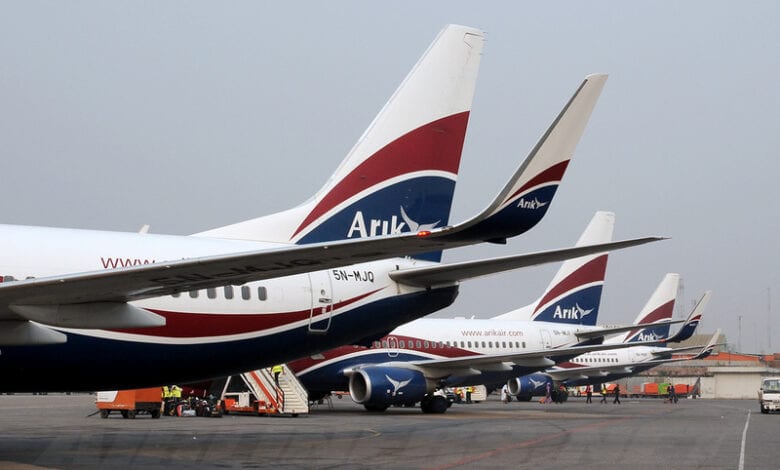
The Assets Management Corporation of Nigeria (AMCON) has advised the Chairman of Arik Air, Johnson Arumemi-Ikide, to present a reasonable debt recovery plan in order to recover the airline.
The Managing Director of AMCON, Mr Ahmed Kuru, gave the advice at a media interactive session in Lagos State.
The News Agency of Nigeria (NAN) recalls that AMCON, the special debt recovery vehicle of the Federal Government, took over Arik Air in February 2017.
The take over was part of measures to “save” the airline from “imminent collapse” citing gross mismanagement by Arik owners, and debt above N300 billion.
Arumemi-Ikide, in July had attempted to reclaim the airline’s headquarters in Lagos following a Federal High Court ruling that faulted AMCON on transparency, transfer of Arik’s asset to float a new airline, and barring of Arumemi-Ikide from the airline’s facilities.
READ ALSO:We’ve delivered Phase 1 of Lagos-Ibadan Expressway project — Federal Controller
Arik had on at least two occasions – in 2018 and 2022 – called for amicable settlement of the debt, which were welcome by AMCON and Arik Air (in-receivership) but failed.
Kuru said once there was a reasonable settlement of the debts to AMCON and the banks, the receivership would be terminated and Arik Air Limited returned to its shareholders/owners alongside all documents and securities held by it and the banks.
The managing director said regardless of the campaign of calumny against AMCON, it remained a resolution agency that had always supported businesses and would continue to support them in the overall interest of the Nigerian economy.
He said, “AMCON is a resolution agency of the government, and we look forward to any obligor or debtor that wants to come to discuss repayment plan with us.
“Our doors are always open to resolve debts because that is our primary function and aside from our recovery mandate, AMCON does not have a secret agenda.
“So the challenges of the founder of the airline to recover his airline might seem difficult, but not irredeemable, however, there is always a way out of every situation.
“There must always be a situation of give and take and AMCOM is now ready to sit down with the owners of Arik, if they are ready to agree on what is good for them and the Federal Government.
“When we engage and arrive at an agreement, we will go back to the Central Bank of Nigeria (CBN) as well as the Ministry of Finance (MOF), and share such resolution strategy with them.”
Kuru said it would be recalled that, in the past, AMCON had resolved issues that were more difficult and more complicated than the Arik issue such as the banks, oil and gas, manufacturing sector, real estate, telecommunications, among others.
The managing director, however, said for any resolution to take place, the two parties involved must have an understanding and they should be convinced that there was always a way out.
Kuru worried that since the coming of a new government, there had been a heightened campaign by some AMCON debtors that sought to evoke the emotion of the public to perceive the corporation and its recovery activities from negative optical prism.
The managing director added that most debtors did not mind the huge problem their debts had caused the country.
He stated that those pushing the negative campaign forgot that Arik at the time had about 50 per cent passenger-load before it took over in 2017 under a receivership arrangement.
Kuru said because the government of the day at that time was interested in saving the airline because of its strategic role in aviation sector, felt strongly that the airline must be saved from imminent collapse and national embarrassment.
“At that time the government mandated AMCON to intervene, the airline was not paying staff salary, or insurance, and could not afford to buy aviation fuel to keep the planes flying.
“It was so bad that nobody including some key aviation international partners wanted to do business with Arik among other issues,” he said.
Kuru said before we took over, everything was wrong with Arik as the airline delayed flights for two to three days in a row while its aircraft were being arrested abroad, which was a big embarrassment to the country.
According to him, if AMCON had not stepped in at the time the government asked AMCON to intervene, Arik would have gone under within two weeks.
He said when some of the obligors heard the news of the proposed AMCON sunset, they stopped picking up its calls.
The managing director said, in their mind, they believe AMCON would soon close shop, which would mean that the government would write off the debt.
He stated that the process of winding AMCON down would be a process, affirming that no government would allow any debtor to walk away with the debt. (NAN)