By Cross Udo, Abuja
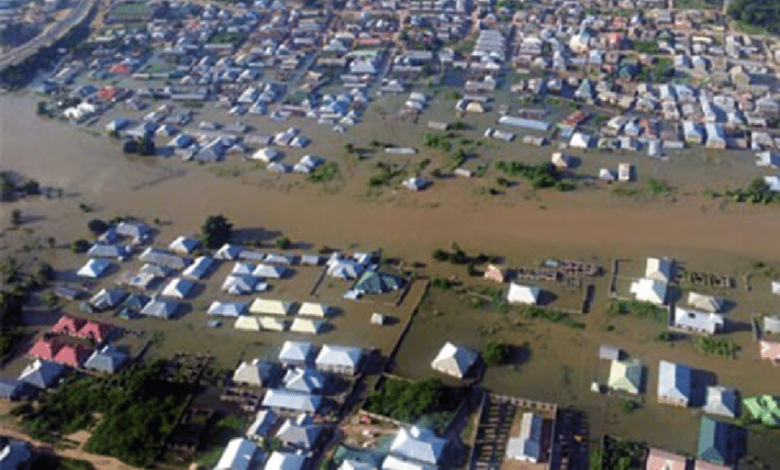
In a move to protect vulnerable communities and avert humanitarian crises, the Federal Government has declared flood prevention a national security priority, unveiling a comprehensive Anticipatory Action Framework on Floods to guide early response strategies ahead of the 2025 flood season.
The framework, developed by the Anticipatory Action Task Force (AATF), introduces a forward-looking approach to disaster preparedness, combining scientific forecasting, traditional knowledge systems, early warning triggers, and a consolidated budget—all designed to build resilience in flood-prone communities across Nigeria.
Receiving the draft framework and its accompanying budget on Wednesday at the Presidential Villa in Abuja, Vice President Kashim Shettima said the government was shifting from “reaction to prevention” as floods continue to claim lives and destroy livelihoods nationwide.
“Disasters are not just environmental issues—they are security and humanitarian issues,” Shettima declared. “We have been reactive for too long. This framework is a turning point—believing in science, acting early, and preparing communities for what lies ahead.”
He praised President Bola Tinubu for his leadership in mainstreaming disaster preparedness and commended the Office of the National Security Adviser (ONSA) for coordinating the initiative across agencies and stakeholders.
*Unveils anticipatory action plan to shift from reactive relief to proactive disaster response ahead of 2025 flood season
Speaking at the presentation, Minister of Humanitarian Affairs and Poverty Alleviation, Prof Nentawe Yilwatda, described the framework as “a major policy shift” that prioritises human lives and livelihoods.
“In 2004 alone, over 1.2 million people were displaced by floods, and 1.3 million hectares of farmland were lost, costing the country over $1 billion. If even one per cent of that had gone into prevention, we could have saved lives and futures,” he said.
National Security Adviser, Mallam Nuhu Ribadu, also emphasised the importance of early preparedness, stating that disasters may be inevitable, but their impact can be significantly mitigated.
“No matter the wealth of a nation, failure to prepare makes it vulnerable. Anticipation is power—and with this framework, we now have a tool to respond before disaster strikes,” Ribadu said.
Special Assistant to the President on Humanitarian Affairs and Development Partners, Mrs Inna Audu, who led the task force, outlined key milestones achieved since its inauguration in March, including a nationwide data validation workshop and field assessments using both traditional and scientific data sources.
She also announced the creation of a Strategic Communication Working Group under the NSA’s office, housed within the National Counter Terrorism Centre (NCTC) and led by Maj Gen Adamu Laka, to coordinate community-level sensitisation and ensure widespread understanding of early warning signals.
“The framework is not just a document; it’s a call to action. With the right partnerships, we can empower states and local governments to act fast and save lives,” Audu stressed.
The Anticipatory Action Framework is expected to serve as a national blueprint for disaster preparedness, with implementation set to begin before the onset of the 2025 rainy season—targeting the most vulnerable areas and communities at risk of displacement, food insecurity, and disease outbreaks.