Cajetan Mmuta, Awka
A legal practitioner and right activist, Ogbangwa Douglas, has issued a seven-day ultimatum to the Nigeria Army to stop what he called ‘ethnic and class profiling’ of passengers travelling along South-East roads across the country.
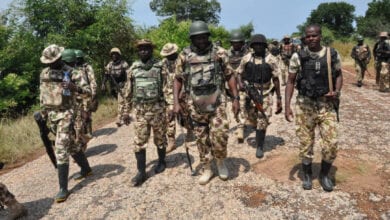
He also berates what he calls the unprofessional and dehumanising conduct being exhibited by soldiers of the Nigerian Army stationed at various checkpoints who, he said, profile passengers in public vehicles to walk past the checkpoints across states in the South-East geo-political zone of the nation.
Ogbankwa, yesterday said after a harrowing experience of passing the checkpoints while travelling along the route to South-East, he was calling on the top hierarchy of the nation’s military to prevail on the soldiers to put an end to such dehumanising actions.
He noted that activities of the Nigeria Army smacked ethnic and class profiling by asking all passengers travelling on commercial vehicles to step down and walk by foot to pass the checkpoints, while occupants of private vehicles are allowed to pass the same checkpoint unchecked.
According to the vocal lawyer, the exercise by the soldiers was mostly noticed at their checkpoint at Ihiala local government area of Anambra State.
He said, “I just passed the army checkpoint at Ihiala, Anambra State, and I am perplexed by the way the Nigerian Army conducts ethnic profiling and class profiling by asking all passengers travelling in commercial vehicles to walk by foot past the checkpoint, while those with private vehicles are saluted and given official complements inside their air-conditioned vehicles, not knowing whether or not they have guns in their boot.”
He lamented that “This only happens in Igbo land in the South-East, and it is completely unacceptable.”
He demands, “I demand that the Nigerian Army stop for with their ethnic profiling and class profiling of maltreating Igbos on that route, failure of which we shall institute a class action for and on behalf all persons travelling through the checkpoint in Ihiala in Anambra State.”
He examined that, “Section 42 of the Constitution of the Federal Republic of Nigeria, 1999 8 (As Amended), by the 4th Alteration, states that no person shall be discriminated against based on tribe, race, religion, gender, creed or circumstance of birth.
“The Nigerian army is hereby given seven days to stop their discriminatory ethnic profiling, class profiling and maltreatment of the Igbos plying that road.
“All other components of the country should also condemn the same, “an injury to one, is an injury to all.”
In another development, no fewer than 23 persons have died in ghastly motor accidents in the past month in Anambra State. Sector Commander of the Federal Road Safety Corps (FRSC) in the state, Mr Adeoye Irelewuyi, disclosed this yesterday in Awka, the state capital.
The figure of the dead victims came from 33 road crashes recorded within the period under review.
Adeoye explained that 72 persons had sustained varying degrees of injury from the road crashes during the period.
He, however, attributed the crashes to speed limit violations.
Also, 473 persons were arrested for various traffic offences, pointing out that the offenders were all booked, while others were prosecuted.
He said, “We commenced ‘Operation Zero Crash Special Patrol’ on December 17, 2021, which ended on January 15, 2022. This is part of strategies targeted at minimising road traffic crashes during the yuletide.
“The number of deaths increased compared to previous years. While we recorded 23 deaths within the period, seven deaths were recorded in 2020 and 2021.”
Adeoye said the state recorded a larger percentage of free traffic flow all through the period, especially on the Niger Bridge.
He said, “We were able to achieve free flow of traffic because there was a collaboration with various security agencies, as well as the governments of Anambra and Delta states.”
“The Niger bridge traffic was flowing because we kept the bridge open. We had four toll trucks, two on both sides, which assisted in removing every obstruction as quickly as possible.
“The command also resolved that direct supervision would be needed to implement whatever strategy that we may have. That informed the temporal relocation of the Sector Commander to the commercial city.”
He advised motorists against speeding, adding that there was the need for motorists to be cautious while on the road to ensure they arrived safely at their destinations.