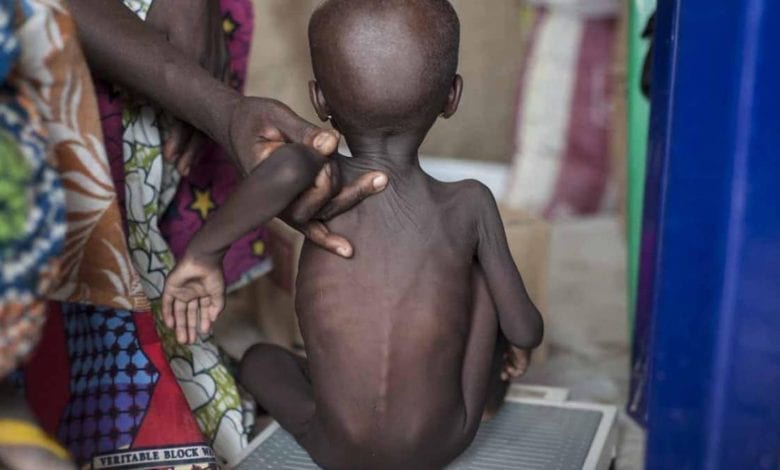
Stakeholders in Nigeria’s nutrition sector have revealed that over 5 million Nigerian children and pregnant women are prone to die from malnutrition-related cases bordering on anemia and Severe Acute Malnutrition (SAM).
The Federal Ministry of Health described the cases of micronutrient deficiencies in Nigeria as severe.
The Deputy Director, Nutrition Division, Federal Ministry of Health, John Uruakpa during a media engagement session on nutrition held at Grand Central Hotel in Kano last Thursday said, “The recent NDHS 2018 data show that 68% of children 6–59 months of age and 58% of women of reproductive age in Nigeria are anemic, with at least a third of the anemias attributable to iron deficiency.
He added that “For zinc deficiency, national prevalence is estimated at 20 percent.” Based on this evidence, WHO and UNICEF recommend Zinc with ORS in the treatment of Diarrhoea NNHS 2015.
According to him, NDHS 2018 revealed that the prevalence of anemia among children age 12 – 17 months in Nigeria is 81%, while noting that NNHS 2018 indicates that 40.8% of children age 6 – 59 months received Vit A supplements .
“NNHS 2018 also indicates that only 40.4% of children age 12 – 59 months were dewormed,” Uruakpa stated.
He noted that malnutrition has led to the increase recorded in higher morbidity rates in children and abundant lower cognitive ability adding that unwanted situation has culminated into lower work productivity, impaired reproduction and growth.
However, he observed micronutrient deficiency as a global phenomenon with over 400 million people suffering from Vitamin A deficiency, adding that 100 million children across the globe suffer from malnutrition, further disclosing that three million children die globally owing to lack of proper nutritional diets.
The Executive Secretary, Civil Society Scaling-Up Nutrition in Nigeria (CS-SUNN), Beatrice Eluaka, said that 76.1% of pre-school aged Nigerian Children are anaemic, with 66.7% of pregnant women suffering from anaemia.
She alleged that it is worrisome that WHO has classified anaemia as a severe public health problem in Nigeria.
Eluaka said “the World Bank nutrition country profile for Nigeria, indicates that Nigeria loses 1.5 billion dollars in GDP annually to Micro-Nutrient Deficiencies.
“The COVID-19 pandemic has some implications for those most vulnerable to micronutrient deficiencies as well as the essential nutrition services that prevent the devastating effects of malnutrition.
“The COVID-19 pandemic may result in significant short and long-term disruptions to food systems increasing and complicating the global prevalence of all forms of malnutrition, including MND. Micronutrient nutrition is particularly important.”
CS-SUNN further lamented that the efforts to address the challenges invoked by nutritional deficiencies in Nigeria is slow.
The Executive Secretary, International Society of Media in Public Health (ISMPH), Moji Makanjuola, who also bemoans the prevalence rate of malnutrition amongst children in Nigeria said, “Malnutrition still poses significant public health and development challenges in Nigeria.
“With a national prevalence rate of 37% among children below the age of five years, the country has the second-highest number of stunted children in the world. Seven percent of children below the age of 5 years are wasted and 58% of women of childbearing age are anaemic. “
The Federal Ministry of Agriculture and Rural Development (FMARD) also in a paper forwarded to the Kano nutrition meeting disclose that micronutrient deficiencies affect the income of a vast number of the Nigerian population. Likewise, it possesses the power to influence food prices.
Oruakpa said to salvage Nigeria from the nutrition crisis there should be strong enforcement of dietary diversification, supplementation and fortification.
He disclosed that the federal government has set up a National Fortification Alliance (NFA) as a forum where government and private sectors meet to address issues relating to fortification.
He added that to address the menace, the federal government has also embarked on the ‘Establishment of Universal Salt Iodization (USI) task force, development of National Guideline on Micronutrient Deficiency Control, development of food dietary diversification guidelines.
He stated that, “Water, Sanitation and Hygiene (WASH) interventions are key for preventing and controlling diseases and parasitic infections that can induce iron deficiency.
“Diseases and infections also impair VA status. Efforts are consistently ongoing in Nigeria to improve the availability or access to basic water and sanitation. More investment is required in the area of micronutrient deficiency control by Government and collaborating partners,” Oruakpa stated.
CS-SUNN said the body is not insensible to strategies and guidelines put in place by the Federal Government to address the burden of Micronutrient Deficiencies.
CS-SUNN said efforts by the relevant authorities include, Vitamin A supplementation, Zinc supplementation, micronutrient powders, Iron-folic acid supplementation, nutrition education on Bio-fortified foods and the National Guidelines on Micronutrient Deficiency Control.
Though said that the major challenges that should be addressed urgently to save the situation is the filling of funding gaps rather than a lack of strategies and guidelines and further indicates that stronger political will and commitment on the part of government are required to deliver on the gains of micronutrient-focused programs in the country.
CS-SUNN added that “there is a need to scale-up provision of a basic package of nutrition services across Primary Health care centres in Nigeria. Massive sensitization, education and awareness creation to provoke behavioural changes that will promote optimal infant and young child feeding practices in communities.
“We call on state governments including to scale-up not only the provision and distribution of these supplements to hard-to-reach areas and across health facilities during the MNCH week but also counselling to ensure compliance.
“We urge the media to step-up reportage on factual issues around micronutrient deficiencies to attract policymakers and concerned stakeholders to take the right steps towards curbing malnutrition in Nigeria,” Eluaka said.
ISMPH said the dangers incurred through malnutrition prevalence could be weakened through innovative funding for Nutrition and alternatives. “If the nation is to align nutrition with the economic goals, objectives and development strategies on the national agenda,” Makanjuola stated.
Federal Ministry of Agriculture and Rural Development (FMARD) said it is investing to combat Micronutrient Deficiencies by enhancing the value chains for improved nutrition through the expansion of bio-fortified staple foods to increase nationwide consumption and utilization.
The Ministry said in the face of the challenge posed by malnutrition in Nigeria, there is the dire need to promote homestead gardens, school agriculture programmes to specifically address control and prevention of micronutrient deficiencies.
FMARD Initiatives to combat Micronutrient Deficiencies is to Improve Food Safety along the value chain, promoting good agricultural practices among farmers and scaling up the use of modern drying and storage techniques and technologies.
Also, “development of a National Aflatoxin Control Initiative: Priority Area, promote nutrition research and Information systems, development of crop varieties with enhanced nutritional attributes, development of food products with improved nutritional attributes.
“Other priority areas contributing to the control and prevention of micronutrient deficiencies by the Ministry is improving the capacity to address food security and nutrition problems within the agricultural sector, capacity building for federal, state and LGA agricultural extension personnel, facilitating integration of nutrition into the agricultural curriculum of tertiary institutions.
“Training of Mothers on the utilization of underutilized food crops for complementary feeding such as carrot, potato, soybean, mushroom,” FMARD said.